SCALE TEENS published: liraglutide reduces BMI in adolescents with obesity
A 56-week trial in 251 teens found daily liraglutide 3.0 mg plus lifestyle therapy cut BMI more than placebo, with more stomach side effects and regain after stopping.
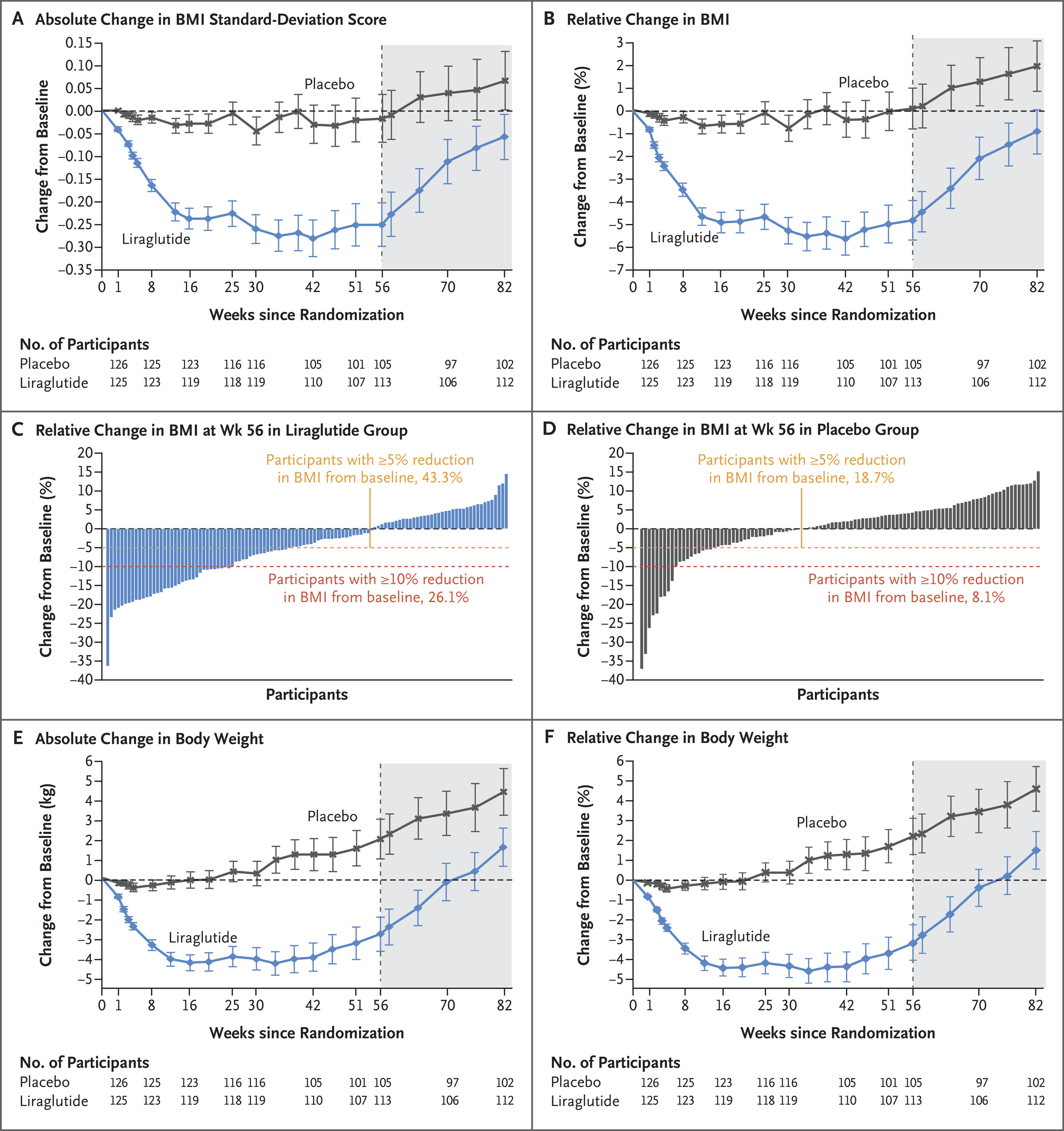
The New England Journal of Medicine published SCALE TEENS, a phase 3 randomized, double-blind trial testing the GLP-1 drug liraglutide 3.0 mg as an addition to lifestyle therapy in adolescents with obesity. After 56 weeks, teens on liraglutide had a significantly larger drop in their BMI standard-deviation score than teens on placebo [1][2].
The trial ran from September 29, 2016, through August 8, 2019, at 32 sites in five countries: Belgium, Mexico, Russia, Sweden and the United States [1]. Of 299 adolescents screened, 251 were randomly assigned after a 12-week run-in period in which everyone received lifestyle counseling on nutrition and physical activity. 125 were assigned to liraglutide and 126 to placebo, injected once daily for 56 weeks, followed by 26 weeks of observation with no study drug [1][2]. Participants were 12 to under 18 years old, had obesity defined as a BMI equal to an adult value of 30 or higher and at or above the 95th percentile for age and sex, and had a poor response to lifestyle therapy alone as judged by the site investigator [1].
What the trial measured
The main endpoint was change in BMI standard-deviation score — how far a teen's BMI sits from the average for their age and sex — at week 56. Liraglutide beat placebo by an estimated 0.22 points (95 percent confidence interval, −0.37 to −0.08; P=0.002) [1][2].
Secondary results: a BMI reduction of at least 5 percent occurred in 51 of 113 teens on liraglutide versus 20 of 105 on placebo (estimated 43.3 percent vs. 18.7 percent), and a reduction of at least 10 percent in 33 versus 9 (26.1 percent vs. 8.1 percent) [1][2]. The estimated difference from placebo was −4.64 percentage points for BMI, −4.50 kg for absolute body weight and −5.01 percentage points for relative weight change [1][2]. The authors note the statistical plan did not correct for multiple comparisons, so those confidence intervals should not be used to infer definitive treatment effects [1].
Weight did not stay off after the drug stopped. During the 26-week off-treatment period, the BMI standard-deviation score rose more in the liraglutide group than in the placebo group, by an estimated 0.15 points (95 percent CI, 0.07 to 0.23) [1][2].
On safety, gastrointestinal adverse events were far more common with liraglutide: 81 of 125 participants (64.8 percent) versus 46 of 126 (36.5 percent) on placebo [1][2]. Thirteen teens on liraglutide (10.4 percent) stopped treatment because of adverse events, compared with none on placebo [1][2]. Serious adverse events were uncommon in both groups — 3 (2.4 percent) with liraglutide and 5 (4.0 percent) with placebo [1][2]. One suicide occurred in the liraglutide group; the investigator assessed it as unlikely to be related to the trial treatment [1][2]. The trial repeatedly screened mental health using the Columbia–Suicide Severity Rating Scale and the Patient Health Questionnaire–9, and also tracked bone age, Tanner stage, height standard-deviation score, hormone levels and heart rate [1].
The trial was funded by Novo Nordisk, which designed and oversaw it and performed the data analyses; it is registered as NCT02918279 [1][2].
Why it matters for patients
For families, the main point is that this was the first large placebo-controlled test of a GLP-1 drug for adolescent obesity at a weight-management dose. At the time of publication, the only obesity drugs approved by the FDA for pediatric patients were orlistat, for ages 12 and older, and phentermine, for those older than 16, and the European Medicines Agency had approved none; bariatric surgery was reserved for severe obesity and performed infrequently [1]. Liraglutide 3.0 mg was already approved for adults with obesity, or overweight plus a weight-related condition [1].
Two findings shape expectations. First, the average benefit was real but moderate, and fewer than half of teens on the drug reached a 5 percent BMI reduction [1]. Second, the regain seen after week 56 points to obesity being treated as a chronic condition rather than a fixed course — the sources do not report longer-term outcomes beyond week 82 [1].
Liraglutide is a daily injection and is a different molecule from semaglutide (Ozempic, Wegovy, Rybelsus) or tirzepatide (Mounjaro, Zepbound). These results do not directly predict how those drugs perform in teens.
What happens next
The sources cover only the trial itself and do not describe any regulatory decision that followed, so any change in approved age ranges is not established by this evidence alone. Published correspondence in NEJM in September 2020 and commentary in Nature Reviews Endocrinology in August 2020 debated the findings, including whether the benefit was durable [2].
Sources
Semaglutides.org is for information only and is not medical advice. Always talk to a licensed healthcare provider about your own care. Some links to telehealth services are affiliate links, labeled where they appear.