STEP 4 shows what happens when semaglutide is withdrawn after titration
A JAMA trial found that people who stopped semaglutide 2.4 mg after reaching the full dose regained weight, while those who kept taking it lost more \u2014 a 14.8-percentage-point gap over 48 weeks.
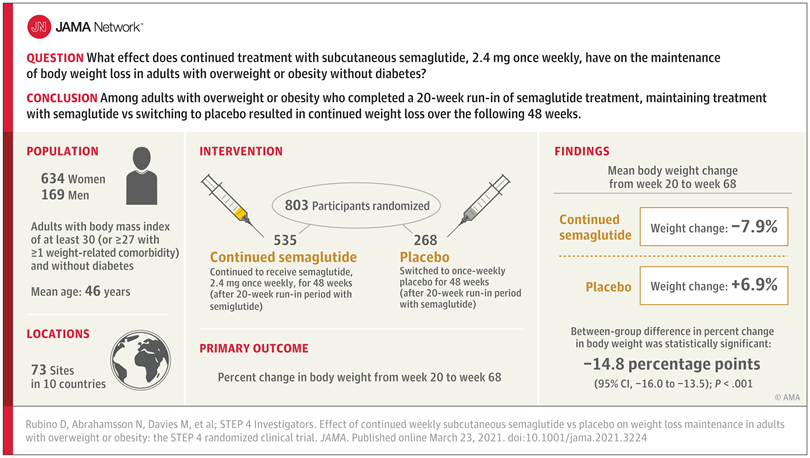
Researchers reported in JAMA that adults who had already worked up to the 2.4 mg weekly dose of semaglutide and then switched to placebo regained weight, while those who stayed on the drug kept losing. Over 48 weeks, the difference between the two groups was 14.8 percentage points of body weight [2].
The study, called STEP 4, was a randomized, double-blind, 68-week phase 3a withdrawal trial run at 73 sites in 10 countries between June 2018 and March 2020. It enrolled adults with a body mass index of at least 30, or at least 27 with one or more weight-related health problems, and who did not have diabetes [2].
How the trial was built
All 902 participants started on once-weekly injectable semaglutide for a 20-week run-in: 16 weeks of gradual dose escalation followed by 4 weeks at the maintenance dose. During that run-in, average weight loss was 10.6% [2].
The 803 people (89.0%) who reached and stayed on 2.4 mg per week were then randomly assigned 2-to-1 to either continue semaglutide (535 people) or switch to placebo (268 people) for 48 more weeks. Both groups continued receiving lifestyle support, so diet and activity counseling was not the variable being tested [2].
At randomization, participants averaged 46 years old, 79% (634) were women, and mean body weight was 107.2 kg, or roughly 236 pounds. Follow-up was high: 787 participants (98.0%) completed the trial and 741 (92.3%) completed treatment [2].
The results
From week 20 to week 68, the group that continued semaglutide lost another 7.9% of body weight on average. The group switched to placebo gained 6.9%. The difference was −14.8 percentage points (95% CI, −16.0 to −13.5; P < .001) [2].
The three main secondary measures moved the same direction. Compared with placebo, continued semaglutide was associated with a 9.7 cm smaller waist circumference (95% CI, −10.9 to −8.5 cm), systolic blood pressure lower by 3.9 mm Hg (95% CI, −5.8 to −2.0), and a 2.5-point better score on the physical functioning scale of the SF-36 health survey (95% CI, 1.6 to 3.3). All were statistically significant at P < .001 [2].
On side effects, gastrointestinal events were reported by 49.1% of people who continued semaglutide versus 26.1% of those on placebo. Despite that gap, roughly the same small share of each group stopped treatment because of adverse events: 2.4% with semaglutide and 2.2% with placebo [2].
The trial was registered as NCT03548987. Several authors are Novo Nordisk employees or shareholders, and many of the academic authors reported consulting fees, speaker fees or research grants from Novo Nordisk and other drugmakers [2].
Why it matters for patients
STEP 4 is one of the clearest tests of a question people ask constantly: what happens if I stop? In this trial, stopping the drug while keeping the lifestyle program did not hold the weight loss in place — the placebo group gained on average, and their waist size and blood pressure moved back in the less favorable direction too [2].
That pattern is why obesity is increasingly discussed as a chronic condition that may require ongoing treatment rather than a short course. A JAMA educational video notes that five drugs are approved by the FDA for long-term weight management in adults — orlistat, phentermine/topiramate, naltrexone/bupropion extended release, liraglutide and semaglutide — yet fewer than 1% of US adults with obesity use one [1].
STEP 4 also has limits worth knowing. Everyone in it had already tolerated the full 2.4 mg dose during the run-in, so the results describe people who did well early on, not everyone who starts. The trial excluded people with diabetes [2]. And it did not test whether tapering slowly, or stopping for a shorter period, would produce different regain — that is not answered by these data.
What happens after 68 weeks, and whether weight eventually stabilizes at a new level after stopping, is also not addressed here. Decisions about starting, continuing or stopping any of these medications are between a patient and their clinician.
Sources
Semaglutides.org is for information only and is not medical advice. Always talk to a licensed healthcare provider about your own care. Some links to telehealth services are affiliate links, labeled where they appear.