STEP 5 shows two-year durability of semaglutide weight loss
A two-year trial of once-weekly semaglutide 2.4 mg (the Wegovy dose) found average weight loss of 15.2% at week 104 versus 2.6% with placebo, the longest look yet at how long the effect holds [1].
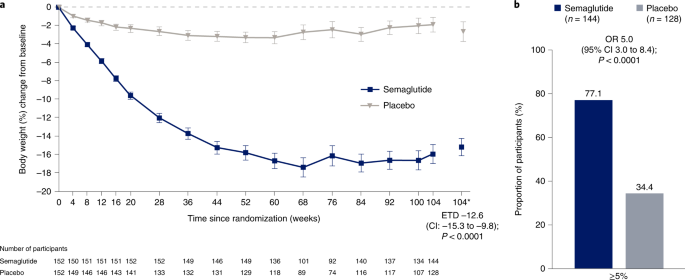
Results from the STEP 5 trial, published in Nature Medicine, show that adults with overweight or obesity who took once-weekly subcutaneous semaglutide 2.4 mg lost an average of 15.2% of their body weight after 104 weeks, compared with 2.6% for those on placebo [1]. Both groups also received a behavioral program covering diet and physical activity [1].
STEP 5 is described by the authors as the longest study of semaglutide for weight management to date [1]. Earlier trials in the same program, including STEP 1 and STEP 3, ran 68 weeks and showed placebo-subtracted weight losses of 12.4% and 10.3% [1].
What the trial measured
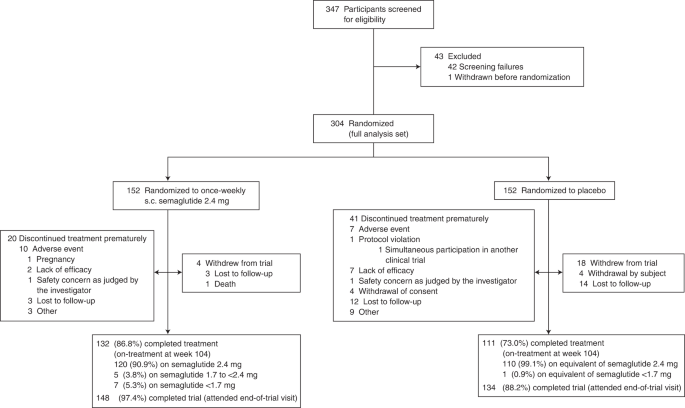
The phase 3, randomized, double-blind, placebo-controlled trial enrolled 304 adults between 5 October 2018 and 1 February 2019, assigning 152 to semaglutide 2.4 mg and 152 to placebo [1]. Participants had obesity (BMI of at least 30 kg/m²) or overweight (BMI of at least 27 kg/m²) plus at least one weight-related health condition, and none had diabetes [1].
The group was mostly female (236 of 304, or 77.6%) and mostly white (283, or 93.1%), with a mean age of 47.3 years, a mean starting weight of 106.0 kg and a mean BMI of 38.5 kg/m² [1].
There were two co-primary endpoints: percentage change in body weight at week 104 and the share of people losing at least 5% of their starting weight by then [1]. On the first, the estimated treatment difference was 12.6 percentage points in favor of semaglutide (95% confidence interval, −15.3 to −9.8; P < 0.0001) [1]. On the second, 111 of 144 semaglutide participants (77.1%) hit the 5% mark versus 44 of 128 on placebo (34.4%), an odds ratio of 5.0 (95% CI, 3.0 to 8.4; P < 0.0001) [1]. Both endpoints met the trial's prespecified criteria for success [1].
The main analysis counted all randomized participants regardless of whether they stopped the drug or started another weight-loss treatment, an approach the authors call the "treatment policy" estimand [1]. A secondary analysis looked only at time on treatment [1].
Dropouts and side effects
Of the 304 participants, 282 (92.8%) completed the trial by attending the end-of-trial safety visit, 272 (89.5%) had a body weight measurement at the week 104 visit, and 243 (79.9%) were still taking the assigned treatment at that point [1]. That means roughly one in five people was no longer on the drug or placebo by the two-year mark [1].
Gastrointestinal side effects were the most common problem and were reported more often with semaglutide than placebo: 82.2% versus 53.9% [1]. The published abstract describes these as mostly mild to moderate [1]. The trial is registered as NCT03693430 [1].
Why it matters for patients
One of the most common questions about GLP-1 drugs is whether the weight comes back while a person is still taking them. STEP 5 provides two years of randomized data and concludes that semaglutide led to "substantial, sustained weight loss over 104 weeks" versus placebo [1]. The average result at 104 weeks (15.2%) is in the same range as the 68-week results from earlier STEP trials, rather than shrinking toward the placebo group [1].
The trial does not answer what happens after treatment stops; STEP 5 compared continued semaglutide with continued placebo, not stopping versus staying on [1]. The detailed shape of the weight curve over time is presented in a trial figure, and the portion of the paper available here does not spell out week-by-week numbers, so readers should treat descriptions of a precise "plateau" point as not fully documented in the published text provided [1].
Two other limits are worth noting. The study population was 93.1% white and 77.6% female, so it may not reflect every US patient group [1]. And side effects were common: more than four in five people on semaglutide reported gastrointestinal events [1].
Semaglutide 2.4 mg was already approved in the United States, Europe, the United Kingdom and Canada for weight management in adults with obesity or with overweight plus a weight-related condition, based on the earlier STEP results [1]. STEP 5 adds duration rather than changing that approval [1].
Images from the sources
Sources
Semaglutides.org is for information only and is not medical advice. Always talk to a licensed healthcare provider about your own care. Some links to telehealth services are affiliate links, labeled where they appear.