SELECT four-year data show weight loss holds for up to 208 weeks
A prespecified SELECT trial analysis found people on semaglutide lost 10.2 percent of body weight on average and kept it off through four years, with fewer serious adverse events than placebo [2].
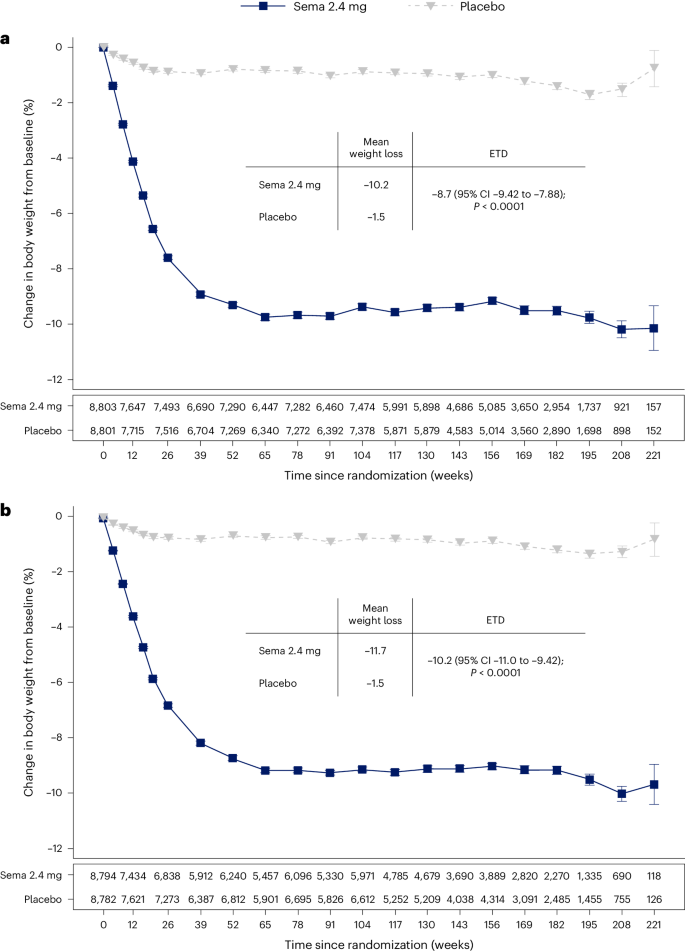
Adults with heart disease and excess weight who took semaglutide in the large SELECT trial lost weight for about 65 weeks and then held most of that loss through 208 weeks — four years — according to a prespecified analysis published in Nature Medicine [2].
SELECT enrolled 17,604 adults with preexisting cardiovascular disease and overweight or obesity, but without diabetes. The main result, reported earlier, was a 20% reduction in major adverse cardiovascular events (hazard ratio 0.80, 95% confidence interval 0.72 to 0.90; P < 0.001) [2]. This new analysis looked at what happened to weight and body measurements over the same period [2].
What the four-year numbers show
At week 208, people assigned to semaglutide had a mean weight reduction of 10.2%, compared with 1.5% for placebo [2]. Waist circumference fell 7.7 cm with semaglutide versus 1.3 cm with placebo, and the waist-to-height ratio dropped 6.9% versus 1.0% [2]. All comparisons against placebo were statistically significant at P < 0.0001 [2].
The authors report that clinically meaningful weight loss occurred in both sexes and across all races, body sizes and geographic regions studied [2]. Weight loss continued over the first 65 weeks and was then sustained for up to four years, rather than rebounding [2].
One detail sets SELECT apart from dedicated obesity trials: both groups received standard-of-care recommendations for secondary cardiovascular disease prevention, without a focus on targeting weight loss [2]. In other words, this was not a study built around an intensive diet-and-exercise program.
Safety and discontinuation
Semaglutide was associated with fewer serious adverse events than placebo in every body mass index category examined [2]. Rates, expressed as events per 100 years of observation, were 43.23, 43.54, 51.07 and 47.06 for semaglutide in the BMI categories under 30, 30 to under 35, 35 to under 40, and 40 kg/m² or above, versus 50.48, 49.66, 52.73 and 60.85 for placebo [2].
At the same time, semaglutide was associated with higher rates of stopping the trial product, and those discontinuations increased as BMI class decreased — meaning people with lower starting BMIs were more likely to come off the drug [2]. The abstract does not break out the specific reasons for discontinuation or the exact percentages, so those details are not available here.
The published abstract also does not state the semaglutide dose used in SELECT, though it notes that once-weekly subcutaneous semaglutide 2.4 mg is approved for chronic weight management and that doses up to 2.0 mg are approved for type 2 diabetes [2]. The trial is registered as NCT03574597 [2].
Why it matters for patients
A common question about GLP-1 medications is whether weight loss lasts. Most randomized obesity trials run 68 weeks or so. This analysis extends the timeline to four years in a very large group and shows the average loss plateaued rather than disappeared while people stayed on treatment [2]. It does not answer what happens after stopping; that question was not part of this analysis.
The waist measurements matter too. Waist circumference and waist-to-height ratio are used as stand-ins for how much fat a person carries and where it sits, which is relevant to cardiovascular risk [2]. A 7.7 cm reduction in waist size is a body-composition signal that a scale alone does not capture [2].
The safety findings are also worth noting for people weighing long-term use: serious adverse events were less common with semaglutide than placebo across BMI groups, even as more people on semaglutide stopped the study drug [2]. Those two facts can coexist — side effects that lead someone to quit are not always classified as serious.
One limit: everyone in SELECT already had established cardiovascular disease and did not have diabetes [2]. Results may look different in people without heart disease or in people with type 2 diabetes.
What happens next
The analysis was published in Nature Medicine on May 13, 2024 [2]. Further reports from SELECT on other outcomes are not described in the material available here, and no follow-up dates are specified [2].
Sources
Semaglutides.org is for information only and is not medical advice. Always talk to a licensed healthcare provider about your own care. Some links to telehealth services are affiliate links, labeled where they appear.