SURMOUNT-OSA gives tirzepatide a sleep apnea result semaglutide does not have
Two Eli Lilly trials published June 21, 2024 found tirzepatide cut sleep apnea events by about 20 to 24 more per hour than placebo over 52 weeks, a result no semaglutide trial in these sources matches.
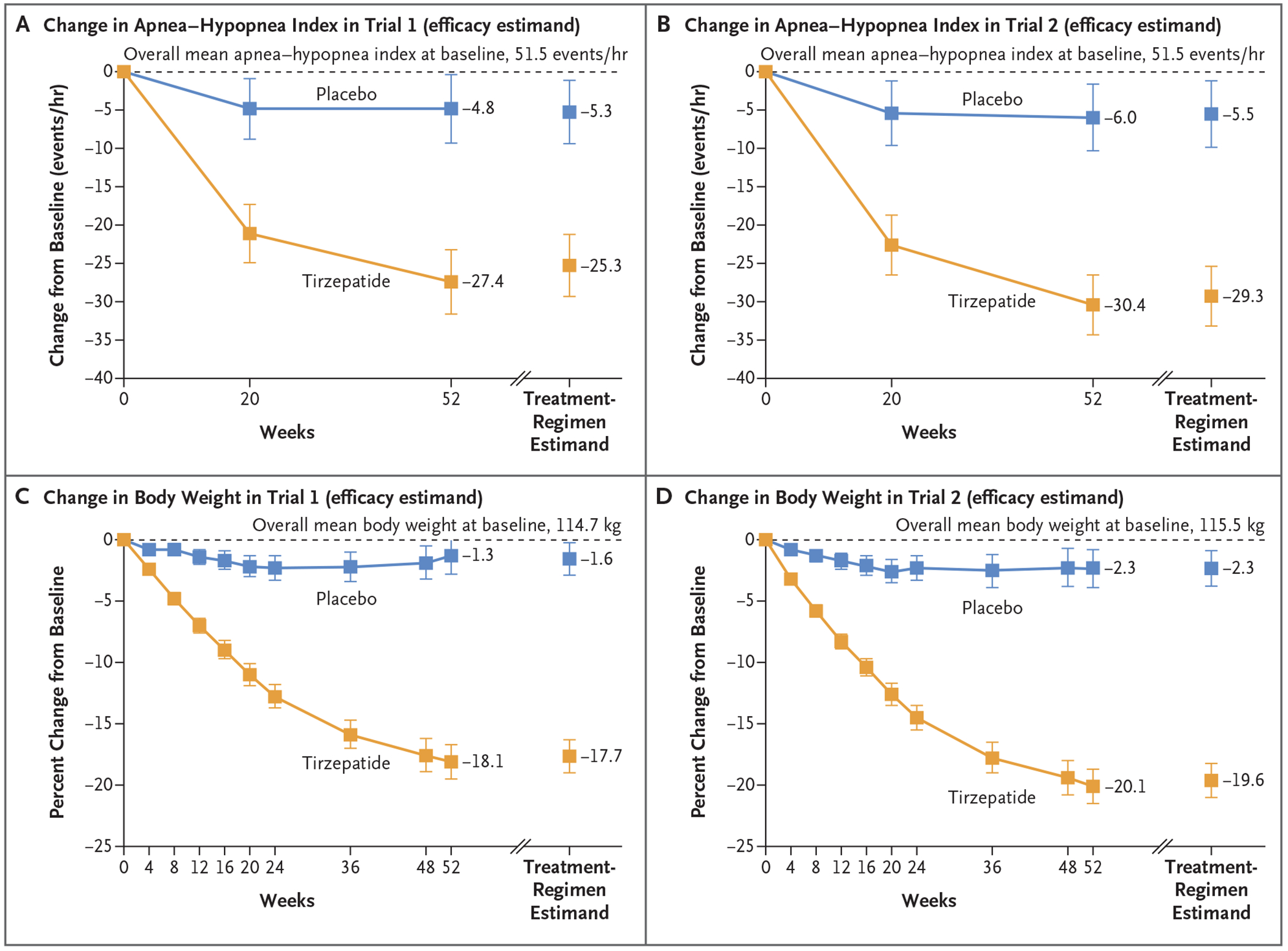
Results from SURMOUNT-OSA, two phase 3 trials of tirzepatide (Mounjaro/Zepbound) in adults with moderate-to-severe obstructive sleep apnea and obesity, were published online in the New England Journal of Medicine on June 21, 2024 and presented in part at the American Diabetes Association's 84th Scientific Sessions in Orlando, held June 21–24, 2024 [3]. Both trials met their main goal: tirzepatide reduced the number of breathing interruptions per hour of sleep far more than placebo [1].
The program ran two separate double-blind, randomized trials. Trial 1 enrolled people who were not using positive airway pressure (PAP) therapy at the start; trial 2 enrolled people who were already on PAP [1]. In each, participants were assigned 1:1 to the maximum tolerated dose of tirzepatide (10 mg or 15 mg) or placebo for 52 weeks [1]. The main measure was the change in the apnea–hypopnea index (AHI), the number of apneas and hypopneas per hour of sleep [1]. Across the two trials, 469 adults took part [4].
At the start, mean AHI was 51.5 events per hour in trial 1 and 49.5 in trial 2, and mean body-mass index was 39.1 and 38.7 [1]. At week 52 in trial 1, AHI fell by 25.3 events per hour (95% CI, −29.3 to −21.2) with tirzepatide versus 5.3 with placebo (95% CI, −9.4 to −1.1), a treatment difference of 20.0 events per hour (95% CI, −25.8 to −14.2; P<0.001) [1]. In trial 2, AHI fell by 29.3 events per hour with tirzepatide versus 5.5 with placebo, a difference of 23.8 events per hour (95% CI, −29.6 to −17.9; P<0.001) [1]. Tirzepatide also beat placebo on every prespecified key secondary endpoint, including percent change in AHI and body weight, hypoxic burden, patient-reported sleep impairment and disturbance, high-sensitivity C-reactive protein, and systolic blood pressure [1][3].
Safety picture
The most common adverse events with tirzepatide were gastrointestinal and mostly mild to moderate, matching what has been seen in the weight-loss trials [1]. Serious adverse events occurred in 7.5% of participants overall and were similar between the tirzepatide and placebo groups [4]. Two cases of acute pancreatitis were adjudicated, both in people taking tirzepatide in the PAP-therapy trial [4]. There were no cases of medullary thyroid cancer and no deaths [4]. Five severe or serious depressive or suicide-related events were reported, two in tirzepatide groups and three in placebo groups [4].
Why it matters for patients
Obstructive sleep apnea is tied to major cardiovascular complications, and excess body fat is one cause of it [1]. Until these trials, the standard approach was PAP therapy and weight management; SURMOUNT-OSA is the first phase 3 evidence in these sources that a GLP-1–based drug lowers AHI itself, both in people who use PAP and in people who do not [1].
The headline comparison to semaglutide (Ozempic/Wegovy/Rybelsus) is about what exists, not about which drug is better. These were placebo-controlled trials of tirzepatide only; there was no head-to-head comparison with semaglutide, and no comparable semaglutide sleep apnea trial appears in these sources [1][3]. How much of the AHI improvement comes from weight loss versus other effects is not broken out in the abstract [1]. The trials also ran 52 weeks, so longer-term effects on apnea, and whether apnea returns if treatment stops, are not addressed here [1].
What happens next
The trials were funded by Eli Lilly and registered as NCT05412004 [1][2]. The paper was published online June 21, 2024, last updated July 1, 2024, and appeared in the October 3, 2024 print issue of NEJM, pages 1193–1205 [3]. An erratum was published October 17, 2024 [1]. Any regulatory action based on these results is not described in these sources.
Sources
Semaglutides.org is for information only and is not medical advice. Always talk to a licensed healthcare provider about your own care. Some links to telehealth services are affiliate links, labeled where they appear.