First randomized trial of semaglutide for alcohol use disorder published
A 48-person randomized trial found low-dose semaglutide cut lab alcohol intake and weekly cravings over nine weeks, but it did not change how many drinks people had per calendar day.
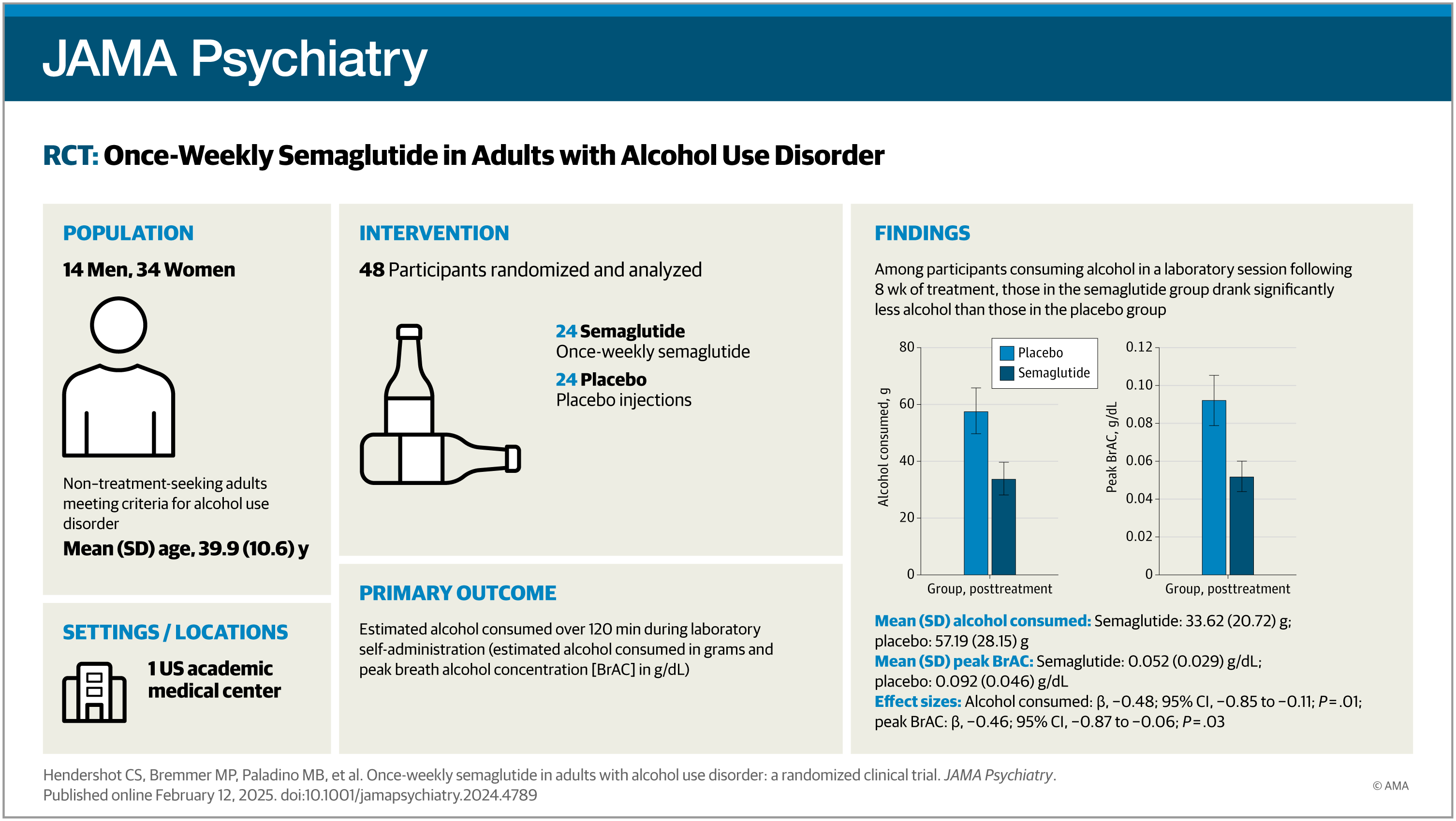
Researchers have published the first randomized, placebo-controlled trial testing semaglutide for alcohol use disorder. In 48 adults who were not seeking treatment for their drinking, nine weeks of low-dose weekly semaglutide reduced how much alcohol people drank in a laboratory setting and lowered weekly alcohol craving compared with placebo [3].
The study was a phase 2, double-blind trial run at a US academic medical center, with enrollment from September 2022 to February 2024 [3]. Of 504 people screened, 48 were randomized [3]. Participants were 71% female (34 of 48) with a mean age of 39.9 years [3]. They received either placebo or semaglutide at doses well below those typically used for weight loss: 0.25 mg per week for four weeks, 0.5 mg per week for four weeks, and 1.0 mg for one final week [3].
What the trial measured
The main outcome was a laboratory "self-administration" task. A week before the first injection, participants were invited to drink their preferred alcoholic beverages over two hours in a comfortable lab setting, with the option to delay drinking; researchers recorded delays and drinks consumed [2]. The task was repeated after treatment [2].
After treatment, the semaglutide group consumed less alcohol in the lab, with medium to large effect sizes for grams of alcohol consumed (β, −0.48; 95% CI, −0.85 to −0.11; P = .01) and peak breath alcohol concentration (β, −0.46; 95% CI, −0.87 to −0.06; P = .03) [3]. That analysis included only the 25 participants with complete self-administration data — 12 on placebo and 13 on semaglutide [3].
In day-to-day drinking outside the lab, the results were mixed. Semaglutide did not change average drinks per calendar day or the number of drinking days [3]. It did significantly reduce drinks per drinking day (β, −0.41; 95% CI, −0.73 to −0.09; P = .04) and weekly alcohol craving measured on the Penn Alcohol Craving Scale (β, −0.39; 95% CI, −0.73 to −0.06; P = .01), and it predicted greater reductions in heavy drinking over time than placebo (β, 0.84; 95% CI, 0.71 to 0.99; P = .04) [3].
Among the small subgroup who smoked cigarettes at the start, semaglutide was linked to greater reductions in cigarettes per day (β, −0.10; 95% CI, −0.16 to −0.03; P = .005) [3]. The university's release notes that no medication is currently approved for both alcohol reduction and smoking cessation [2].
Why it matters for patients
Semaglutide is approved in the US as Ozempic for type 2 diabetes and Wegovy for obesity [2]. Alcohol use disorder is not an approved use, and this trial does not change that. Three drugs are FDA-approved for alcohol use disorder, and the researchers note they are underused [2]. An estimated 178,000 US deaths per year are attributed to alcohol [2].
People taking GLP-1 drugs have widely reported drinking less, and the senior author said those anecdotal reports helped motivate the trial [2]. This study offers the first randomized evidence behind those reports, but it is small and short: 48 people, nine weeks, low doses, and participants who were not trying to quit drinking [3]. The authors describe the findings as initial evidence that justifies larger trials [3]. The university release calls the data preliminary and says longer studies are needed to define long-term effects, ideal doses, and treatment durations, which may differ from those used for diabetes and obesity [2].
Also worth knowing: the effect on the most common real-world yardstick — average drinks per day across the whole week — was not significant [3]. The clearest signals were in a controlled lab drinking session, in craving scores, and in how much people drank on the days they did drink [3].
What happens next
The trial was registered as NCT05520775 and was funded by a National Institute on Alcohol Abuse and Alcoholism grant (R21AA026931) [2][3]. The senior author reported consulting fees from Novo Nordisk outside the submitted work and institutional research contracts from several drugmakers, including Novo Nordisk and Eli Lilly [3].
The sources do not name any specific larger trial, timeline, or regulatory filing for semaglutide in alcohol use disorder, so what comes next — and when — is not yet known from this reporting.
Images from the sources
Sources
Semaglutides.org is for information only and is not medical advice. Always talk to a licensed healthcare provider about your own care. Some links to telehealth services are affiliate links, labeled where they appear.