Lilly's first-quarter revenue rises 45%, but the CVS news overshadows it
Eli Lilly posted $12.73 billion in first-quarter revenue on Mounjaro and Zepbound sales, but its stock slid after CVS Caremark picked rival Wegovy as the preferred obesity drug on its main formularies.
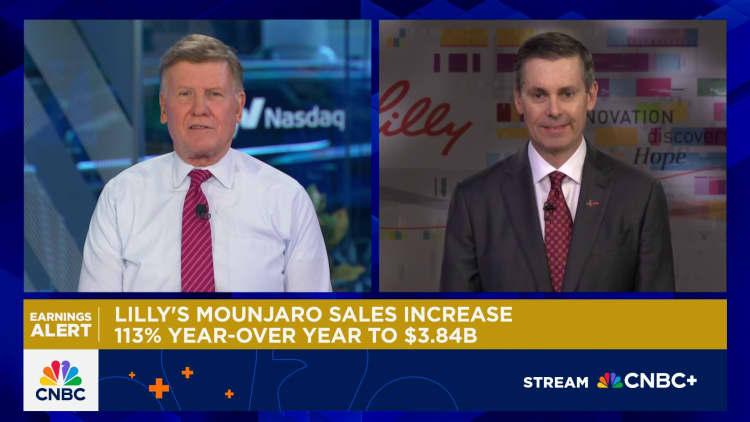
Eli Lilly reported first-quarter 2025 revenue of $12.73 billion on May 1, a 45% jump from a year earlier, driven mainly by its tirzepatide products Mounjaro and Zepbound [1]. The same day, CVS Health said its pharmacy benefit manager would make Novo Nordisk's Wegovy (semaglutide) the preferred weight-loss medication on its main formularies instead of Zepbound, and Lilly shares moved more than 11% on the news [2].
The quarter by the numbers
Mounjaro, tirzepatide approved for type 2 diabetes, brought in $3.84 billion worldwide, up 113% from the first quarter of 2024 [1]. U.S. Mounjaro revenue was $2.66 billion, up 75% [1]. Zepbound, the same molecule approved for weight management, generated $2.31 billion in U.S. sales, compared with $517.4 million a year earlier, when it had only recently launched [1][2]. Both beat Wall Street estimates of $3.81 billion and $2.28 billion, according to StreetAccount figures cited by CNBC [2].
One detail matters for anyone watching drug prices: Lilly's growth came almost entirely from selling more, not charging more. Worldwide volume rose 53% while realized prices fell 6%, and in the U.S. volume rose 57% while realized prices fell 7% [1]. "Realized price" is what the company actually collects after rebates and discounts paid to insurers and pharmacy benefit managers, not the list price a cash-paying patient sees.
Reported earnings per share were $3.06, up 23%, and non-GAAP EPS was $3.34, up 29% [1]. Both figures include $1.72 per share in acquired in-process research and development charges, largely tied to Lilly's acquisition of Scorpion Therapeutics' cancer drug program [1]. Lilly kept its 2025 revenue guidance at $58 billion to $61 billion but cut adjusted full-year earnings guidance to $20.78–$22.28 per share from $22.50–$24, citing that $1.57 billion charge [1][2]. The company said guidance reflects tariffs in effect as of May 1 but not planned tariffs on imported pharmaceuticals [2].
Why the CVS decision overshadowed strong sales
Strong sales and a beat on estimates did not protect the stock, because formulary decisions can redirect huge numbers of prescriptions at once. CVS Caremark's choice means that for people covered by those main commercial formularies, Wegovy becomes the preferred obesity drug and Zepbound does not [2]. Neither source gives the effective date of the change, how many members are affected, or what exception or appeal process CVS will offer — those details are not in the sources.
Why it matters for patients
Prescribers write for a specific drug, but coverage decides what most insured patients can actually fill at an affordable copay. A preferred-drug switch can mean a person stable on tirzepatide is asked to move to semaglutide, or faces a higher copay, prior authorization, or a non-formulary denial to stay on the current product. The sources do not describe how CVS plans to handle people already on Zepbound.
The falling realized prices in Lilly's report [1] are the flip side of that leverage: exclusive or preferred deals are typically won with bigger rebates, which do not necessarily reach patients at the counter. Lilly has also been building direct channels around insurance, including additional Zepbound vials and savings for self-pay patients announced in February [1].
Supply, which dominated 2023 and 2024, is a smaller factor now. The FDA reaffirmed in December that the U.S. tirzepatide shortage was over, a decision that bars many compounding pharmacies from selling cheaper unapproved copies [2].
What happens next
Lilly said orforglipron, an oral small-molecule GLP-1, succeeded in the first of seven planned Phase 3 trials in diabetes and obesity, with efficacy that was statistically significant and a safety profile the company described as consistent with injectable GLP-1 medicines [1]. Six more late-stage readouts are still pending, and no U.S. approval or launch date is set in these sources.
Lilly also said it is accelerating manufacturing, including four new facilities and more than $50 billion in U.S. manufacturing investment since 2020 [1]. Whether the CVS decision shifts market share in a measurable way should show up in the companies' next quarterly reports.
Sources
Semaglutides.org is for information only and is not medical advice. Always talk to a licensed healthcare provider about your own care. Some links to telehealth services are affiliate links, labeled where they appear.