SURMOUNT-5 gives the first randomized head-to-head of tirzepatide and semaglutide for obesity
A 751-person randomized trial found tirzepatide cut body weight 20.2% versus 13.7% for semaglutide over 72 weeks, with similar overall side effects but more injection site reactions.
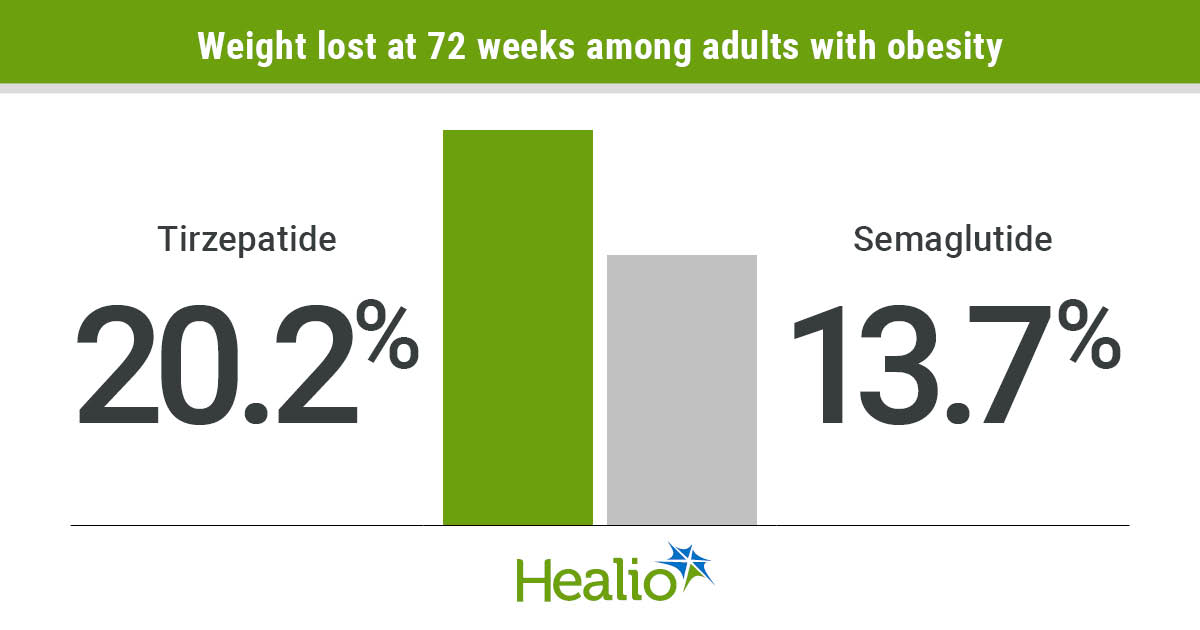
Eli Lilly's SURMOUNT-5 trial, published in the New England Journal of Medicine on May 11, 2025, is the only randomized head-to-head comparison of tirzepatide (Zepbound) and semaglutide (Wegovy) in adults with obesity and no type 2 diabetes [3]. Over 72 weeks, tirzepatide produced roughly 6.5 percentage points more weight loss [4].
What the trial did
The phase 3b trial randomly assigned 751 adults 1:1 to the maximum tolerated dose of tirzepatide (10 mg or 15 mg) or the maximum tolerated dose of semaglutide (1.7 mg or 2.4 mg), injected once weekly for 72 weeks [1]. Participants averaged 44.7 years old and 64.7% were women [4]. The trial was open-label, meaning participants and investigators knew which drug was being used, and it was funded by Eli Lilly, which makes tirzepatide [3].
The main result: average weight change at week 72 was −20.2% (95% CI, −21.4 to −19.1) with tirzepatide and −13.7% (95% CI, −14.9 to −12.6) with semaglutide (P<0.001) [1]. The estimated treatment difference was −6.5 percentage points (95% CI, −8.1 to −4.9) [4]. Waist circumference fell 18.4 cm with tirzepatide versus 13.0 cm with semaglutide, a 5.4 cm difference [4].
More people on tirzepatide hit each weight-loss threshold: at least 10% (81.6% vs. 60.5%), 15% (64.6% vs. 40.1%), 20% (48.4% vs. 27.3%) and 25% (31.6% vs. 16.1%), all P<0.001 [4]. Both groups improved on systolic and diastolic blood pressure, HbA1c, fasting glucose and lipids [4].
Side effects were close, with one reversal
Overall adverse events were reported by 76.7% of the tirzepatide group and 79% of the semaglutide group [4]. Serious adverse events occurred in 4.8% versus 3.5% [4]. Gastrointestinal complaints were the most common side effects in both arms, mostly mild to moderate and concentrated during dose escalation [1]. There was one confirmed case of pancreatitis, in the semaglutide group, and no deaths, major cardiovascular events, medullary thyroid cancers or pancreatic cancers [4].
In the published results, stopping treatment because of an adverse event was somewhat less common with tirzepatide (6.1% vs. 8.0%), as was stopping specifically for gastrointestinal events (2.7% vs. 5.6%) [3]. Vomiting was reported by 15.0% on tirzepatide versus 21.3% on semaglutide, and acid reflux by 6.1% versus 10.6% [3]. The clearest difference running the other way was injection site reactions: 8.6% with tirzepatide versus 0.3% with semaglutide [3].
Why it matters for patients
Until now, comparisons between these two drugs came from separate trials with different participants, or from observational records — including an earlier real-world study that also favored tirzepatide on the odds of losing 5%, 10% or 15% of body weight [4]. SURMOUNT-5 is a direct, randomized comparison, which carries more weight, though its open-label design and industry funding are limitations to keep in mind [3].
The results do not mean one drug is right for everyone. "Some patients aren't responders or can't tolerate one medication," obesity medicine physician Katherine H. Saunders of Weill Cornell Medicine told Healio. "It's important for us to have many medications in our obesity armamentarium to personalize treatment" [4].
Coverage may matter more than the trial data for many people. Saunders raised concern about CVS Health's May 1, 2025 announcement that semaglutide would become the preferred GLP-1 for obesity on CVS Caremark formularies starting July 1, 2025, a change she said could limit tirzepatide access [4]. "For some patients, the medications can be interchangeable, but for other patients, they can't," she said [4].
The trial also does not answer what happens after switching. Endocrine Today co-editor Sangeeta Kashyap wrote that for patients who do well on tirzepatide, moving to semaglutide for maintenance "is not an option" and "will likely lead to weight regain" — an opinion, not a trial finding [4].
What happens next
The results were presented at the European Congress on Obesity in Malaga, Spain, held May 11–14, 2025, and appeared in the July 3, 2025 print issue of NEJM [3][4]. On October 23, 2025, NEJM published letters debating the comparison, with a reply from lead author Louis J. Aronne [1]. Longer-term outcomes, such as how the two drugs compare on heart events or weight maintenance beyond 72 weeks, were not tested here and remain unknown.
Images from the sources
Sources
Semaglutides.org is for information only and is not medical advice. Always talk to a licensed healthcare provider about your own care. Some links to telehealth services are affiliate links, labeled where they appear.