SURMOUNT-CN follow-up measures regain 26 weeks after tirzepatide stopped
A new follow-up of the SURMOUNT-CN tirzepatide trial found participants in China regained weight after stopping the drug, but retained most of their fat loss 26 weeks later.[1][2]
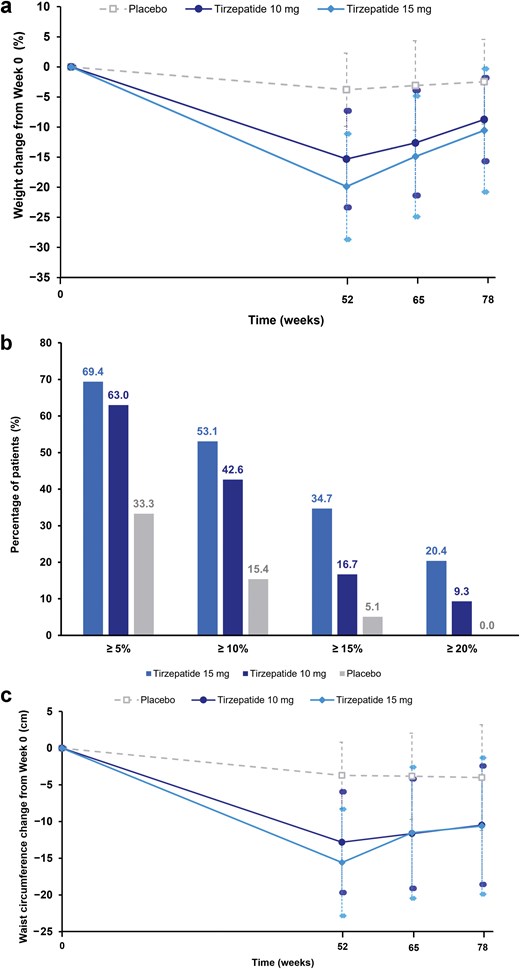
A real-world follow-up study of the SURMOUNT-CN trial found that people who took tirzepatide for a year and then stopped regained a meaningful share of the weight they had lost, though most of the loss held up six months later. The study followed 152 participants from the original phase 3 China trial after they completed 52 weeks of treatment and then had 26 weeks with no anti-obesity medication or bariatric procedure.[1][2]
Participants had taken tirzepatide at 10 mg, 15 mg, or a placebo. By week 78 — 26 weeks after stopping the drug — the 10 mg group had regained an average of 9.1% of body weight and the 15 mg group had regained 12.3%, compared with 1.8% in the placebo group.[1][2] Waist circumference also crept back up, rising 2.9 cm in the 10 mg group and 5.5 cm in the 15 mg group after stopping, versus a slight 0.5 cm decrease in the placebo group.[1]
Despite the regain, both tirzepatide groups still showed large net losses from where they started the trial. From baseline to week 78, the 10 mg group had a net weight loss of 8.7% and the 15 mg group had a net loss of 10.6%, compared with 2.5% in the placebo group.[1][2] Waist circumference stayed about 10.5 cm below baseline in the 10 mg group and 10.6 cm below baseline in the 15 mg group, versus a 4.0 cm reduction in the placebo group.[1] The study authors reported that several cardiometabolic markers also showed residual improvement at week 78, though the paper does not specify which markers or by how much in the published abstract.[1]
The research adds a non-Western dataset to a body of withdrawal literature that has so far leaned heavily on trials run in the United States and Europe. It was published in Life Metabolism, an Oxford University Press journal, and several authors are employees of Eli Lilly and Company, the maker of tirzepatide, which is sold as Mounjaro for diabetes and Zepbound for weight management in the US.[1]
Why it matters for patients
The findings reinforce a pattern seen in other tirzepatide and semaglutide withdrawal studies: stopping the drug tends to bring weight back, but not necessarily all the way back to where a person started. For someone weighing whether to stay on tirzepatide long-term or consider stopping, this study suggests that even a temporary course can leave lasting reductions in weight and waist size after six months off the drug, though the amount of regain was larger in the higher-dose group.[1][2]
The study also underscores a gap in the research base. Because it draws on participants in China rather than the mostly American and European cohorts that have dominated tirzepatide research, it offers a data point on whether these patterns hold across different populations. Whether the same regain trends apply beyond 26 weeks, or in US patients specifically, is not addressed by this study.[1]
The study did not report on side effects during the follow-up period, cost, or insurance coverage, and it is a real-world observational look at a subset of trial completers rather than a new randomized comparison. The paper does not detail exactly which cardiometabolic indicators improved or by how much beyond noting that improvements were evident.[1]
What happens next
The published paper does not lay out a specific next research phase, but the authors' cited literature includes broader analyses of weight-loss maintenance after stopping GLP-1 and dual-agonist medications, suggesting the question of long-term regain will keep drawing follow-up research.[1]
Sources
Semaglutides.org is for information only and is not medical advice. Always talk to a licensed healthcare provider about your own care. Some links to telehealth services are affiliate links, labeled where they appear.