Truveta quantifies the switching caused by the Zepbound exclusion
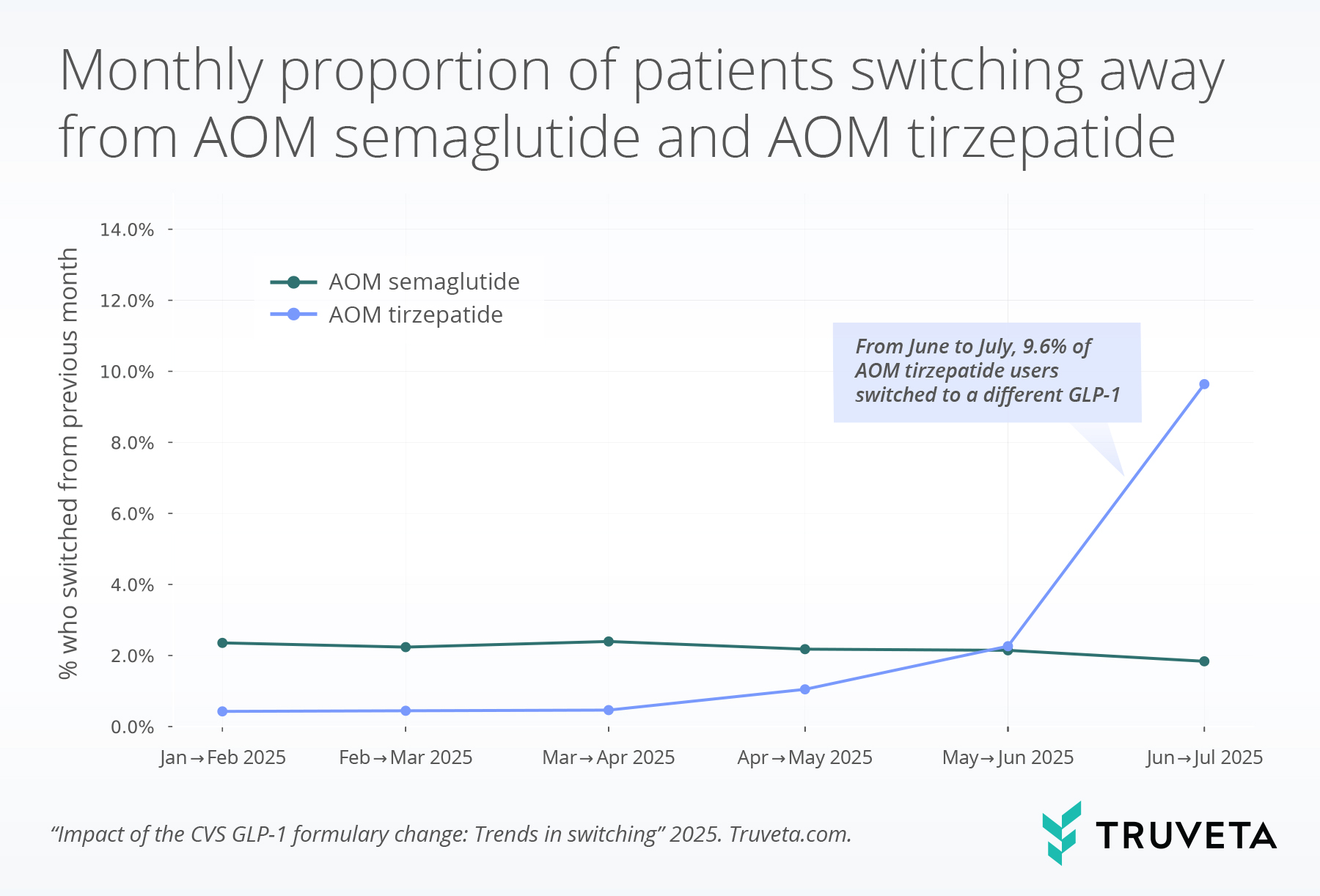
New real-world data show 9.6% of people on Zepbound switched drugs in July 2025 after CVS Caremark dropped it, and more than 8 in 10 of those switches went to Wegovy [1].

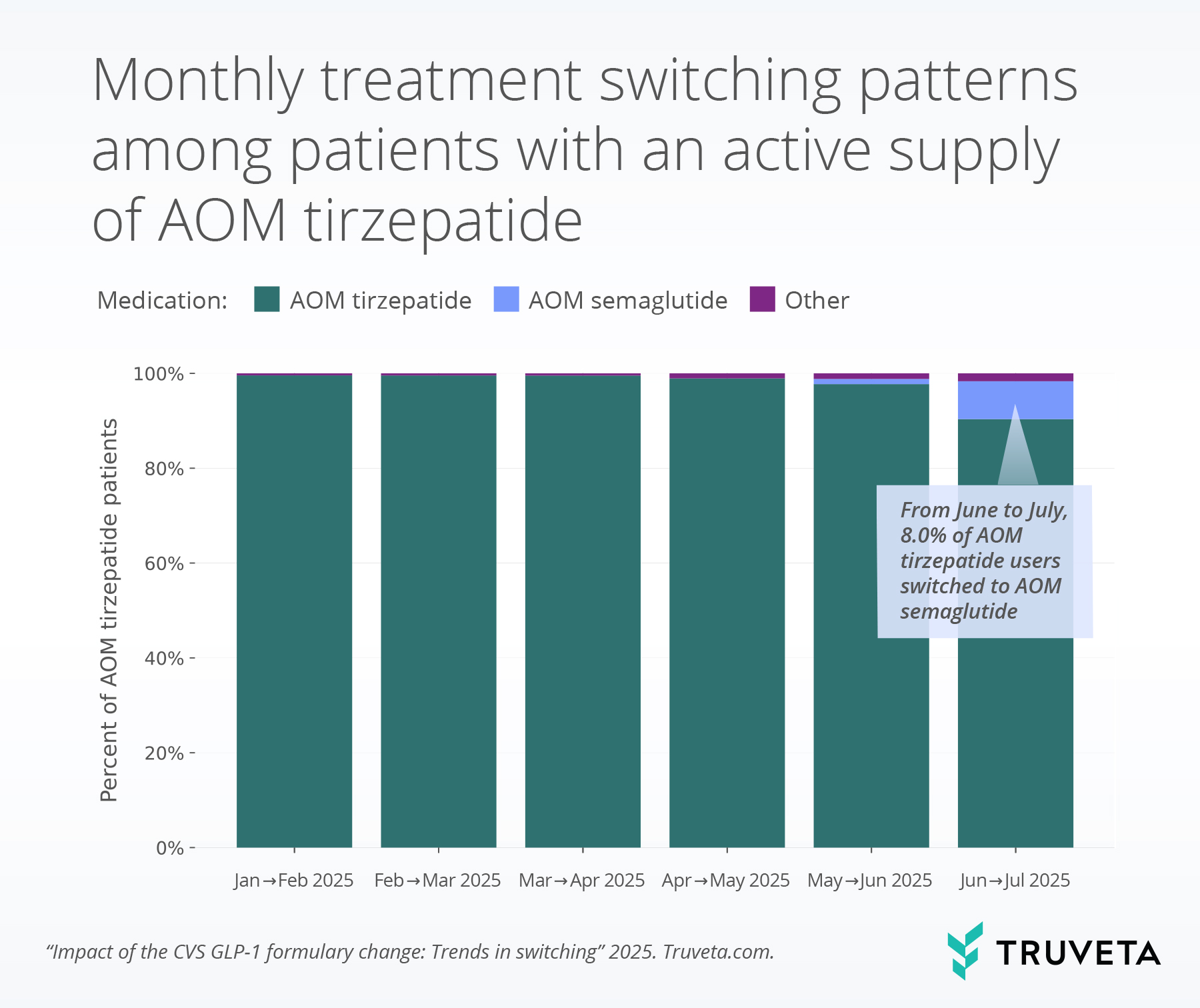
Truveta Research reported on September 5, 2025 that 9.6% of patients with an active supply of anti-obesity tirzepatide (Zepbound) in June 2025 were on a different GLP-1 drug in July — more than a 16-fold jump over the monthly average earlier in the year [1]. Among those who switched, 82.8% moved to anti-obesity semaglutide (Wegovy) [1].
The timing lines up with a formulary decision. CVS Caremark announced on May 1, 2025 that, effective July 1, anti-obesity tirzepatide would be removed from its standard preferred formulary, with anti-obesity semaglutide named the preferred therapy for obesity [1]. The change applied only to the obesity indication; tirzepatide remains available as Mounjaro for type 2 diabetes [1].
What the numbers show
Truveta looked at a subset of its data covering adults 18 and older with a BMI over 27 who filled at least one GLP-1 prescription between January and July 2025 — 609,406 patients in all [1]. About 52.2% were between 45 and 60, 62.2% were female, 70.9% identified as white, and 54.8% had type 2 diabetes [1]. Across all GLP-1 drugs studied, 6.6% of patients switched at least once during the January–July window [1].
Before the change, switching was rare. From January through April 2025, the average monthly switching rate to a different drug was 0.6% for anti-obesity tirzepatide and 2.3% for anti-obesity semaglutide [1]. In that same stretch, 99.4% of patients on anti-obesity tirzepatide in a given month were still on it the next month [1].
June to July looked different. Of patients with an active supply of anti-obesity tirzepatide in June, 90.4% still had it in July, 8.0% moved to anti-obesity semaglutide, and 0.9% moved to anti-diabetic tirzepatide, meaning Mounjaro [1]. Switching among people on anti-obesity semaglutide actually declined over the same two months, which matches its new status as the preferred product [1].
Truveta counted a "switch" as having an active supply of a different GLP-1 in two sequential months, and treated fills longer than 30 days as covering later months [1].
Why it matters for patients
CVS Caremark manages prescription benefits for more than 25–30 million Americans, so a single formulary decision can reach a very large group [1]. Truveta frames the practical choice bluntly: patients on anti-obesity tirzepatide may need to move to anti-obesity semaglutide to keep insurance coverage, while those who want to stay on tirzepatide may face higher out-of-pocket costs or coverage denials [1].
The two molecules are not interchangeable in effect. Truveta notes that in clinical trials anti-obesity tirzepatide has shown greater weight-loss efficacy than anti-obesity semaglutide, so some people changing drugs may see different results [1]. The report also flags added administrative work for patients and clinicians who weigh alternatives or pursue coverage exceptions [1]. CVS Caremark has described the change as an effort to lower out-of-pocket costs and broaden access to weight-management drugs [1].
One thing this analysis does not capture: people who simply stopped. Truveta only measured switching, not discontinuation, so the total amount of therapy disruption may be larger than these figures suggest [1].
The researchers are also careful about cause. The analysis did not evaluate causality and did not include payer information, so it cannot confirm that the CVS change directly drove each switch [1]. Supply dynamics, regional payer policies, and provider preferences could also have contributed [1]. Truveta contrasts this episode with earlier GLP-1 switching it studied from 2018 to 2023, which was largely driven by shortages; this one is payer-initiated rather than supply-driven [1].
What happens next
Truveta expects more switching in the months ahead, partly because many patients receive more than a one-month supply at a time, which delays when a formulary change shows up in the data [1]. The July figure may therefore be an early read rather than the full picture.
The findings are preliminary and not peer reviewed, and are consistent with data accessed on August 27, 2025 [1]. Other limitations: dispense data reach Truveta's health systems with delays and often require a patient encounter, so the people included may have had more recent care contact and may be less healthy than the broader GLP-1 population, though Truveta says it has no reason to think switching patterns differ between those groups [1]. Whether switching rates keep climbing, and how many people leave GLP-1 treatment altogether, is not yet known from this analysis.
Images from the sources
Sources
Semaglutides.org is for information only and is not medical advice. Always talk to a licensed healthcare provider about your own care. Some links to telehealth services are affiliate links, labeled where they appear.