Real-world study finds semaglutide and tirzepatide equally protective for the heart
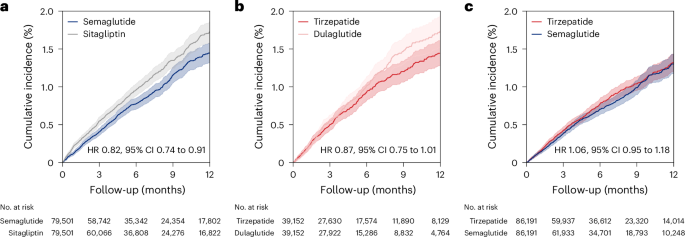
A Nature Medicine analysis of US insurance claims found no clear difference between tirzepatide and semaglutide in heart attack, stroke or death risk, with a hazard ratio of 1.06 (95% CI 0.95-1.18) [1].
Researchers using US insurance claims data compared tirzepatide (Mounjaro/Zepbound) and semaglutide (Ozempic/Wegovy/Rybelsus) head to head and found similar rates of heart attack, stroke and death. The hazard ratio was 1.06, with a 95% confidence interval of 0.95 to 1.18 — a range that includes 1.0, meaning the study could not detect a meaningful difference in either direction [1].
The findings were published in Nature Medicine and drew on patients enrolled in US insurance programs between 2018 and 2025 [1]. Until now, no randomized trial has directly compared the two drugs for cardiovascular outcomes, so doctors have had to rely on indirect comparisons across trials that enrolled different kinds of patients [1].
How the study was built
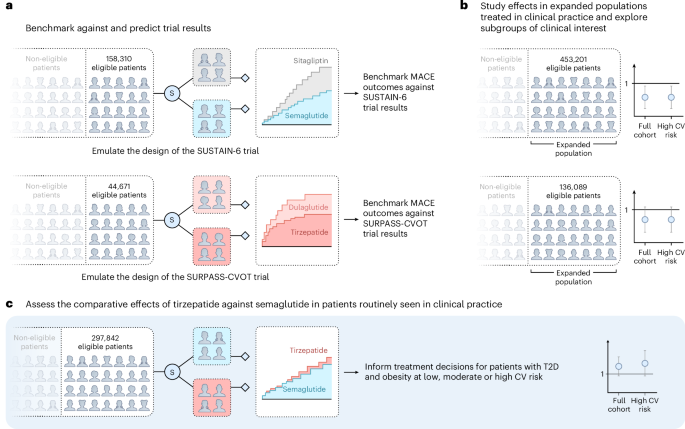
The authors ran five cohort studies in three national US claims databases. Rather than jumping straight to the head-to-head question, they first tried to reproduce two known cardiovascular outcome trials using claims data — a technique meant to test whether their methods can generate trustworthy answers [1].
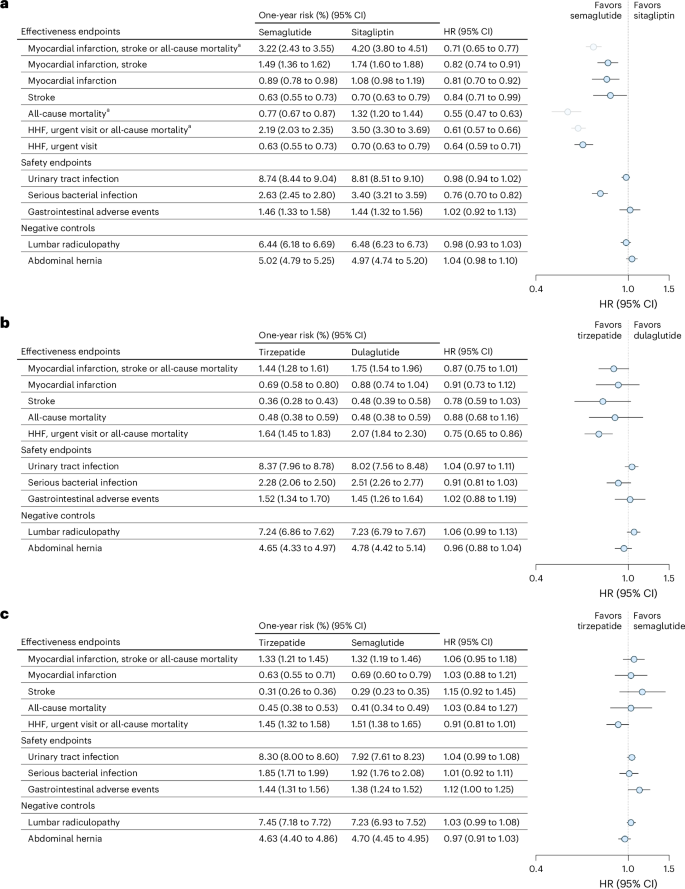
They emulated SUSTAIN-6 (semaglutide versus sitagliptin, used as a stand-in for placebo) with 158,310 eligible patients, and SURPASS-CVOT (tirzepatide versus dulaglutide) with 44,671 patients [1]. The emulations closely matched the real trials on every individual endpoint except all-cause mortality in SUSTAIN-6, and that discrepancy was used to shape the later analyses [1].
Next, the researchers loosened the trial entry criteria to reflect patients seen in ordinary practice. In that broader group, 453,201 people started semaglutide or sitagliptin, and 136,089 started tirzepatide or dulaglutide [1]. Semaglutide versus sitagliptin produced a hazard ratio of 0.82 (95% CI 0.74 to 0.91) for the combined outcome of heart attack or stroke — roughly an 18% lower relative risk [1]. Tirzepatide versus dulaglutide gave a hazard ratio of 0.87 (95% CI 0.75 to 1.01) for the composite that also included death; because the upper bound crosses 1.01, that result did not reach conventional statistical significance [1].
The direct comparison included 297,842 people who started either tirzepatide or semaglutide [1]. Baseline differences between groups were balanced using propensity score matching, a statistical method that pairs patients with similar characteristics [1]. The authors concluded the results "support a comparable cardiovascular benefit of tirzepatide and semaglutide in clinical practice" [1].
Why it matters for patients
Tirzepatide has shown greater effects on blood sugar control and weight loss than semaglutide in prior research [1]. It would be reasonable to assume that bigger weight loss automatically translates into bigger heart protection. This analysis does not support that assumption — at least not in the population and time window studied [1].
That has practical consequences for people weighing the two drugs, or for those whose insurance covers one and not the other. If cardiovascular protection is similar, then cost, coverage, side effects, injection schedule and how well a person tolerates each drug become relatively more important factors in a conversation with a prescriber.
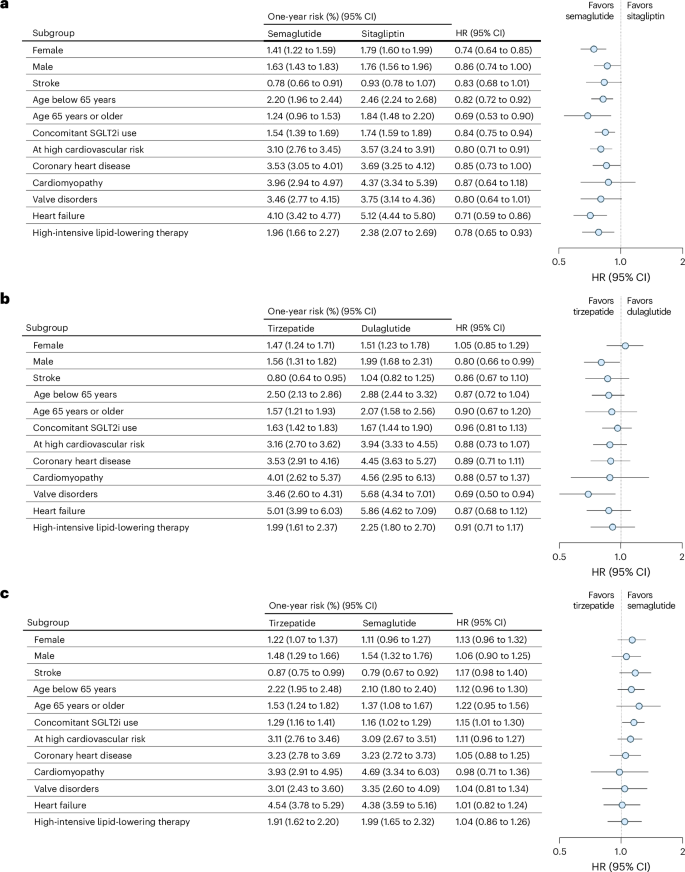
Important limits apply. This is observational research, not a randomized trial. Even with propensity score matching, people who get one drug may differ from those who get the other in ways claims data cannot capture. The confidence interval of 0.95 to 1.18 also leaves room for a small difference that a larger or longer study might detect [1]. The study covered patients with type 2 diabetes and elevated cardiovascular risk, including people with obesity, spanning low, moderate and high risk levels [1]. How long patients were followed, and whether results differed by dose, is not specified in the material available here.
What happens next
SURPASS-CVOT, the randomized trial of tirzepatide against dulaglutide, had not reported results when the study protocols were finalized; its findings were released while the analysis was underway, with Eli Lilly announcing cardiovascular protection in that head-to-head trial [1]. The cohort studies are registered on ClinicalTrials.gov under NCT06659744, NCT07088718 and NCT07096063 [1].
No randomized trial directly comparing tirzepatide and semaglutide on heart outcomes has been reported [1]. Until one exists, real-world analyses like this one are the closest available evidence.
Images from the sources
Sources
Semaglutides.org is for information only and is not medical advice. Always talk to a licensed healthcare provider about your own care. Some links to telehealth services are affiliate links, labeled where they appear.