Medicare negotiated prices take effect for 10 drugs, with semaglutide set for 2027
The first round of Medicare drug price negotiation is now in force, while the round covering Ozempic and Wegovy is a year away.
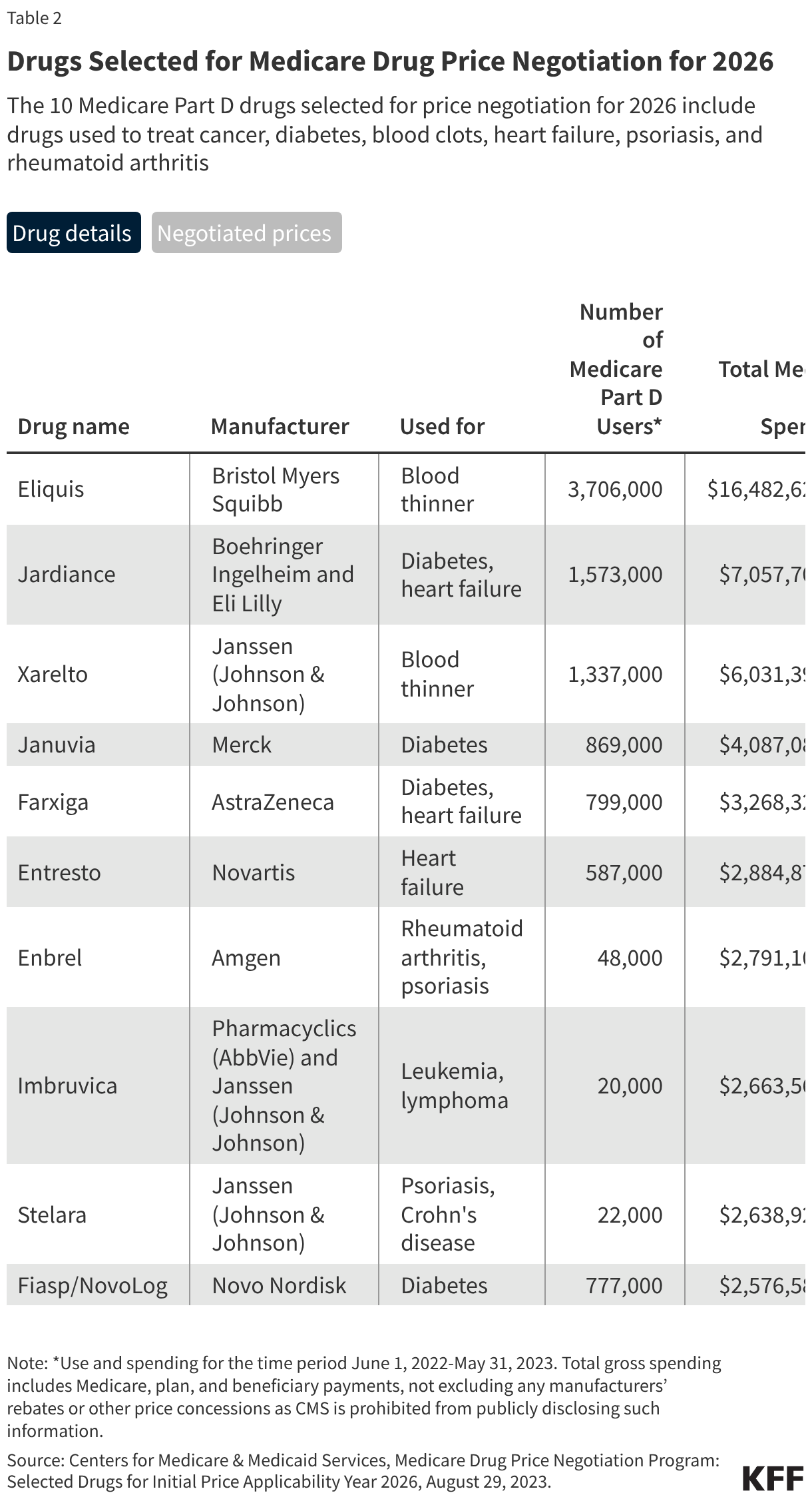
Negotiated prices for the first 10 Medicare Part D drugs took effect on January 1, 2026, the first time the federal government's negotiated prices have applied to drugs covered by Medicare's outpatient prescription benefit [1]. The change comes under the Medicare Drug Price Negotiation Program, a provision of the Inflation Reduction Act of 2022 [1].
The first group of 10 Part D drugs covers treatments for diabetes (Farxiga, Fiasp/NovoLog, Januvia, Jardiance), blood clots (Eliquis, Xarelto), heart failure (Entresto, Farxiga), psoriasis (Stelara, Enbrel), rheumatoid arthritis (Enbrel), Crohn's disease (Stelara) and blood cancers (Imbruvica) [1]. Eliquis had the most Medicare Part D users in the data CMS used to select the drugs, at 3,706,000, followed by Jardiance at 1,573,000 and Xarelto at 1,337,000; those figures cover June 2022 through May 2023 [1].
The Centers for Medicare & Medicaid Services (CMS) estimated that Medicare would have saved $6 billion if the negotiated prices had been in effect in 2023, a net savings of 22% on those drugs [1]. CMS also estimated that Medicare beneficiaries will save $1.5 billion when the negotiated prices take effect in 2026 [1]. CMS has published explanations of its negotiated prices and the factors considered, including manufacturer financial data and evidence about the clinical benefits of the selected drugs compared with alternatives [1].
Semaglutide is not part of this first group. The second set of 15 Part D drugs selected for negotiation includes Ozempic and Wegovy, and its negotiated prices do not take effect until 2027 [1]. CMS estimated Medicare would save $12 billion on that group relative to existing net prices in 2024, a net savings of 44%, and that beneficiaries will save $685 million when those prices take effect in 2027 [1]. That savings rate is higher than in the first round, due in part to the larger number of drugs involved [1].
In January 2026, CMS selected an additional 15 Part B and Part D drugs for negotiation, with negotiated prices effective January 1, 2028 [1]. The list includes Trulicity for type 2 diabetes, Biktarvy for HIV, and treatments for psoriasis, arthritis, Crohn's disease and several types of cancer [1]. Gross spending on those 15 drugs was $27 billion between November 2024 and October 2025, with 1.8 million Medicare beneficiaries using them during that period [1]. Total Medicare spending on the 40 drug products selected for negotiation so far accounted for more than one-third (36%) of all Medicare Part B and Part D drug spending in 2024, or $125 billion out of $350 billion, not accounting for Part D rebates [1].
Why it matters for patients
For people with Medicare Part D coverage who take one of the first 10 drugs, the prices Medicare pays are now the result of negotiation rather than the standard process used before 2026 [1]. The savings figures CMS has published are totals across the program, not estimates of what any one person will pay, and the amount an individual's out-of-pocket cost changes has not been reported [1].
People taking semaglutide are affected later, if at all through this program, because the negotiated price for Ozempic and Wegovy begins in 2027 [1]. Medicare's Part D figures are also gross spending totals that do not subtract manufacturer rebates or other price concessions, because CMS is prohibited from publicly disclosing that information [1].
What happens next
Negotiated prices for the second group of 15 Part D drugs, including Ozempic and Wegovy, take effect January 1, 2027, with CMS estimating $685 million in beneficiary savings that year [1]. Negotiated prices for the 15 drugs selected in January 2026 take effect January 1, 2028; that is also the first year CMS is required to negotiate prices for physician-administered drugs covered under Medicare Part B, and the first year a change broadening the orphan drug exclusion is in effect [1]. Starting in 2027 and each year after, up to 20 additional Part B or Part D drugs will be selected for negotiation, and the number of drugs with negotiated prices will build over time [1]. The negotiated prices for the second round, and how they translate to individual costs for people taking semaglutide, have not yet been reported [1].
Sources
Semaglutides.org provides information only, not medical advice. Talk to a licensed provider about your own care before making changes. Some telehealth links are affiliate links and are labeled where they appear.