CMS selects 15 more drugs for the next negotiation round
Medicare picked 15 more drugs for price negotiation on January 27, 2026, including the GLP-1 diabetes drug Trulicity, with negotiated prices set to start January 1, 2028.
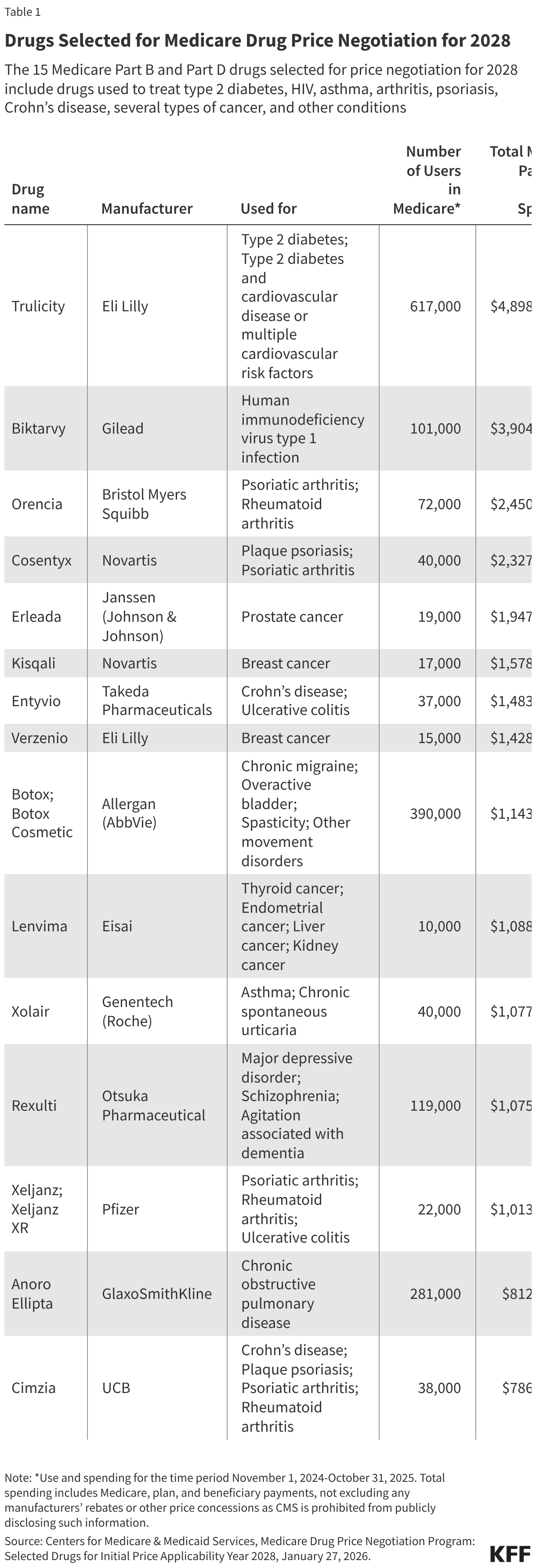
The Centers for Medicare & Medicaid Services announced on January 27, 2026 that it selected 15 more high-cost drugs for the third cycle of the Medicare Drug Price Negotiation Program — the first cycle to include drugs paid for under Medicare Part B, which covers medications given in a doctor's office or clinic [2]. Negotiations happen during 2026, and any agreed prices take effect January 1, 2028 [2].
One GLP-1 medicine is on the new list: Trulicity (dulaglutide), Eli Lilly's weekly injection for type 2 diabetes [2]. It is the biggest spending item in the group, used by about 617,000 people with Medicare and accounting for roughly $4.9 billion in combined Part B and Part D spending between November 1, 2024 and October 31, 2025 [1].
What else is on the list
The other 14 selections are Anoro Ellipta, Biktarvy, Botox and Botox Cosmetic, Cimzia, Cosentyx, Entyvio, Erleada, Kisqali, Lenvima, Orencia, Rexulti, Verzenio, Xeljanz and Xeljanz XR, and Xolair [2]. They treat HIV, asthma, arthritis, psoriasis, Crohn's disease, several cancers, COPD, chronic migraine and other conditions [1].
About 1.8 million people with Medicare Part B or Part D coverage used these 15 drugs during the November 2024 to October 2025 measurement window, at roughly $27 billion in total spending — about 6% of all Part B and Part D drug spending [2]. CMS also published a list of the top 50 negotiation-eligible drugs; the 15 selected are the highest-spending drugs on that list [2]. Separately, CMS picked one previously negotiated drug, the diabetes pill Tradjenta, for the program's first renegotiation [2].
Where semaglutide fits in
Semaglutide is already in the pipeline from the prior round. Ozempic and Wegovy were among the 15 Part D drugs selected in the second cycle, and those negotiated prices take effect in 2027 [1]. Negotiated prices for the first 10 drugs, selected in 2023, started January 1, 2026 [1].
The two sources describe second-round savings differently. CMS said that if the round-two prices had been in effect in 2024, they would have saved an estimated $8.5 billion in net covered prescription drug costs, inclusive of Coverage Gap Discount Program spending — about 36% lower net spending in aggregate [2]. KFF, citing CMS's negotiated-price fact sheet, reported $12 billion in savings relative to existing net prices in 2024, or 44% [1]. The figures use different bases, so they are not directly comparable. KFF also reported a CMS estimate that beneficiaries will save $685 million when the round-two prices begin in 2027, and $1.5 billion from the round-one prices in 2026 [1].
Across all three cycles, 40 drug products have now been selected. Together they accounted for 36% of total Medicare Part B and Part D drug spending in 2024 — $125 billion out of $350 billion, not accounting for rebates in Part D [1].
Why it matters for patients
For people on Medicare, a negotiated price mainly changes what the government and plans pay, which can flow through to what a patient owes at the pharmacy counter. CMS's own estimates put beneficiary savings in the hundreds of millions to low billions of dollars per round across all users, spread over millions of people [1] — so the effect on any one person's bill depends on their plan, their drug and their coverage phase, and is not stated in these documents.
For GLP-1 users specifically, the signal is that Medicare's negotiation program is steadily working through this drug class. Trulicity joins the list for 2028 prices, while Ozempic and Wegovy prices arrive in 2027 [1][2]. Prices for the newly selected drugs have not been set yet — negotiations happen during 2026 — so it is not yet known how much they will change [2].
Also not yet known: whether every manufacturer will take part. Companies with a selected drug had until February 28, 2026 to decide whether to participate in negotiations [2].
What happens next
- February 28, 2026: deadline for drug companies to decide whether to join negotiations for the third cycle [2].
- During 2026: CMS negotiates, weighing clinical benefit, alternative treatments, unmet medical need, effects on specific populations, and research, production and distribution costs [2].
- January 1, 2027: negotiated prices for the second round, including Ozempic and Wegovy, take effect [1].
- January 1, 2028: third-cycle prices, including Trulicity, and the Tradjenta renegotiated price take effect [2].
- 2027 and beyond: up to 20 additional Part B or Part D drugs may be selected each year, so the list keeps growing [1].
Sources
Semaglutides.org is for information only and is not medical advice. Always talk to a licensed healthcare provider about your own care. Some links to telehealth services are affiliate links, labeled where they appear.