Claims analysis shows tirzepatide is displacing first-time CPAP starts
A claims analysis of nearly 20 million US adults with sleep apnea found that people who started tirzepatide were far less likely to begin CPAP, and that primary care, not sleep specialists, is driving prescribing.[1]
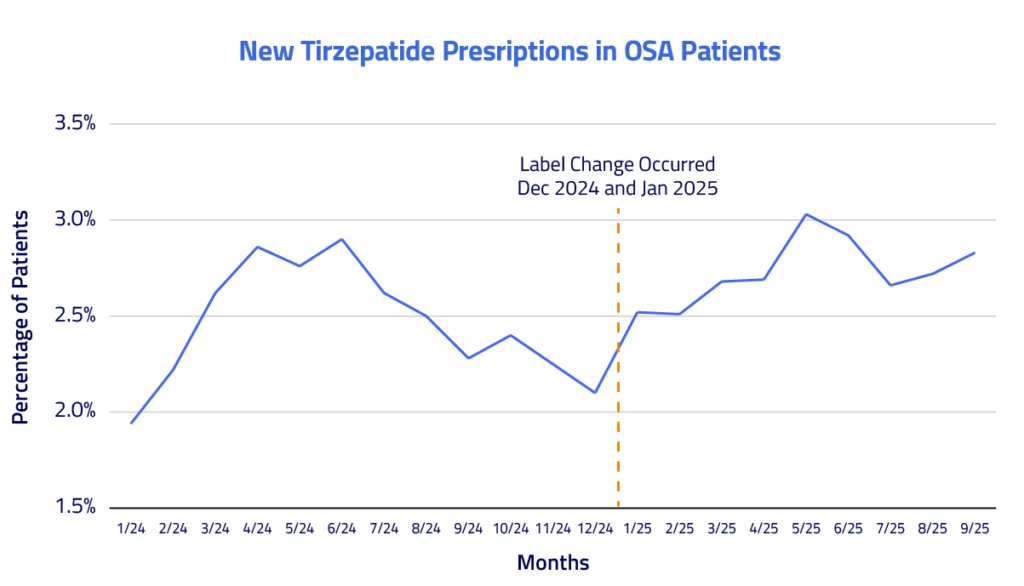
A new real-world analysis of insurance claims from nearly 20 million US adults diagnosed with obstructive sleep apnea (OSA) found that tirzepatide is increasingly being used early in the treatment pathway — and that patients who start it rarely go on to begin CPAP therapy.[1] The analysis, published by data firm Komodo Health, covers the first six months after the FDA approved tirzepatide (sold as Zepbound) for moderate-to-severe OSA in adults with obesity in December 2024.[1]
Among patients with OSA who had no prior CPAP use, 4% of those who started tirzepatide went on to start CPAP within six months, compared with 22% of those without GLP-1 exposure — a relative difference of about 83%.[1] New tirzepatide starts among people with OSA rose 16% in the six months following the label expansion, from January through June 2025.[1]
Who is prescribing, and when
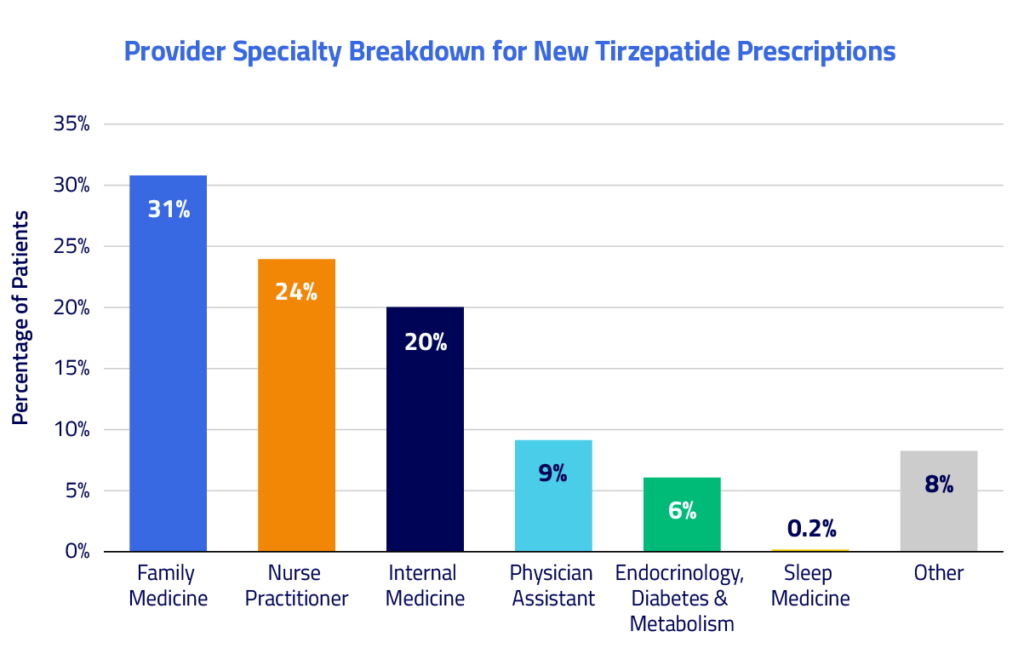
The prescribing pattern is striking. Family medicine physicians wrote 31% of tirzepatide prescriptions among patients with OSA, followed by nurse practitioners at 24%, internal medicine physicians at 20%, and physician assistants at 9%.[1] Endocrinology, diabetes and metabolism specialists accounted for 6%.[1] Together, primary care and generalist settings wrote roughly 84% of new prescriptions, while sleep medicine accounted for just 0.2%.[1]
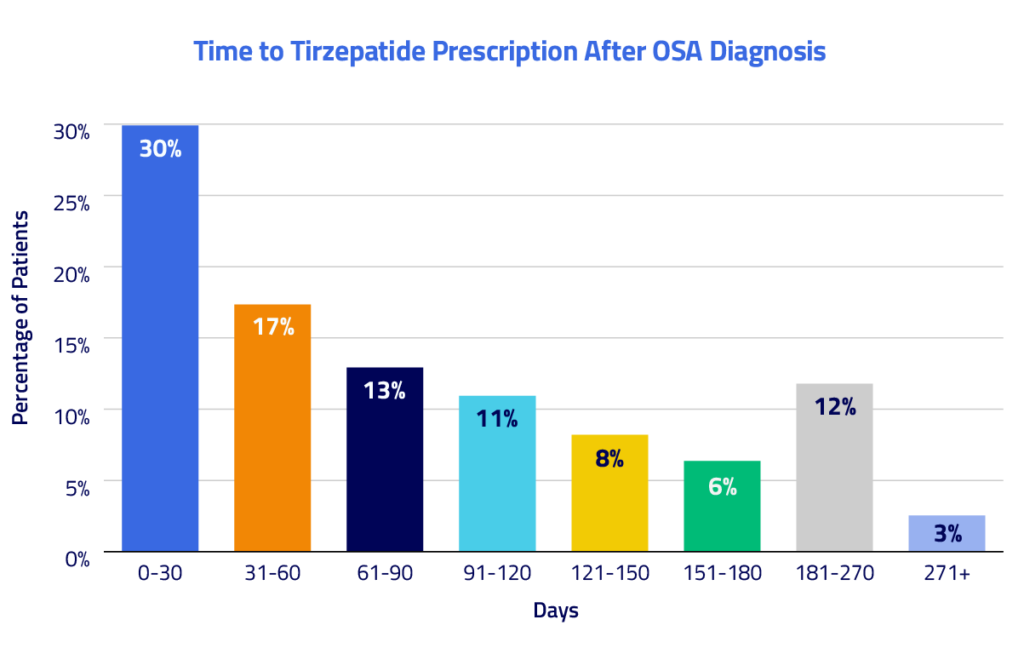
The drug is also being started quickly after diagnosis. Nearly 30% of newly diagnosed OSA patients who initiated tirzepatide did so within 30 days of their diagnosis, and 47% within 60 days.[1] Only 3% started more than 270 days after diagnosis.[1] The authors say this suggests the medication is being introduced as an early step rather than after a long trial of device therapy.[1]
Initiation rates varied by age. Adults 45 to 54 had the highest rate at 91 per 1,000 patients with OSA, followed by ages 35 to 44 at 87 per 1,000.[1] Adults 75 and older had the lowest rate, at 37 per 1,000.[1]
Among people already using CPAP, 26% of those who started tirzepatide had a six-month gap with no CPAP-related claims, compared with 15% of matched patients who did not receive the drug — a 75% relative difference.[1] The authors caution that a gap in claims cannot be read as confirmed clinical discontinuation, only as lower engagement with CPAP-related services.[1]
For context, before the label expansion only 14% of patients diagnosed with OSA received any GLP-1 therapy, while 66% received device-based treatment such as CPAP.[1] Looking further back across patients' histories, including before OSA diagnosis, GLP-1 exposure rose to 24%.[1]
Why it matters for patients
This is an observational claims analysis, not a randomized trial. It shows what happened in billing records; it does not prove that tirzepatide caused people to skip or stop CPAP, and the two groups compared may differ in ways claims data cannot capture. The authors themselves describe the CPAP findings as "directional insights."[1]
Still, the numbers describe a care pathway that appears to be shifting fast. If a new OSA diagnosis now often leads to a GLP-1 prescription from a primary care office within weeks, patients may encounter fewer conversations with sleep specialists, who wrote just 0.2% of these prescriptions.[1] That matters because OSA severity is typically measured with sleep testing, and the source does not report whether patients who started tirzepatide instead of CPAP had repeat sleep studies or ongoing monitoring of their apnea. That question is not answered here.
The approval also changed access. Komodo notes that expanding the labeled indication to include OSA "opened the door to payer-supported access to GLP-1 therapy for patients with obesity-associated OSA."[1] For people whose plans would not cover a GLP-1 for weight alone, an OSA diagnosis may be the route to coverage.
The analysis does not report how much sleep apnea improved, whether symptoms returned in people who reduced CPAP use, or what happened to patients who stopped tirzepatide. It also does not report side effects, discontinuation rates, or costs.
What happens next
The FDA approved tirzepatide for OSA in adults with obesity in December 2024.[1] The data window in this analysis runs through June 2025, so it captures only the first six months of post-approval uptake.[1] Longer follow-up would be needed to see whether the drop in CPAP starts holds up over years, and whether people who never begin device therapy fare as well. Komodo estimates the potentially eligible population is large: published epidemiologic estimates cited in the analysis suggest about 39% of adults with OSA have moderate-to-severe disease, and 43% to 54% of those patients meet criteria for obesity.[1]
Images from the sources
Sources
Semaglutides.org is for information only and is not medical advice. Always talk to a licensed healthcare provider about your own care. Some links to telehealth services are affiliate links, labeled where they appear.