BMJ study examines GLP-1 drugs and substance use disorders in US veterans
A large VA study found veterans with type 2 diabetes who started a GLP-1 drug had lower rates of new alcohol, nicotine, opioid and other substance use disorders than those who started a different diabetes drug, though the study cannot prove cause and effect.
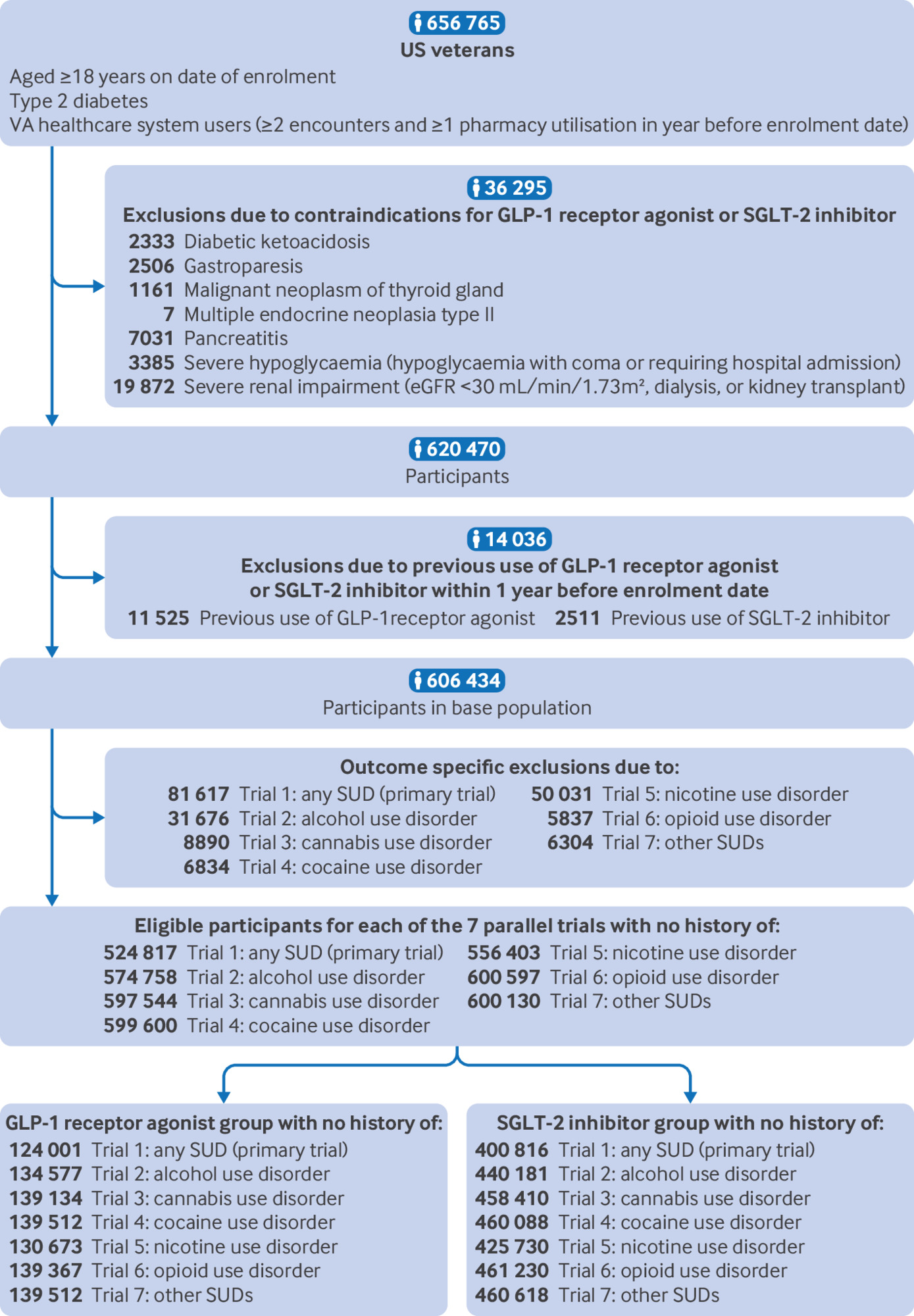
A study published March 4, 2026, in The BMJ looked at whether starting a GLP-1 receptor agonist changes the risk of developing a substance use disorder, and whether it changes outcomes for veterans who already had one [1]. Researchers used Department of Veterans Affairs health records to build eight separate comparisons, called target trial emulations, rather than a single randomized trial [1].
The study drew from 606,434 US veterans with type 2 diabetes [1]. For the question of new substance use disorders, 524,817 people who had no prior history of a given disorder were compared: 124,001 who started a GLP-1 drug and 400,816 who started a sodium-glucose cotransporter-2 (SGLT-2) inhibitor, a different class of diabetes medicine used as the comparison group [1]. A separate group of 81,617 veterans who already had a substance use disorder was split into 16,768 GLP-1 starters and 64,849 SGLT-2 inhibitor starters, followed for up to three years [1].
Among people with no prior history, starting a GLP-1 drug was linked to lower three-year rates of new disorders across several substances, compared with starting an SGLT-2 inhibitor [1]. The hazard ratio was 0.82 for alcohol use disorder, 0.86 for cannabis, 0.80 for cocaine, 0.80 for nicotine, and 0.75 for opioid use disorder, with a combined hazard ratio of 0.86 for any of these disorders [1]. In real numbers, that translated to roughly 5.6 fewer alcohol use disorder cases, 1.6 fewer nicotine cases, and 0.9 fewer opioid cases per 1,000 people over three years, among other differences [1].
For veterans who already had a substance use disorder, starting a GLP-1 drug was linked to fewer serious downstream events. Emergency department visits related to substance use dropped by a hazard ratio of 0.69, hospital admissions by 0.74, and deaths related to substance use by 0.50 [1]. Drug overdoses were lower with a hazard ratio of 0.61, and suicidal ideation or attempts were lower at 0.75, corresponding to about 9 fewer overdose-related events and 10 fewer suicidal ideation or attempt events per 1,000 people over three years [1]. The researchers noted that people who stuck with their medication longer showed results pointing the same direction as those seen at the start of treatment [1].
The authors describe this as observational data, meaning veterans were not randomly assigned to drugs, and they wrote that the findings suggest a possible role for GLP-1 drugs in both preventing and treating substance use disorders, but that this needs further study [1]. They also point to earlier, smaller studies with mixed results, including one trial that found no significant drop in heavy drinking except among people with a BMI over 30, and mixed findings on whether the drugs help people quit smoking [1].
Why it matters for patients
This study does not show that GLP-1 drugs are approved or intended to treat substance use disorders. It is an observational comparison among veterans with type 2 diabetes, almost all of whom were prescribed these drugs for diabetes rather than for addiction [1]. The population studied skews toward older veterans with diabetes, so the results may not carry over directly to younger people or those without diabetes who are considering these drugs for weight loss.
The study also compared GLP-1 drugs against another diabetes medicine, not against no treatment or against therapies specifically designed for addiction, so it says nothing about how GLP-1 drugs stack up against existing addiction treatments. Because the researchers relied on health records rather than a randomized trial, unmeasured differences between the two groups could still explain part of what they found, even after statistical adjustment [1].
What happens next
The study's authors call for further evaluation of GLP-1 drugs for both preventing and treating substance use disorders [1]. The BMJ published this cohort study alongside a linked editorial and opinion piece discussing what these findings might add to substance use care, signaling that clinical and research interest in this question is likely to continue [1].
Sources
Semaglutides.org is for information only and is not medical advice. Always talk to a licensed healthcare provider about your own care. Some links to telehealth services are affiliate links, labeled where they appear.