Review maps the psoriasis and psoriatic arthritis research pipeline for GLP-1 drugs
A research review found early studies suggest GLP-1 drugs like liraglutide and semaglutide may ease psoriasis, and lists new trials testing tirzepatide alongside a biologic for psoriatic arthritis.
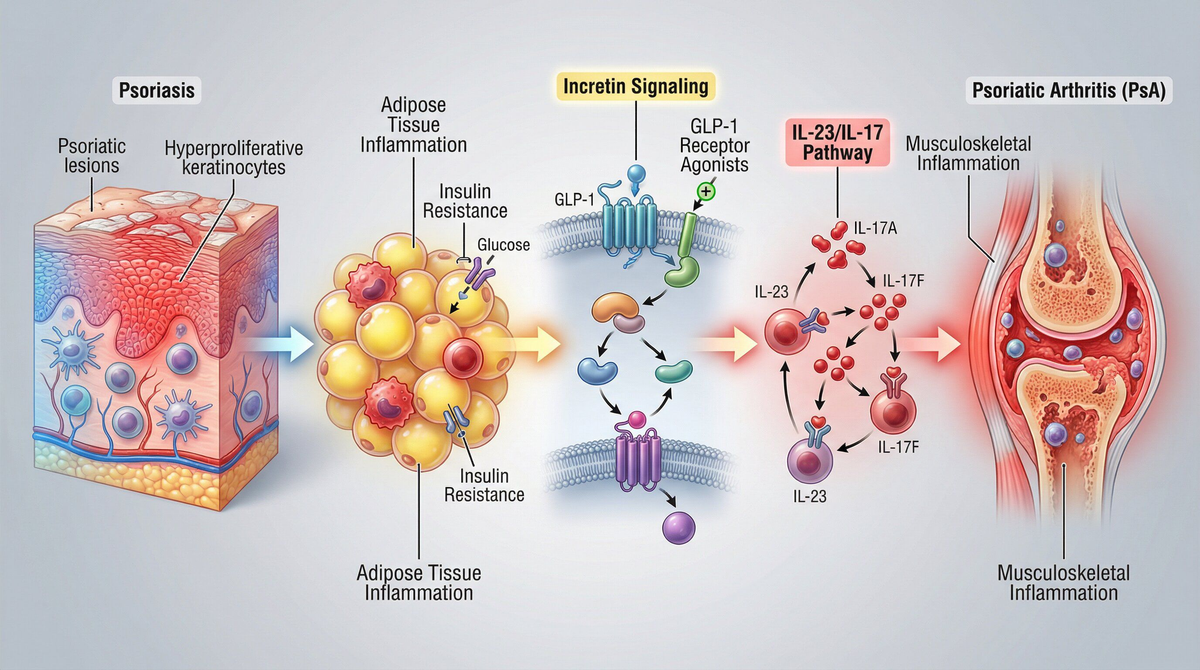
A review published in Frontiers in Immunology on April 27, 2026, gathered existing research on GLP-1 receptor agonist drugs and two related skin and joint conditions: psoriasis and psoriatic arthritis (PsA) [1]. The authors, a group of rheumatology and immunology researchers based in Italy, did not run a new clinical trial. Instead they collected and summarized published studies and listed ongoing trials that use these drugs alongside standard psoriasis treatments [1].
Psoriasis affects an estimated 2% to 3% of people worldwide, and up to 30% of people with psoriasis eventually develop psoriatic arthritis, a joint condition [1]. The review's authors argue that psoriasis is not just a skin disease but is tied to broader metabolic problems like obesity, insulin resistance, and type 2 diabetes, which may help explain why drugs originally built for diabetes and weight loss show effects on skin and joint inflammation [1].
Several small studies cited in the review reported that liraglutide, taken by people who also had psoriasis and type 2 diabetes or obesity, was linked to lower PASI scores, a standard measure of psoriasis severity [1]. One early study followed two patients with psoriasis and type 2 diabetes on liraglutide and also ran lab experiments showing the drug affected certain immune cells tied to skin inflammation [1]. A separate study of seven patients found PASI scores and body mass index both fell during liraglutide treatment [1]. A single case report combined liraglutide with a psoriasis drug called acitretin and also reported improvement [1]. The review states that both liraglutide and semaglutide have shown PASI improvements across the available evidence [1].
For psoriatic arthritis specifically, the review points to two open-label trials in patients with obesity that reported improvements in disease activity, measured by a scale called minimal disease activity, along with metabolic benefits [1]. It also lists two newer registered trials, NCT06588296 (called TOGETHER-PsA) and NCT06864026 (called TOGETHER AMPLIFY-PsA), which are testing the biologic drug ixekizumab both with and without tirzepatide, the GLP-1 drug sold as Mounjaro and Zepbound [1]. The review notes that, so far, no study has specifically tested GLP-1 drugs in early-stage psoriatic arthritis, even though the authors believe that stage could be a useful window for treatment based on how metabolism and inflammation interact [1].
The authors are careful to note limits in the current evidence. Most PsA studies involved small numbers of patients and short follow-up periods, and the review is a narrative summary rather than a formal meta-analysis [1].
Why it matters for patients
This review does not represent a new approval or a new use cleared for GLP-1 drugs. The psoriasis findings come from small studies, some with only a handful of patients, not large randomized trials [1]. For people who already take a GLP-1 drug for diabetes or obesity and who also have psoriasis or psoriatic arthritis, the review suggests a possible added benefit for skin symptoms is biologically plausible, tied partly to weight loss and partly to direct effects on inflammatory pathways such as IL-17 and IL-23 that drive psoriatic disease [1]. But the evidence for joint disease specifically remains preliminary, and the authors state clearly that data in psoriatic arthritis are limited [1]. Nothing in this review changes how psoriasis or psoriatic arthritis are currently treated in the United States.
What happens next
The review lists TOGETHER-PsA (NCT06588296) and TOGETHER AMPLIFY-PsA (NCT06864026) as active registered trials studying tirzepatide alongside ixekizumab in psoriatic arthritis, though the source does not give expected completion dates [1]. The authors call for dedicated studies testing GLP-1 drugs in early-stage psoriatic arthritis, which have not yet been done [1].
Sources
Semaglutides.org is for information only and is not medical advice. Always talk to a licensed healthcare provider about your own care. Some links to telehealth services are affiliate links, labeled where they appear.