ATTAIN-MAINTAIN tests switching from an injection to an oral GLP-1 for maintenance
A phase 3b trial found people who switched from injectable tirzepatide or semaglutide to daily oral orforglipron kept about three-quarters of their weight loss at one year, versus far less on placebo [1].
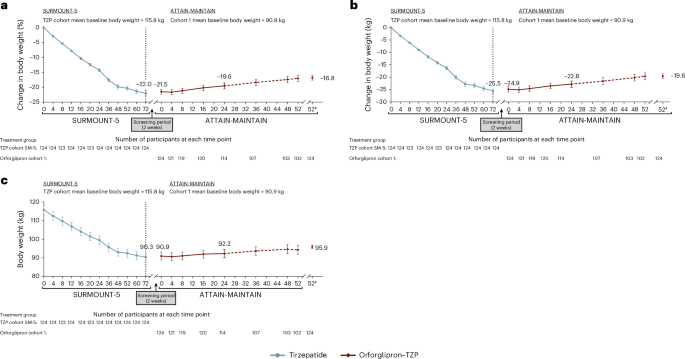
People who lose weight on an injectable GLP-1 drug and then switch to a daily pill may keep most of that loss, according to the phase 3b ATTAIN-MAINTAIN trial published in Nature Medicine. The trial randomized 376 adults who had already completed 72 weeks of injectable treatment to either oral orforglipron or placebo for a year [1][2].
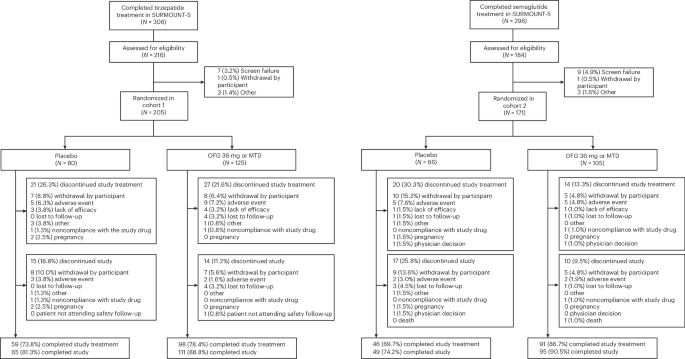
The study drew its participants from SURMOUNT-5, the head-to-head trial of tirzepatide (Mounjaro/Zepbound) versus semaglutide (Ozempic/Wegovy) [1]. Everyone in ATTAIN-MAINTAIN had obesity, or a BMI of at least 27 kg/m² with obesity-related complications [1]. Cohort 1 had been on tirzepatide (205 randomized: 125 to orforglipron, 80 to placebo). Cohort 2 had been on semaglutide (171 randomized: 105 to orforglipron, 66 to placebo) [1]. Orforglipron, sold in the US as Foundayo, is a once-daily nonpeptide GLP-1 receptor agonist taken as a pill without food or water restrictions [1].
What the numbers showed
The primary measure was how much of the weight already lost was still off at week 52, among participants whose weight had plateaued (less than 5% change from weeks 60 to 72 of SURMOUNT-5) [1].
In the tirzepatide cohort, orforglipron users held onto a model-based estimate of 74.7% of their prior weight reduction, versus 49.2% on placebo — a difference of 25.5 percentage points (95% confidence interval 14.5 to 36.5; P < 0.001) [1][2].
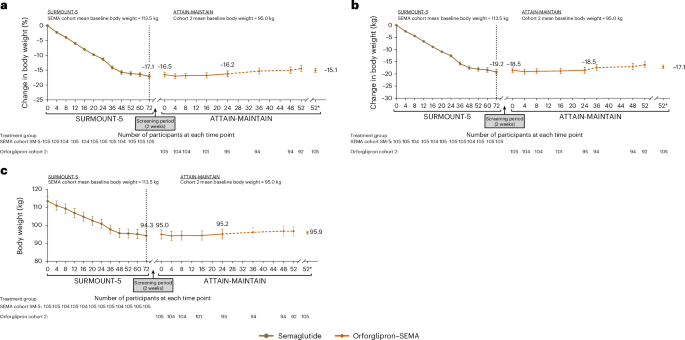
In the semaglutide cohort, orforglipron users held 79.3%, versus 37.6% on placebo — a difference of 41.7 points (95% CI 24.4 to 59.0; P < 0.001) [1][2]. The placebo groups, in other words, regained roughly half to nearly two-thirds of what they had lost once active treatment stopped.
All key secondary endpoints were met, the authors report [1][2]. The most common side effects were gastrointestinal, mostly mild to moderate [2].
The trial ran at 29 US sites and enrolled between September 13, 2024 and November 21, 2025 [1]. In cohort 1, mean age was 48.5 years, 62.9% were female, and mean body weight at the start was 90.1 kg (about 199 pounds). In cohort 2, mean age was 48.6, 68.4% female, mean weight 94.4 kg (about 208 pounds) [1]. Completion of study treatment was 76.6% in cohort 1 and 80.1% in cohort 2 [1].
One technical note: the trial used an investigational capsule formulation at doses of 1, 3, 6, 12, 24 and 36 mg, which the authors say are bioequivalent to tablet doses of 0.8, 2.5, 5.5, 9, 14.5 and 17.2 mg — the tablet strengths approved in the US [1]. Participants took 36 mg or their maximum tolerated dose [1].
Why it matters for patients
Weight regain after stopping GLP-1 treatment is well documented, and staying on injectable therapy long-term is hard for many people — because of cost, supply, travel, refrigeration or simple dislike of needles [1]. Until now, there was no randomized evidence on whether moving to a pill could hold the line. This trial is the first to test that switch directly [1].
The results suggest a pill can preserve most, though not all, of an injectable's result over a year. Orforglipron users still drifted back somewhat: roughly a quarter of the tirzepatide cohort's loss and a fifth of the semaglutide cohort's loss was not maintained [1]. Whether that trade-off is acceptable is a conversation for patients and their clinicians, not something this study answers.
The authors flag two limitations directly. There was no arm in which people simply stayed on their injectable, so the trial cannot say whether switching is as good as continuing [1][2]. And it lasted only one year, leaving longer-term durability unknown [2].
Other details not covered in the published abstract and excerpt include full adverse event rates, discontinuation rates due to side effects, and how the transition dosing was handled week by week. The trial was funded by Eli Lilly and Company; several authors are Lilly employees and shareholders, and most academic authors report consulting or research ties to Lilly and Novo Nordisk [2].
What happens next
The trial is registered as NCT06584916 [1][2]. Because it ran only 52 weeks, questions about whether the maintenance effect holds beyond one year — and how a pill compares against staying on an injectable — will require additional studies that have not yet been reported.
Images from the sources
Sources
Semaglutides.org is for information only and is not medical advice. Always talk to a licensed healthcare provider about your own care. Some links to telehealth services are affiliate links, labeled where they appear.