BARI-STEP: first randomized trial of semaglutide after bariatric surgery reports 18 percent weight loss
A UK randomized trial found semaglutide 2.4 mg produced 18 percent weight loss over 68 weeks in people who lost less than expected after gastric bypass or sleeve surgery, versus no loss on placebo [1].
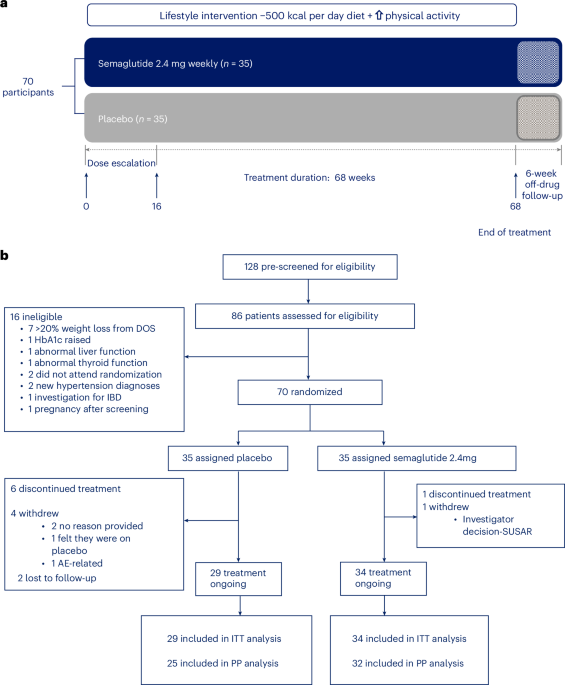
Researchers have published the first randomized, placebo-controlled trial of semaglutide 2.4 mg in people whose weight loss stalled after bariatric surgery. In the BARI-STEP trial, reported in Nature Medicine, adults treated with weekly semaglutide lost an estimated 18.0 percent of their body weight at 68 weeks, while those on placebo gained 0.4 percent [1][2].
What the trial tested
BARI-STEP was a double-blind trial that randomly assigned participants 1:1 to semaglutide 2.4 mg weekly or placebo [1]. To enroll, adults had to be at least one year past a Roux-en-Y gastric bypass or sleeve gastrectomy and have what the authors call a "suboptimal clinical response," defined as less than 20 percent weight loss from surgery [1]. Everyone also received a lifestyle program built around a 500-calorie daily energy deficit, so the drug was tested as an add-on rather than a stand-alone [1].
Seventy people were randomized, 35 to each group [1]. Mean age was 47.3 years (standard deviation 10.3), and 58 participants (82.9 percent) were female, 12 (17.1 percent) male [2]. The intention-to-treat analysis included 63 participants [1].
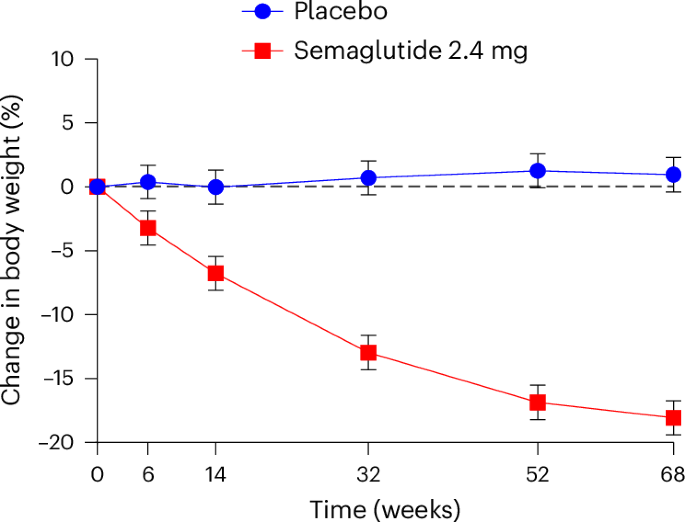
The primary outcome was percentage weight loss at 68 weeks. Mean change was −18.0 percent (s.d. 9.2) with semaglutide (n = 34) versus +0.4 percent (s.d. 7.0) with placebo (n = 29), for an adjusted treatment difference of −19.18 percentage points (95 percent confidence interval −23.4 to −14.8; P < 0.001) [1][2]. Weight curves separated early: the difference between groups was already statistically significant at week 6 (P = 0.008) and remained so at weeks 14, 32, 52 and 68 [2]. The authors also report improvements in metabolic measures and quality of life compared with placebo, though the specific figures are not in the abstract text available here [1].
On safety, the investigators say adverse events matched semaglutide's known profile, with "no new safety concerns for the post-bariatric population" [1]. There were eight serious adverse events, one suspected unexpected serious adverse reaction, and no treatment-related deaths [1][2]. The trial is registered as NCT05073835 [1][3].
How this compares with earlier work
The same research group previously ran BARI-OPTIMISE, a 24-week trial in which liraglutide 3.0 mg produced 9.4 percent weight loss versus 1.1 percent with placebo (estimated treatment effect −8.8; 95 percent CI −11.9 to −5.7) [1]. An earlier trial, GRAVITAS, tested liraglutide 1.8 mg in people with persistent or recurrent type 2 diabetes after surgery and found a mean weight difference of −4.2 kg (95 percent CI −6.8 to −1.4) at 26 weeks [1]. The authors note that in people with overweight or obesity without diabetes, semaglutide 2.4 mg has outperformed liraglutide 3.0 mg (−15.8 percent versus −6.4 percent at 68 weeks) [1].
Why it matters for patients
Bariatric surgery works well on average, but individual results vary widely, and roughly 20 percent of patients have a suboptimal response [1]. Because improvement in weight-related conditions tends to track with how much weight is lost, people in that group get fewer metabolic benefits, and regain can bring conditions back [1]. With about 500,000 operations performed worldwide each year, the number of people facing this problem keeps growing, and the authors describe existing options as limited, with revisional surgery having only modest effects [1].
Until now, the evidence for GLP-1 medicines after surgery came largely from liraglutide trials and observational data [1]. BARI-STEP is a randomized comparison at the higher-efficacy dose used for weight management, and the size of the difference — nearly 19 percentage points — is large for a group often described as hard to treat [1][2].
Important limits remain. The trial enrolled 70 people at a small number of UK sites; several authors are supported by the UCLH NIHR Biomedical Research Centre, and the disclosure statement lists honoraria, advisory work or institutional funding involving Novo Nordisk and Eli Lilly, with one author now an Eli Lilly employee and shareholder [2]. Who funded the trial is not stated in the material available here. Whether the weight loss holds after treatment stops, how results differ between bypass and sleeve patients, and how this evidence might affect US insurance coverage for post-surgical GLP-1 use are not addressed in these sources.
What happens next
The paper is published in Nature Medicine, with a 2026 copyright on the PubMed record [1][2]. Longer-term follow-up and any replication in larger, multi-country trials have not been announced in these sources.
Images from the sources
Sources
Semaglutides.org is for information only and is not medical advice. Always talk to a licensed healthcare provider about your own care. Some links to telehealth services are affiliate links, labeled where they appear.