Hypothesis paper proposes tirzepatide for refractory endometriosis, with no human data
A June 2026 paper floats the idea that tirzepatide could someday help treatment-resistant endometriosis, but its own authors say the theory has zero supporting human trials and rests on one unrepeated study.
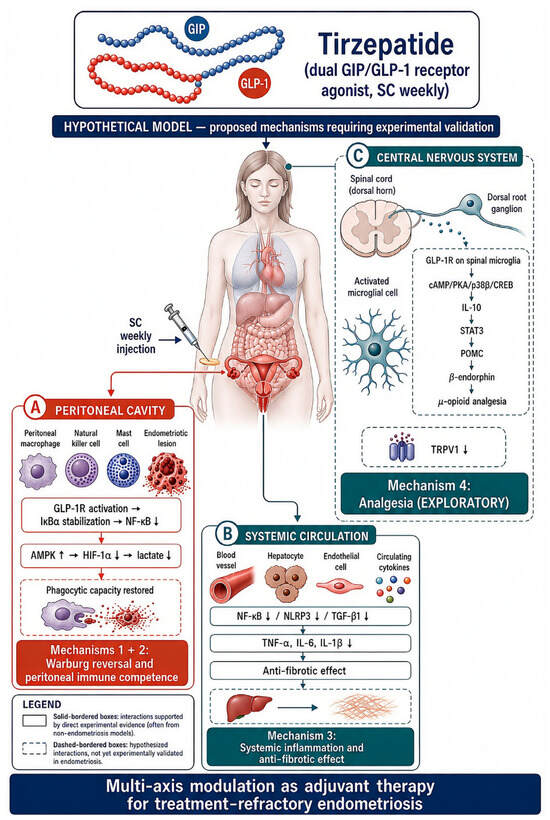
A hypothesis paper published June 24, 2026, in the International Journal of Molecular Sciences proposes that tirzepatide, the dual GIP/GLP-1 drug sold as Mounjaro and Zepbound, might one day help people with treatment-refractory endometriosis [1]. The authors are explicit that this is a theoretical framework, not a study result, and that no human testing of the idea has been done [1].
The paper, written by researchers affiliated with the Brazilian Society for Research and Teaching in Medicine, the Federal University of São Paulo's gynecology department, and the Brazilian Society of Personalized Medicine, introduces a concept the authors call "peritoneal incretin deficiency" [1]. Around that idea, they build a four-part mechanistic argument for how tirzepatide might act on refractory endometriosis: through metabolic reprogramming, correction of peritoneal immune dysfunction, reduction of inflammatory and fibrotic tissue remodeling, and reduced nociceptive sensitization, which relates to pain signaling [1].
The authors are unusually direct about the limits of their own argument. They state that the entire "peritoneal incretin deficiency" concept rests on a single case-control study that has not been replicated [1]. They also acknowledge that the broader mechanistic chain linking tirzepatide to endometriosis biology relies on indirect evidence drawn from other diseases, not from endometriosis research itself [1]. Most notably, they state plainly that direct experimental or clinical validation of the hypothesis is absent [1]. This is a hypothesis paper, a recognized category of scientific publication meant to propose ideas for future testing, not a clinical trial or laboratory study of tirzepatide in people or animals with endometriosis [1].
Why it matters for patients
Endometriosis, a condition where tissue similar to the uterine lining grows outside the uterus, can be difficult to treat, and some cases do not respond well to existing therapies. That is the backdrop for why a paper proposing a new angle, even a speculative one, draws attention. But nothing in this paper shows that tirzepatide reduces endometriosis symptoms, slows disease progression, or is safe for that purpose in real patients, because no such testing has been done [1].
Tirzepatide is approved in the United States under the brand names Mounjaro, for type 2 diabetes, and Zepbound, for chronic weight management. This paper does not report or claim any regulatory review, clinical trial, or approval related to endometriosis. Readers who encounter this paper cited online as evidence that tirzepatide treats endometriosis should know that the authors themselves describe their own framework as resting on one non-replicated study and indirect evidence borrowed from unrelated diseases, with no direct experimental or clinical data behind it [1].
Hypothesis papers like this one serve a specific role in science: they lay out reasoning that other researchers might later test in labs or clinical trials. They are not evidence that a treatment works, and they are not a substitute for trial data reviewed by regulators. Whether tirzepatide has any real effect on endometriosis is, based on what is published here, not yet known.
What happens next
The paper itself does not describe any planned laboratory experiments or clinical trials testing tirzepatide in people with endometriosis, and no such studies are mentioned in the source material [1]. The authors' own text calls for direct experimental or clinical validation, but the sources reviewed here do not indicate that any such research has started or has a scheduled timeline [1]. Until that kind of testing happens and is published, whether this mechanistic idea holds up remains an open question.
Sources
Semaglutides.org is for information only and is not medical advice. Always talk to a licensed healthcare provider about your own care. Some links to telehealth services are affiliate links, labeled where they appear.