PERCEPTIONS survey reports why 518 US adults started tirzepatide
A survey of 518 US adults starting tirzepatide found most were driven by hopes for better overall health, but nearly all worried about insurance coverage and cost.
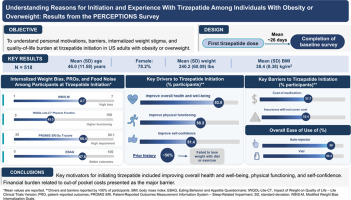
A new real-world survey called PERCEPTIONS looked at why 518 US adults began taking tirzepatide, the medicine sold as Mounjaro and Zepbound. The survey found that 83.8% of participants started the drug to improve their overall health and well-being, while 58.3% wanted to improve physical functioning [1]. At the same time, 90% of participants reported concerns about health insurance coverage, and 57.7% cited treatment cost as a barrier [1].
The survey was conducted between June and November 2025 and enrolled adults with obesity, defined as a BMI of 30 or higher, or overweight with at least one obesity-related complication, defined as a BMI of 27 or higher [1]. People with type 2 diabetes were not included in the study [1]. Participants completed the survey within four to eight weeks of their first tirzepatide dose, with an average gap of about 26 days [1].
The average participant was 46 years old, and 78.2% were female. Most participants, 69.5%, identified as White. The average body mass index was 38.4 [1]. Most participants, 89.2%, started tirzepatide at the lowest dose of 2.5 mg, and 12.7% had previously taken semaglutide, the active ingredient in Ozempic, Wegovy, and Rybelsus [1].
The survey also found that nearly half of participants had previously tried and failed to lose weight or keep it off using exercise and diet alone [1]. Before starting tirzepatide, participants reported substantial impairments in physical functioning and psychosocial well-being, along with high levels of internalized weight bias, meaning negative feelings about their own weight [1]. Other motivators for starting the drug included improving self-confidence and appearance outside of work, cited by 51.4% of participants [1].
Once people began treatment, most found it manageable. Among those using auto-injector pens, 98.0% said tirzepatide was easy to use, and among those using vials, 95.8% said the same [1].
Why it matters for patients
This survey offers a window into what motivates people to start a GLP-1 medication and what stands in their way before they ever take a first dose. The finding that 90% of participants worried about insurance coverage, and that more than half worried about out-of-pocket cost, points to access as a major hurdle even for people who already decided to try the drug and got a prescription [1]. The study's authors wrote that these barriers highlight a need to address what they called systemic barriers that limit equitable access to effective treatment options [1].
The data also show that many people arrive at tirzepatide after other efforts, since nearly half had already tried and failed at weight loss through exercise and diet [1]. The survey measured physical functioning, psychosocial well-being, and internalized weight bias at the start of treatment, but it did not report how those measures changed over time in this data set, since this was baseline information collected close to the first dose [1].
Because this is a survey and not a clinical trial, it reflects participants' self-reported experiences and motivations rather than measured medical outcomes. The study did not include people with type 2 diabetes, so it is not known whether the same motivators and barriers apply to that group [1].
What happens next
The published results describe baseline data collected during the June to November 2025 survey period [1]. The article does not describe additional planned survey waves or follow-up data collection, so whether researchers will report on how these participants' experiences changed after continued treatment is not yet known from the available source.
Sources
Semaglutides.org is for information only and is not medical advice. Always talk to a licensed healthcare provider about your own care. Some links to telehealth services are affiliate links, labeled where they appear.