Audit finds the compounded GLP-1 market still operating after the shortage ended
A JAMA Health Forum secret-shopper study found 75 weight-loss clinics and med spas in two states still selling compounded semaglutide and tirzepatide, often mixed with B vitamins, and some suppliers lacked sterile compounding licenses [2].
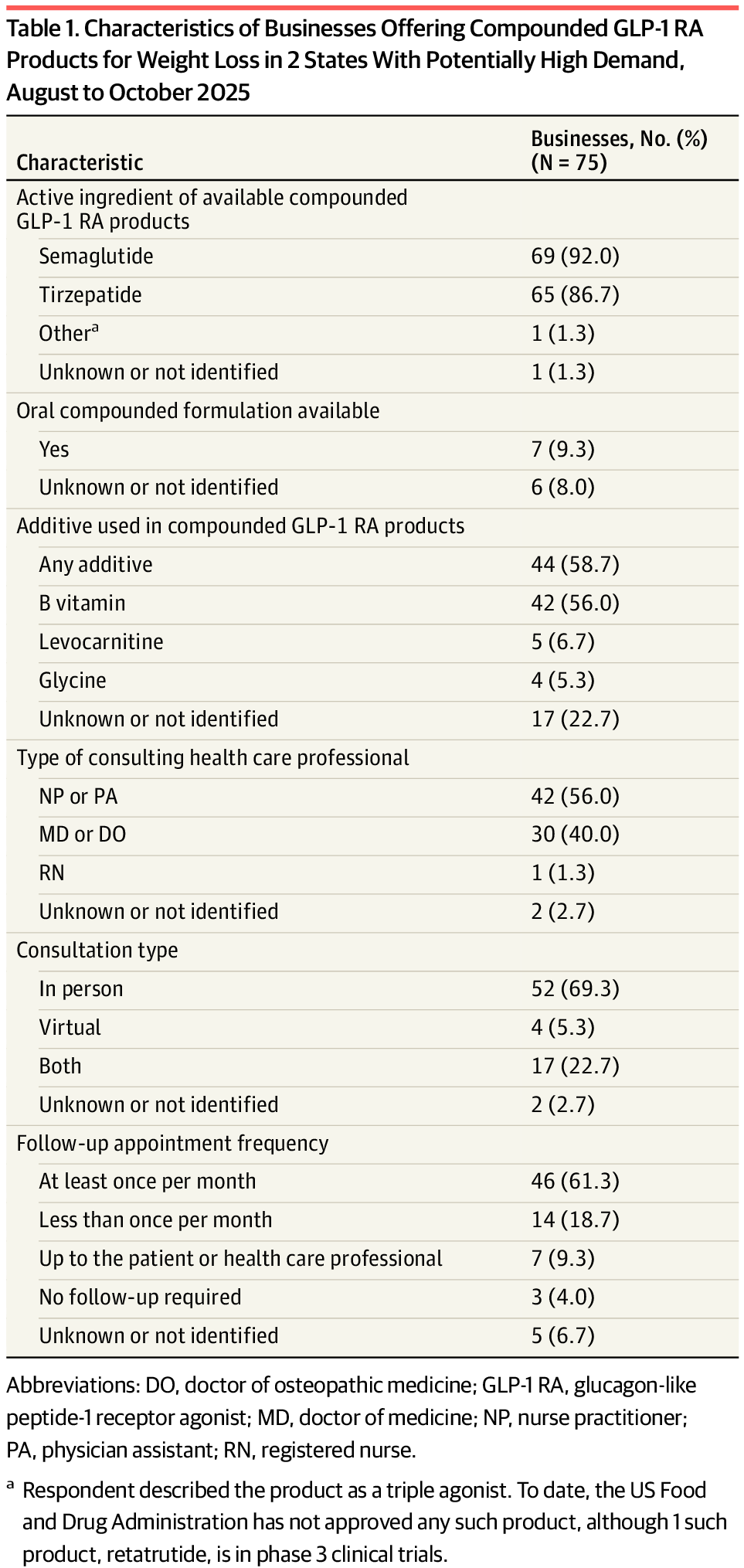
Researchers who posed as customers at brick-and-mortar weight-loss clinics and medical spas in West Virginia and Oklahoma found a compounded GLP-1 market still running well after the federal semaglutide and tirzepatide shortages ended, according to a cross-sectional study published in JAMA Health Forum [2]. The team identified 75 businesses selling compounded GLP-1 receptor agonist products, and traced them back to 23 compounding facilities — several of which were not licensed for sterile compounding or had recent disciplinary records [1].
The study was run by researchers at the University of Colorado Anschutz Medical Campus, who identified candidate businesses in January 2025 using a web mapping application and business websites, then conducted secret-shopper calls from August to October 2025 [2]. The two states were chosen on purpose because their obesity rates and insurance mix suggested potentially high demand for lower-cost compounded versions [2].
What the shoppers found
Among the 75 businesses, 69 (92.0%) offered compounded semaglutide and 65 (86.7%) offered compounded tirzepatide [2]. Seven (9.3%) said they offered an oral compounded formulation, and for 6 (8.0%) that detail could not be determined [2].
Additives were common. Some kind of added ingredient was reported by 44 businesses (58.7%), most often a B vitamin at 42 businesses (56.0%) [2]. Levocarnitine was named by 5 (6.7%) and glycine by 4 (5.3%), while 17 (22.7%) could not be classified [2]. These combination products are a key distinction from FDA-approved Ozempic, Wegovy, Mounjaro and Zepbound, which contain only the single active drug.
Care arrangements varied. A nurse practitioner or physician assistant was the consulting clinician at 42 businesses (56.0%) and a physician at 30 (40.0%) [2]. Most consultations were in person (52, or 69.3%), with 4 (5.3%) virtual only and 17 (22.7%) offering both [2]. Follow-up was at least monthly at 46 businesses (61.3%), less often than monthly at 14 (18.7%), left to the patient or clinician at 7 (9.3%), and not required at all at 3 (4.0%) [2].
The supply chain behind the clinics
Of the 23 compounding facilities identified as suppliers, 22 of 23 (95.6%) held a state license and 3 of 23 (13.0%) were federally registered 503B outsourcing facilities; 2 (8.7%) were both [2]. Among the 21 facilities where this could be assessed, 17 (81.0%) were licensed for sterile compounding — meaning 4 (19.0%) were not, even though injectable GLP-1 products must be made sterile [1][2].
Since 2023, 3 of 22 facilities (13.6%) had faced a state board of pharmacy action, and 1 of 23 (4.3%) had received multiple FDA warning letters [1]. Three of 23 (13.0%) had an open FDA Form 483, a notice of objectionable conditions issued after an inspection, and all three of those forms referred to sterile compounding practices [2]. Of the four facilities with disciplinary action, three (75.0%) involved sterile compounding [2].
The authors concluded that compounding facilities "have continued to manufacture GLP-1 RAs with added ingredients" and that sourcing is "diverse but includes facilities without licenses to perform sterile compounding or that have been subject to recent disciplinary action, posing clinical and regulatory challenges" [1].
Why it matters for patients
Compounded drugs are not FDA-approved and are not reviewed for safety, effectiveness or manufacturing quality the way branded semaglutide and tirzepatide are. This study shows that even after the shortages that made large-scale compounding legally permissible were declared over, products are still widely advertised in at least these two states [1][2].
The findings also point to information patients may not have: which facility made the product, whether that facility is licensed for sterile injectables, and whether extra ingredients such as B vitamins are in the vial. More than one in five businesses could not say what additive, if any, was used [2].
Several things remain unknown. The study covered only brick-and-mortar businesses in two states and did not include online telehealth sellers, did not test the products themselves, and did not measure patient outcomes, side effects or prices [1][2]. Whether these patterns hold nationally is not established by this research.
Sources
Semaglutides.org is for information only and is not medical advice. Always talk to a licensed healthcare provider about your own care. Some links to telehealth services are affiliate links, labeled where they appear.