PERCEPTIONS survey quantifies the workplace side of obesity treatment
A survey of 518 US workers starting tirzepatide found nearly a third of overall work capacity lost to obesity-related impairment, and most said employers should cover the drugs.
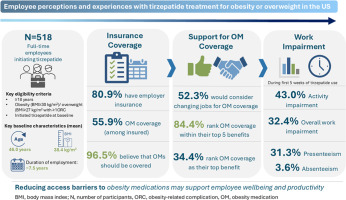
A new baseline analysis from the PERCEPTIONS survey, an observational study of full-time employed US adults starting tirzepatide for obesity or overweight, quantifies how much obesity affects work life and how strongly workers want employer insurance to pay for treatment [1].
The study enrolled 518 full-time employees with a mean age of 46.0 years and an average body mass index (BMI) of 38.4 kg/m2. Participants had worked for their employer for an average of 89.8 months, or about 7.5 years, and completed a self-administered electronic survey between June and November 2025 [1].
Using the Work Productivity and Activity Impairment (WPAI) questionnaire, researchers found mean overall work impairment of 32.4% and activity impairment of 43.0% among these employees before or as they began tirzepatide treatment. The overall work impairment was driven mainly by presenteeism, meaning employees were at work but not functioning at full capacity, rather than by missed days [1].
On insurance, 80.9% of participants had employer-provided health insurance, and among that group, 55.9% said their plan covered obesity medications. Despite that coverage gap, 96.5% of all respondents said employer-provided insurance should cover obesity medications, citing expected improvements in health, productivity, and management of obesity-related complications. Separately, 81.7% said coverage for these drugs could increase job satisfaction, and 52.3% said they would consider changing jobs to get that coverage [1].
Why it matters for patients
For patients already managing obesity, these findings put numbers to something many may feel but rarely see measured: obesity and its complications can chip away at daily functioning at work, even when someone is present and working. The 32.4% overall work impairment figure reflects lost productivity, not just missed shifts, and the study's authors say it points to a functional cost of obesity that isn't always visible on a balance sheet [1].
The insurance findings are also directly relevant to patients weighing the cost of tirzepatide, sold as Mounjaro or Zepbound. With just over half of insured respondents in the survey reporting that their employer's plan covered obesity medications, many workers in this group were left paying out of pocket or seeking other paths to coverage. The fact that more than half said they would consider changing jobs for coverage signals how much medication cost and access can shape decisions well beyond the clinic [1].
The survey does not establish that treatment with tirzepatide improves these workplace impairment scores over time; it reports baseline conditions among people who were initiating the drug. Whether productivity or activity impairment changes as patients continue treatment is not addressed in this reported data [1].
What happens next
The PERCEPTIONS survey is described as longitudinal, meaning researchers plan to follow this same group over time rather than take a single snapshot [1]. The published findings so far cover only the baseline period, with data collected from June to November 2025 [1]. Future reports from this survey could show whether work impairment scores change as participants continue tirzepatide treatment, but no such follow-up results are included in this study, and no date for a follow-up publication is given in the source [1].
The study was published in the journal Obesity Pillars in September 2026 and is authored by researchers including Theresa Hunter Gibble, Angela Fitch, and Harold Bays, among others [1]. It does not address perceptions of other GLP-1 medications, such as semaglutide (Ozempic, Wegovy, Rybelsus) or orforglipron (Foundayo), and its results are specific to the tirzepatide-initiating population it surveyed [1].
Sources
Semaglutides.org is for information only and is not medical advice. Always talk to a licensed healthcare provider about your own care. Some links to telehealth services are affiliate links, labeled where they appear.