JAMA Psychiatry links GLP-1 use to lower mortality in serious mental illness
A large observational study found that people with serious mental illness who started a GLP-1 drug had notably lower death rates over one and four years than those started on an SGLT2 inhibitor, but the study cannot prove the drugs caused the difference [1].
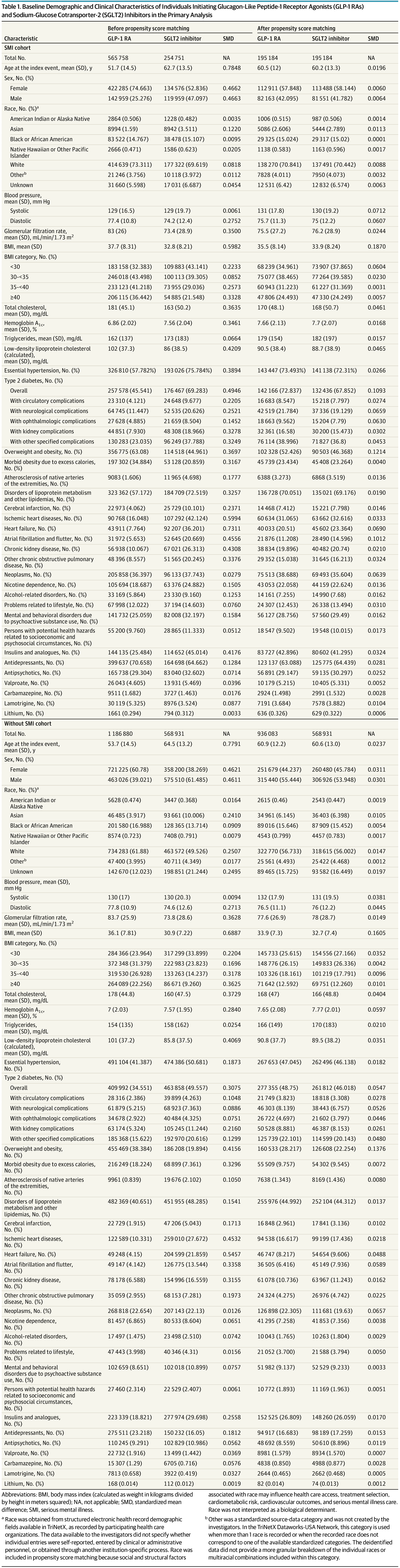
A study published in JAMA Psychiatry reports that adults with serious mental illness — major depressive disorder, bipolar disorder, or schizophrenia — who began taking a GLP-1 receptor agonist had lower rates of death and cardiovascular events than similar patients who began taking an SGLT2 inhibitor instead [1]. The finding matters because people with serious mental illness die younger than the general population, mostly from heart disease, and have historically had less access to obesity treatments [1].
The research team used electronic health records from the TriNetX Analytics Network and built a "target trial emulation," a method that tries to mimic a randomized trial using existing medical data [1]. Researchers matched more than 1.5 million adults total, including 195,184 pairs of patients with serious mental illness and 568,931 pairs without it, so that each person starting a GLP-1 drug was compared with a similar person starting an SGLT2 inhibitor [1]. Average age in the groups was about 60 [1].
Among people with serious mental illness, 4.91% of those started on a GLP-1 drug died within four years, compared with 6.45% of those started on an SGLT2 inhibitor — a difference researchers describe as a 24% lower relative risk of death (hazard ratio 0.76) [1]. The gap showed up even faster: at one year, 1.46% of the GLP-1 group had died versus 2.84% of the SGLT2 inhibitor group [1]. Among patients with serious mental illness and type 2 diabetes, those started on semaglutide (the active ingredient in Ozempic, Wegovy, and Rybelsus) had lower rates of heart attack, stroke, heart failure, and a measure combining major cardiovascular events, compared with those started on an SGLT2 inhibitor [1]. In longer, 10-year exploratory analyses limited to patients with type 2 diabetes, semaglutide was linked to lower mortality across all three psychiatric groups studied, with the strongest reduction seen in major depressive disorder [1]. The authors say the benefits were driven mainly by semaglutide and tirzepatide, the drug sold as Mounjaro and Zepbound [1].
Why it matters for patients
People with serious mental illness often gain significant weight from antipsychotic medications and face a much higher risk of early cardiovascular death, yet they have been prescribed obesity and diabetes drugs less often than the general population [1]. This study suggests GLP-1 drugs might help close that mortality gap, and that the effect could appear within a year of starting treatment [1]. However, the study is observational, not a randomized trial, so it cannot rule out "confounding by indication" — meaning doctors may have chosen to prescribe GLP-1 drugs to patients who were already healthier or more engaged with care in ways the data cannot fully capture [1]. The authors themselves call for prospective randomized trials to confirm the findings [1]. For now, the results describe an association seen in large health-record datasets, not proof that the drugs caused the lower death rates.
What happens next
The study's data were queried and analyzed in March 2026, with additional subgroup analyses conducted after peer review in May 2026 [1]. The authors state that randomized controlled trials are needed before the findings can be treated as definitive evidence that GLP-1 drugs reduce mortality in people with serious mental illness [1]. No specific trial dates or sponsors are mentioned in the study [1].
Sources
Semaglutides.org is for information only and is not medical advice. Always talk to a licensed healthcare provider about your own care. Some links to telehealth services are affiliate links, labeled where they appear.