Large-employer GLP-1 coverage falls to 60% from 72%
A survey of 127 large employers found GLP-1 weight-loss coverage dropped to 60% in 2026 from 72% in 2025, and 14% have cut it or plan to in 2027 [5][1][4].
Large US employers are pulling back on paying for GLP-1 weight-loss drugs. Business Group on Health's 2027 Employer Healthcare Strategy Survey, released August 25, 2026, found the share of large employers covering GLP-1s for weight management fell to 60% in 2026 from 72% in 2025 [1][4]. About 14% said they have already dropped that coverage or plan to in 2027 [1][4]. KFF Health News highlighted the numbers on September 8, 2026, citing Modern Healthcare reporting [2].
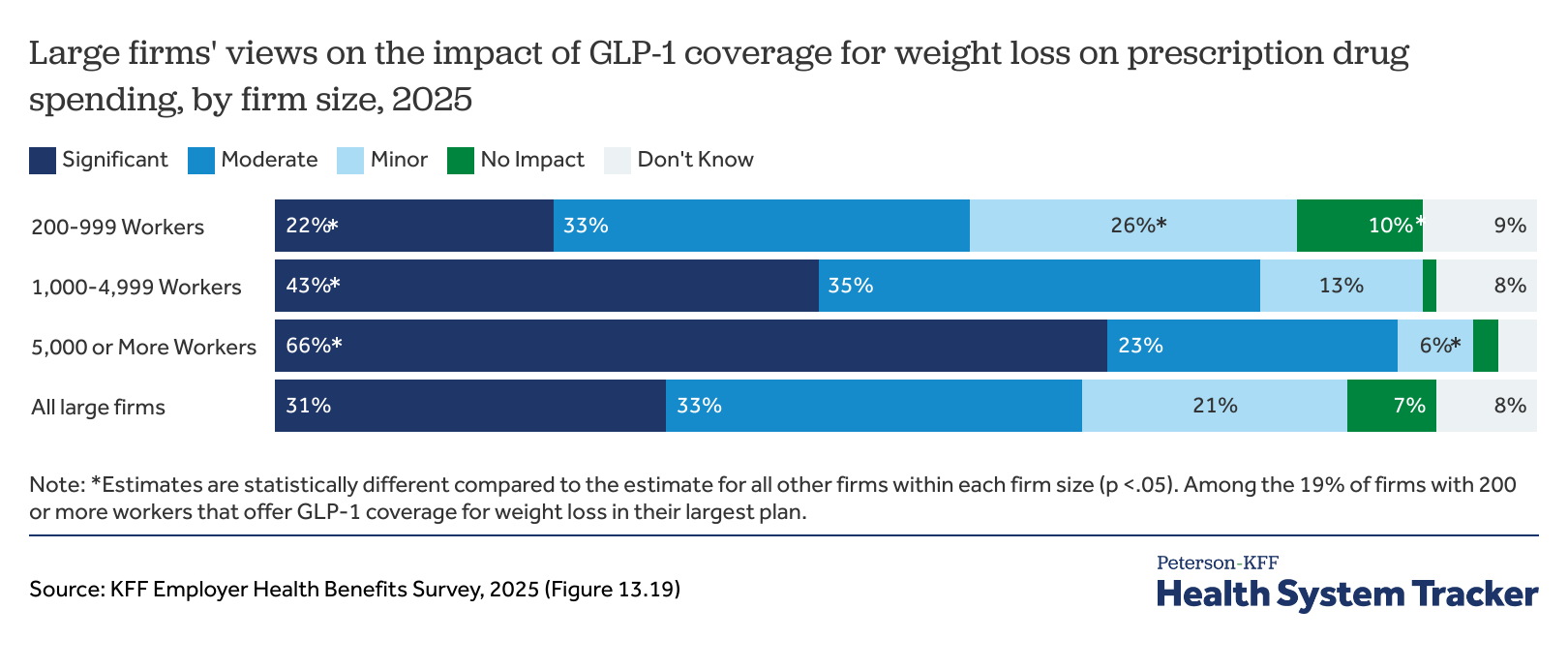
That is a reversal. Earlier surveys had shown coverage growing: KFF's 2025 Employer Health Benefits Survey found 43% of firms with 5,000 or more workers covered GLP-1s for weight loss, up from 28% in 2024 [3]. The two surveys use different samples and produce different numbers — the Business Group on Health report covered 127 large employers representing 11 million covered lives, with workforces ranging from under 5,000 to more than 100,000 people [5][4] — but both now point the same direction on cost pressure.
What's driving the cuts
Money, mostly. Business Group on Health projects employer healthcare costs rising 9.2% in 2027 if employers make no changes, up from 8.5% in 2026 [4]. Pharmacy now makes up 25% of employer healthcare spending and is expected to rise 12% in 2027 before plan changes, or 11% after interventions [4][5]. Ninety-five percent of surveyed employers said they are concerned or very concerned about pharmacy costs [5]. Two-thirds reported rising GLP-1 use [4].
List prices remain high: Zepbound (tirzepatide) is listed at $499 a month and Wegovy (semaglutide) at $1,349.02 a month on manufacturer websites, according to Reuters [4]. Brenna Shebel, a vice president at Business Group on Health, said most companies covering the drugs for weight loss are not yet seeing them lower the cost of treating obesity-related conditions such as diabetes or sleep apnea [4]. "This represents an unfortunate new reality for employers, who now face growing difficulty in budgeting and forecasting," said group president Ellen Kelsay [4].
Specific companies have already acted. Cigna Group and PricewaterhouseCoopers eliminated weight-loss GLP-1 coverage this year, and PepsiCo and Starbucks will do so in October, Modern Healthcare reported [2]. Insurance Business also named Starbucks and Deloitte among employers removing or restricting the coverage [5].
Tighter rules for those who keep it
Dropping coverage is only one option. Among employers still covering GLP-1s for weight management, 69% validate eligibility through biometrics and 45% require participation in a weight management program [1]. Some cover the drugs only for diabetes, some apply stricter eligibility criteria such as higher cardiometabolic risk or more clinical documentation, and some limit prescribing to designated providers or clinical programs [1].
Others are rerouting rather than cutting. Sixteen percent of surveyed employers said they would point employees to direct-to-consumer channels for GLP-1s, and 17% plan direct-to-employer arrangements that bypass the pharmacy benefit manager [5].
Why it matters for patients
If you get insurance through a large employer, your GLP-1 coverage for weight management is less secure than it was a year ago, and the decision may be made at open enrollment rather than by your prescriber. Business Group on Health advises employers to communicate clearly about what is covered, who qualifies, and how prior authorization works — and, when weight-loss coverage is dropped, to point members to other options like different anti-obesity medications, lifestyle and nutrition programs, or bariatric centers of excellence [1].
Even where coverage continues, the conditions attached are getting stricter — biometric screening, program participation, higher copays, or limits on which clinicians can prescribe [1][3]. In KFF's 2025 focus groups, some employers said they grandfathered current users while applying new requirements to new starts [3]. Whether your specific plan does that is not something these surveys can answer.
What happens next
PepsiCo and Starbucks cuts take effect in October 2026 [2]. Most other changes land with 2027 plan years, which for many employers begin January 1. Separately, 32% of surveyed employers will offer transparent or next-generation PBM plans in 2027, and 47% are considering it for 2028 or 2029 [5]. Whether the 60% figure keeps falling is not yet known; the next survey will tell.
Images from the sources
Sources
- https://www.businessgrouphealth.org/topics/blog/how-are-employers-managing-glp-1-coverage-amid-rising-demand-and-costs
- https://kffhealthnews.org/morning-breakout/healthcare-costs-090826/
- https://www.healthsystemtracker.org/brief/perspectives-from-employers-on-the-costs-and-issues-associated-with-covering-glp-1-agonists-for-weight-loss
- https://wtbx.com/2026/08/25/more-us-employers-to-drop-weight-loss-drugs-in-2027-as-healthcare-costs-increase/
- https://www.insurancebusinessmag.com/us/news/benefits/employers-cut-glp1-coverage-as-pharmacy-costs-hit-25-of-health-spend-587708.aspx
Semaglutides.org is for information only and is not medical advice. Always talk to a licensed healthcare provider about your own care. Some links to telehealth services are affiliate links, labeled where they appear.