Researchers propose an 'adaptive maintenance' framework beyond continue-or-stop
A new Obesity Pillars review says care after GLP-1 weight loss should not be a simple choice between staying on a full dose forever or stopping, and lists five drug strategies that need testing.
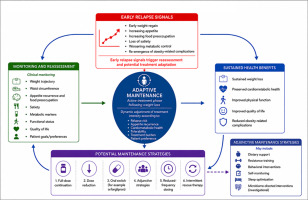
Researchers have published a framework arguing that what happens after incretin-induced weight loss should not come down to a yes-or-no decision about continuing medication. The narrative review, titled "Adaptive maintenance after incretin-induced weight loss: Moving beyond the continue-or-stop paradigm," appears in the journal Obesity Pillars as article 100327 in Volume 20 [2].
The authors — F.H. van Bruggen, M.A. Damhof and E.N. van Roon — write that GLP-1 receptor agonists and dual GLP-1/GIP receptor agonists have transformed obesity treatment, but that weight regain after dose reduction or discontinuation "remains a major clinical challenge" [2]. Their central reframing: regain after treatment may reflect "the re-emergence of biological pressures favouring weight restoration rather than treatment failure" [1].
What the paper actually did
This is a perspective piece, not a new trial. The authors say they reviewed evidence from randomized withdrawal and maintenance trials of incretin-based obesity medications, along with emerging pharmacological, behavioral and monitoring strategies, using targeted PubMed searches and reference-list screening [1]. From that, they built a conceptual framework rather than a treatment protocol.
Their bottom line on the evidence as it stands: among drug strategies after incretin-induced weight loss, continued obesity medication "currently has the strongest direct evidence for limiting weight regain" [2]. But they add two qualifiers that matter — maintenance requirements vary substantially between individuals, and some patients may keep clinically meaningful weight reduction without continued medication [1].
The options the authors list for study are continued obesity medication, monitored dose reduction with predefined re-escalation criteria, oral switching, reduced-frequency dosing, intermittent rescue therapy, and structured lifestyle support [2]. Note that the abstract lists six items, including the lifestyle component alongside the five medication-related approaches.
The paper also proposes watching for relapse before the scale moves. Early changes in appetite, satiety, food preoccupation, weight trajectory, waist circumference and cardiometabolic markers may help flag emerging relapse before substantial regain occurs — though the authors state plainly that these approaches "require prospective validation" [1]. A figure in the paper describes an "active maintenance phase" with structured monitoring of those measures plus functional status, quality of life and patient goals, with early relapse signals prompting reassessment and possible adjustment of treatment intensity [1].
The stated goal of the framework is to find "the minimum effective maintenance intensity that preserves clinically meaningful health benefit while accounting for relapse risk, treatment burden, and patient preferences" [2]. The authors caution that the framework is conceptual and that the proposed monitoring thresholds and treatment pathways are not yet validated [1].
Why it matters for patients
Many people on semaglutide (Ozempic, Wegovy, Rybelsus) or tirzepatide (Mounjaro, Zepbound) eventually face a decision point once weight loss levels off — driven by cost, insurance changes, side effects, supply or simply preference. Until now, published guidance has largely framed that decision as continue or stop. This paper is an argument that there is a middle territory that clinicians and patients are already improvising in, without evidence to guide it.
The practical caveat is important: none of the middle options — lower dose with rules for going back up, switching to an oral agent, longer intervals between shots, or using medication only intermittently as rescue — has direct trial evidence behind it in this review. Continued medication is the strategy the authors say has the strongest support [2]. So a patient reading about "dose reduction" or "intermittent dosing" is reading about hypotheses the authors want tested, not established practice.
The monitoring idea may be the most immediately relatable part. If changes in hunger, fullness or how much a person thinks about food show up before pounds return, that could give earlier warning than a monthly weigh-in. But the paper does not provide thresholds, timelines or validated questionnaires, and says validation studies are still needed [1].
What happens next
The article is scheduled in the December 2026 volume of Obesity Pillars, published by Elsevier on behalf of the Obesity Medicine Association, and is open access under a Creative Commons license [2]. The authors report no conflicts of interest [1].
What is not yet known from these sources: whether any trials of the five proposed drug strategies are underway, how long the maintenance phase should be monitored, or which patients are most likely to hold weight loss without medication. The review's references include the STEP 1 trial extension on regain after semaglutide withdrawal and the JAMA analysis of continued weekly semaglutide for maintenance, but the abstract does not report figures from either [1].
Sources
Semaglutides.org is for information only and is not medical advice. Always talk to a licensed healthcare provider about your own care. Some links to telehealth services are affiliate links, labeled where they appear.