Review finds no evidence for a best day of the week to take semaglutide or tirzepatide
The review found no head-to-head research on whether a particular injection day improves results, so the choice rests on routine and staying on treatment rather than on timing.
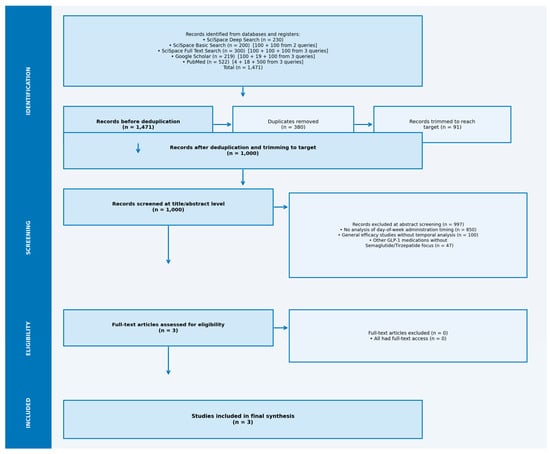
A systematic review published August 10, 2026, in the journal Medicina found no evidence that any specific day of the week is better than another for weekly semaglutide or tirzepatide injections [1].
The authors, Sandro La Vignera and Rosita A. Condorelli at the University of Catania in Italy, followed PRISMA 2020 guidelines and searched SciSpace, Google Scholar and PubMed through June 2026 for studies on whether the timing of weekly dosing affects adults with type 2 diabetes or obesity [1]. They identified 1,471 records. After duplicates were removed and the list trimmed, 1,000 unique papers went through abstract and full-text screening. Three studies met the inclusion criteria [1].
Those three were the SUSTAIN 4 randomized controlled trial of once-weekly semaglutide (sold as Ozempic and Wegovy), a retrospective case series that examined alternate-day dosing of oral semaglutide (Rybelsus), and an expert panel discussion about flexible dosing schedules [1]. None of the included studies directly compared one day of the week with another for injectable semaglutide or tirzepatide, the review states. The three studies focused on semaglutide; no day-of-week comparison for tirzepatide was found [1].
The review's conclusion is blunt: "Current evidence does not support a specific optimal day of the week for semaglutide or tirzepatide administration" [1]. It adds that the limited literature emphasizes flexible dosing schedules tailored to individual patient preferences and lifestyles in order to maximize adherence [1]. That suggestion, the authors write, "derives primarily from indirect evidence and expert opinion rather than direct comparative clinical studies" [1].
The review also leaves several questions open. It says direct comparative data on day-of-week effects are absent, so there is no evidence that timing changes blood sugar control, weight loss, tolerability or how long patients stay on treatment [1]. The authors call for future prospective studies to test whether administration timing influences outcomes in real-world settings [1].
Why it matters for patients
Semaglutide and tirzepatide are taken once a week, which makes the choice of day feel consequential to people who use them. This review found no published head-to-head evidence that one day produces better results than another — and, by the same token, no evidence that a particular day is worse [1].
Adherence is the outcome the review can speak to, and only indirectly. It reports that flexible scheduling tied to a patient's own routine may help people stay on treatment without hurting glycemic control, but that this comes mainly from expert opinion and indirect evidence rather than from studies built to test the question [1].
The review does not address what to do about a missed dose, or whether switching days mid-treatment is safe or effective; those questions were not among the outcomes any included study could answer [1]. It also does not cover other GLP-1 medications or other dosing intervals. Anyone weighing a change in schedule has no comparative data here to rely on, and the review does not offer one.
What happens next
The review's stated next step is prospective research that would systematically evaluate whether administration timing affects clinical outcomes outside of controlled trial settings [1]. No specific study, sponsor or start date has been disclosed.
The article itself moved through the journal quickly: submitted June 15, 2026, revised August 1, accepted August 4, and published August 10 [1]. It appears in a special issue of Medicina on diabetes and obesity care [1]. Whether any group is now recruiting for the kind of timing study the authors call for has not been reported.
Sources
Semaglutides.org provides information only, not medical advice. Talk to a licensed provider about your own care before making changes. Some telehealth links are affiliate links and are labeled where they appear.