Post hoc analysis examines orforglipron in adults 65 and older
A new subgroup analysis of two orforglipron obesity trials found weight loss in adults 65 and older was similar to younger participants, though the data are early and not designed to prove effects in this age group specifically.[1]
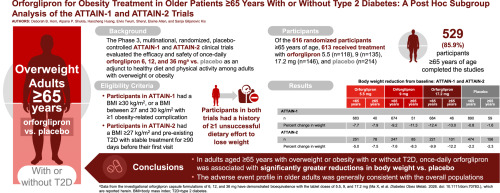
A post hoc subgroup analysis published in Obesity Pillars examined how orforglipron, an oral GLP-1 receptor agonist sold under the brand name Foundayo, performed in adults aged 65 and older who took part in the Phase 3 ATTAIN-1 and ATTAIN-2 trials.[1] The analysis found that older participants lost weight at rates broadly similar to younger trial participants, and that side effects were also similar across age groups.[1]
ATTAIN-1 tested orforglipron in people with obesity, while ATTAIN-2 tested it in people with obesity and type 2 diabetes.[1] Across both trials, 616 randomized participants were 65 or older, and 613 of them received treatment: 118 on the 5.5 mg dose, 135 on 9 mg, 146 on 17.2 mg, and 214 on placebo.[1]
At week 72 in ATTAIN-1, participants 65 and older lost an average of 7.9% of body weight on the 5.5 mg dose, 11.3% on 9 mg, and 13.0% on 17.2 mg, compared with a 1.6% loss on placebo, with all differences statistically significant.[1] In ATTAIN-2, the pattern was similar: 7.5%, 8.3%, and 12.2% weight loss across the three doses, versus 2.3% on placebo, again with all differences statistically significant.[1] The authors report these results were comparable to what was seen in participants under 65.[1]
Safety findings were also consistent across age groups and with the overall results from the two trials.[1] Gastrointestinal side effects were the most common adverse events with orforglipron and were generally mild to moderate in severity.[1]
Why it matters for patients
Older adults have been underrepresented in obesity drug trials, even though this group faces particular concerns with weight-loss medications, including loss of lean muscle mass and fracture risk.[1] The study's authors note that limited research exists on incretin-based medications, the drug class that includes GLP-1 receptor agonists, specifically in older adults with obesity.[1]
The authors also point out that some oral weight-loss options require fasting before dosing, and that needle-based injectable drugs may be unappealing to some older patients, both of which can limit choices for this age group.[1] Orforglipron is a small-molecule, non-peptide oral GLP-1 receptor agonist, a formulation different from injectable semaglutide (Ozempic, Wegovy) or tirzepatide (Mounjaro, Zepbound).[1]
For patients 65 and older considering obesity treatment, this analysis offers early evidence that orforglipron's weight-loss effect and side-effect pattern do not appear to differ dramatically by age in these two trials.[1] However, this was a post hoc subgroup analysis, meaning the comparison was not one of the trials' original, statistically powered goals; the researchers looked at it after the fact.[1] That makes the findings hypothesis-generating rather than definitive proof of how the drug performs specifically in older adults.
The analysis did not report on lean mass changes or fracture outcomes specifically for the 65-and-older subgroup, so it is not yet known from this publication how orforglipron affects those particular concerns in older patients.
What happens next
ATTAIN-1 (NCT05869903) and ATTAIN-2 (NCT05872620) remain the source trials for this analysis.[1] Because this was a subgroup look rather than a purpose-built study of older adults, further dedicated research would be needed to confirm these findings and to examine outcomes like muscle loss and fracture risk that matter most for this age group.
Sources
Semaglutides.org is for information only and is not medical advice. Always talk to a licensed healthcare provider about your own care. Some links to telehealth services are affiliate links, labeled where they appear.