Retatrutide cut sleep apnea severity by up to 24 AHI events per hour in Phase 3 trials
Two Phase 3 trials found weekly retatrutide lowered the apnea-hypopnea index by up to 24.4 events per hour more than placebo at 80 weeks in adults with sleep apnea and obesity.
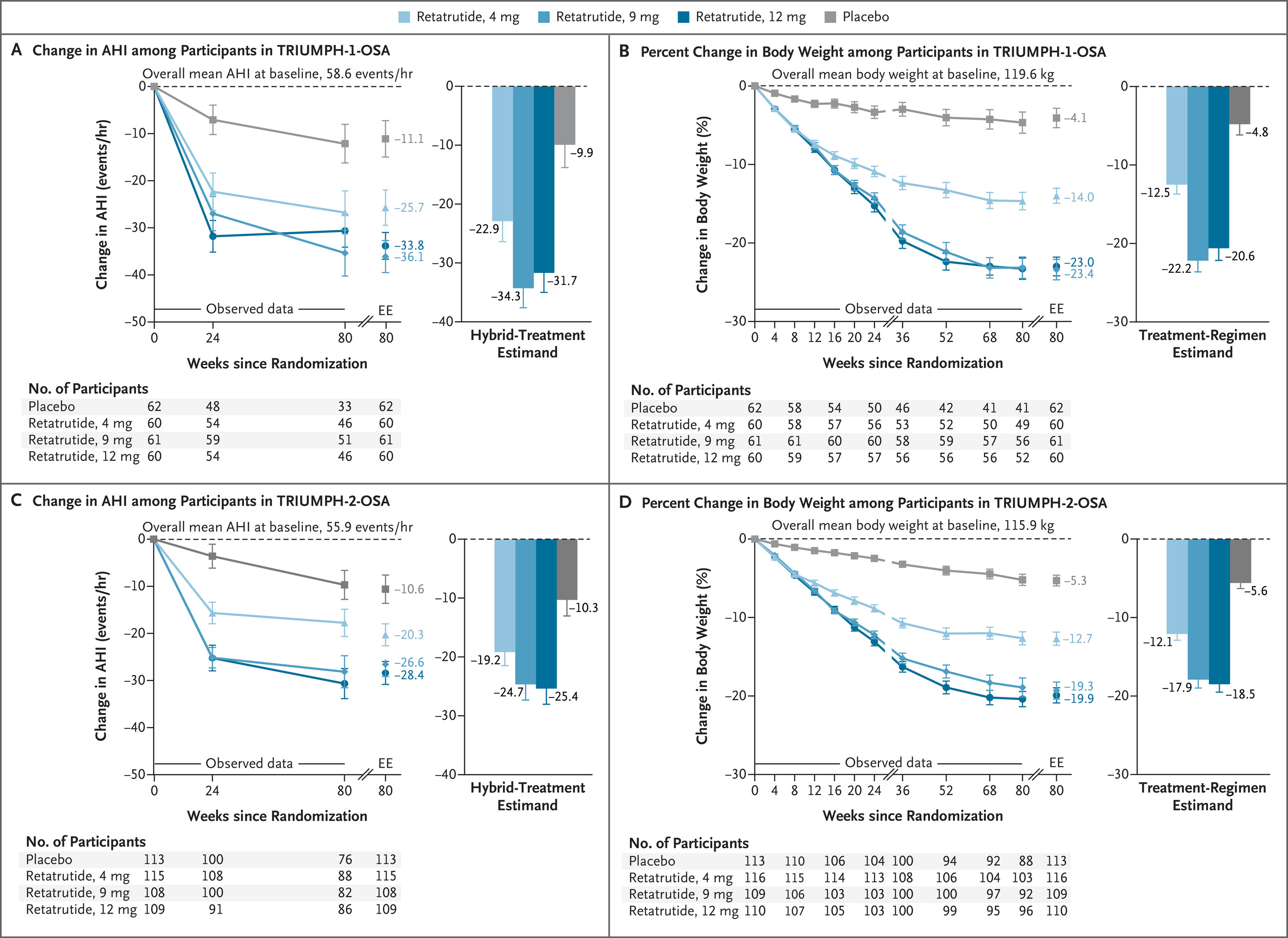
Retatrutide lowered the apnea-hypopnea index (AHI) by as much as 24.4 events per hour more than placebo after 80 weeks in adults with moderate-to-severe obstructive sleep apnea and obesity, according to two Phase 3 trials [1]. The results were published online by the New England Journal of Medicine on October 20, 2026 [1]; the journal's notes give the publication date as October 21, 2026, while its article history lists October 20, 2026 [1].
Both trials were double-blind, randomized and placebo-controlled, and were built inside larger basket trials of once-weekly subcutaneous retatrutide [1]. TRIUMPH-1-OSA enrolled 243 adults without type 2 diabetes, and TRIUMPH-2-OSA enrolled 448 adults with type 2 diabetes [1]. Everyone had moderate-to-severe sleep apnea and a body-mass index of at least 27, and was assigned to retatrutide 4 mg, 9 mg or 12 mg, or placebo [1]. At the start, mean AHI was 58.6 events per hour in TRIUMPH-1-OSA and 55.9 in TRIUMPH-2-OSA, and mean body weight was 119.6 kg and 115.9 kg [1]. The main measure was the change in AHI at 80 weeks for the 9 mg and 12 mg doses [1].
In TRIUMPH-1-OSA, mean AHI fell by 34.3 events per hour with 9 mg and 31.7 with 12 mg, compared with 9.9 with placebo. The differences from placebo were −24.4 (95% CI, −34.1 to −14.7) and −21.9 (95% CI, −32.2 to −11.5) events per hour [1]. The 4 mg dose, which was not part of the primary comparison, produced a fall of 22.9 events per hour, a difference of −13.0 (95% CI, −23.0 to −3.0) [1].
In TRIUMPH-2-OSA, which enrolled people with type 2 diabetes, AHI fell by 24.7 events per hour with 9 mg and 25.4 with 12 mg, against 10.3 with placebo. The differences from placebo were −14.4 (95% CI, −21.6 to −7.2) and −15.1 (95% CI, −22.5 to −7.7) [1]. The 4 mg difference was −8.9 (95% CI, −15.9 to −2.0) [1]. The primary analysis used a hybrid-treatment estimand, applying a hypothetical strategy for participants whose care suggested treatment failure and a treatment-policy strategy elsewhere [1]. Under the intention-to-treat analysis, the differences from placebo were slightly smaller: −24.7 and −22.5 events per hour for 9 mg and 12 mg in TRIUMPH-1-OSA, and −13.9 and −15.0 in TRIUMPH-2-OSA [1].
Body weight fell 12.5% to 22.2% with retatrutide in TRIUMPH-1-OSA and 12.1% to 18.5% in TRIUMPH-2-OSA, compared with 4.8% and 5.6% with placebo in the two trials, measured with a treatment-regimen estimand [1]. The most common adverse events were gastrointestinal [1]. Retatrutide is an investigational triple agonist of GIP, GLP-1 and glucagon receptors, and both trials were funded by Eli Lilly, which makes it [1]. The results were also presented at the 28th Congress of the European Sleep Research Society, held October 20–23, 2026 [1]. Endpoints News reported that Lilly's launch of retatrutide in obesity is expected next year [2].
Why it matters for patients
AHI is the average number of times per hour of sleep that breathing pauses or becomes shallow, and it is the measure used to grade how severe obstructive sleep apnea is [1]. Participants in these trials started near 56 to 59 events per hour, and the placebo groups improved by about 10 events per hour over 80 weeks, so the gap between drug and placebo is the part attributed to the drug [1].
Two limits stand out. The reductions were smaller in the trial that enrolled people with type 2 diabetes, roughly 14 to 15 events per hour versus placebo, compared with roughly 22 to 24 in people without diabetes [1]. And every participant had moderate-to-severe apnea with a body-mass index of at least 27, so the results do not describe people with milder apnea or lower body weight [1].
Whether retatrutide reduces daytime sleepiness or other symptoms, whether it changes the need for CPAP or other breathing devices, and whether it lowers heart or metabolic risk over time have not been reported from these trials [1]. Rates of serious adverse events and how many participants stopped treatment because of side effects have not been disclosed [1]. Retatrutide is not approved for sleep apnea or any other use; it remains investigational [1].
What happens next
October 20, 2026: the results were published online by the New England Journal of Medicine and presented at the European Sleep Research Society congress, which runs October 20–23, 2026 [1].
2027: Lilly's launch of retatrutide for obesity is expected next year, according to Endpoints News [2].
Whether Lilly has filed, or plans to file, for a sleep apnea indication has not been disclosed [1][2].
Sources
Semaglutides.org provides information only, not medical advice. Talk to a licensed provider about your own care before making changes. Some telehealth links are affiliate links and are labeled where they appear.