First cryo-EM structures of tirzepatide bound to both incretin receptors
Scientists published the first detailed 3D pictures of how tirzepatide, the drug in Mounjaro and Zepbound, locks onto two different gut hormone receptors, work that helps explain why the medicine acts differently from single-target drugs like semaglutide.[1]
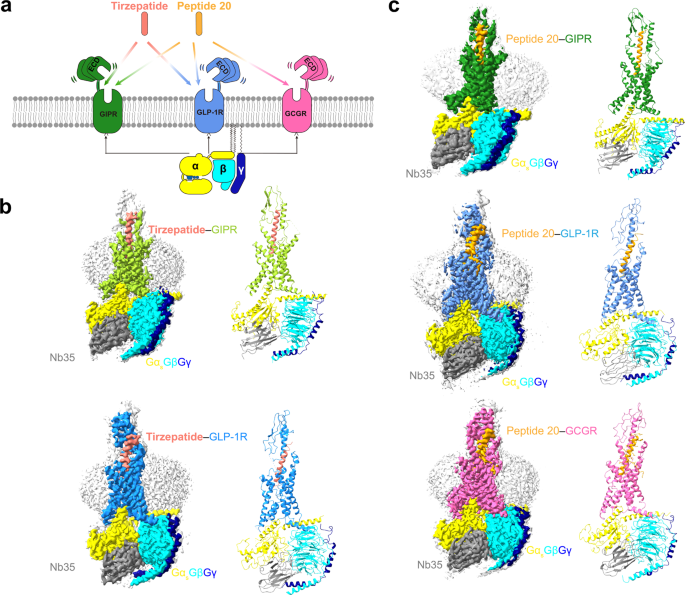
Researchers led by Zhao and colleagues reported the first cryo-electron microscopy structures of tirzepatide bound to its two target receptors, publishing the work in Nature Communications on February 25, 2022.[1] Tirzepatide, sold as Mounjaro and Zepbound, is built to activate both the GIP receptor (GIPR) and the GLP-1 receptor (GLP-1R) at once, rather than targeting only one receptor the way semaglutide (Ozempic, Wegovy, Rybelsus) does.[1]
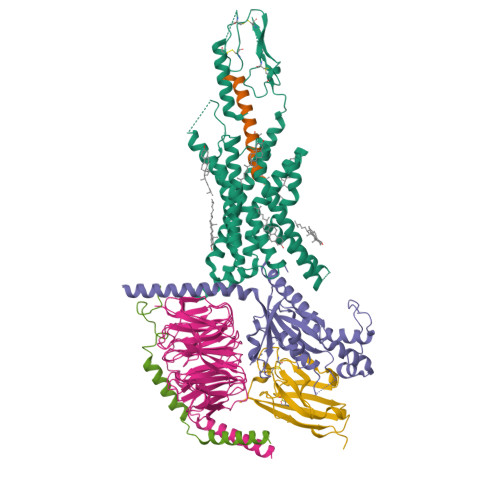
The team solved the structure of tirzepatide bound to the human GIPR paired with its G protein at 3.4 angstrom resolution, deposited in the Protein Data Bank as entry 7FIY, and a matching structure of tirzepatide bound to GLP-1R, deposited as entry 7FIM.[1][2] An angstrom is a unit smaller than a nanometer, and 3.4 angstroms is fine enough to see how individual amino acids in the drug fit into pockets on the receptor surface.[1]
Alongside the tirzepatide structures, the researchers also solved three more structures showing a related experimental peptide called peptide 20 bound to GIPR, GLP-1R, and the glucagon receptor (GCGR).[1] Peptide 20 is a triagonist, meaning it is designed to activate all three receptors, and had completed phase 1 clinical trials at the time of the study.[1] In total the paper reports five cryo-EM structures of these drug-receptor pairs, all captured together with their Gs signaling proteins.[1]
The paper says tirzepatide has shown "a profound therapeutic superiority in reducing blood glucose and body weight" compared with semaglutide and dulaglutide in head-to-head clinical trials, citing earlier published trial data.[1] The researchers write that their structural work aims to explain the molecular basis for that difference by showing exactly how the drug engages each receptor.[1] They also note that in animal studies, activating the glucagon receptor alongside GIP and GLP-1 receptors reduced body weight, lowered fasting blood glucose, decreased HbA1c, and protected pancreatic islet tissue in a diabetic rat model, and the authors state that retaining glucagon receptor activity is what allows drugs like peptide 20 to outperform GLP-1 medicines used alone.[1]
Why it matters for patients
This study is basic laboratory science, not a clinical trial, and it does not change how tirzepatide is prescribed or dosed. But structural biology like this helps explain, at the molecular level, why a dual-target drug such as tirzepatide can produce different effects on blood sugar and weight than a single-target drug such as semaglutide, an idea that has been discussed based on clinical trial results but had not been shown this directly at the atomic level before.[1]
For people already taking Mounjaro or Zepbound, or considering them, the findings do not add new safety information and are not a reason to change a treatment plan. The practical value is mostly for future drug design: understanding precisely how tirzepatide grips GIPR and GLP-1R gives chemists a blueprint for designing next-generation molecules, including multi-target peptides like peptide 20, that might fine-tune effects on weight, blood sugar, or side effects.[1]
What happens next
The paper does not describe specific new clinical trials tied to this structural data. It does note that peptide 20 had already finished phase 1 testing as of publication, and that more than a dozen other multi-target peptides aimed at GIPR, GLP-1R, or GCGR were in clinical development across the field at that time, though the sources do not give updated status on those programs.[1] Whether these structural insights lead to new approved drugs is not yet known from the sources provided.
Images from the sources
Sources
Semaglutides.org is for information only and is not medical advice. Always talk to a licensed healthcare provider about your own care. Some links to telehealth services are affiliate links, labeled where they appear.