STEP-HFpEF published: semaglutide eases heart failure symptoms
A 529-person trial found semaglutide 2.4 mg improved heart failure symptoms, walking distance and weight more than placebo in people with obesity and preserved-ejection-fraction heart failure [1].
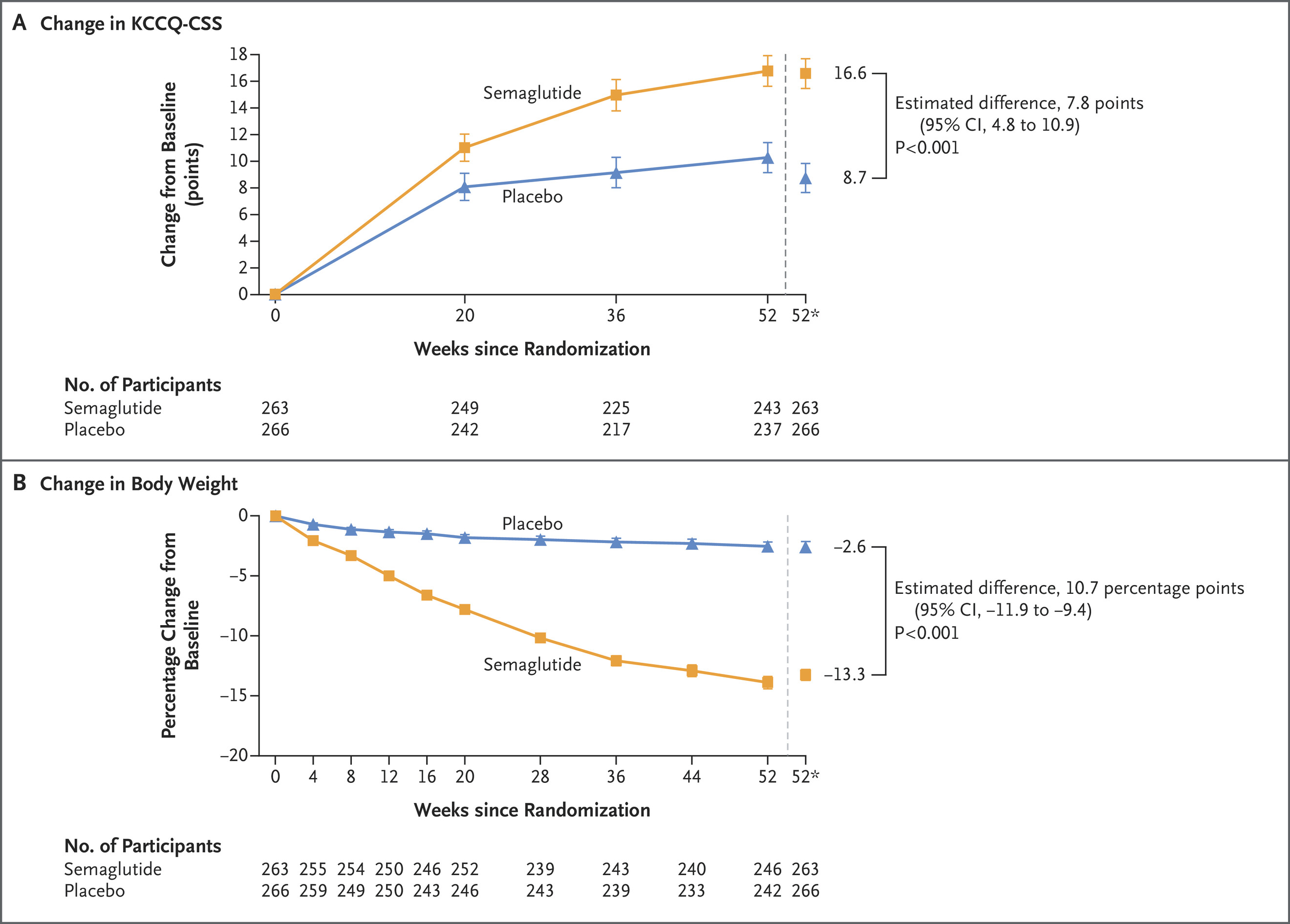
The New England Journal of Medicine published the STEP-HFpEF trial on August 25, 2023, reporting that once-weekly semaglutide 2.4 mg — the dose sold as Wegovy for weight management — produced larger improvements in heart failure symptoms, physical limitations and exercise capacity, plus more weight loss, than placebo in people with obesity and heart failure with preserved ejection fraction (HFpEF) [1][2].
HFpEF is a form of heart failure in which the heart muscle pumps normally, or close to it, but doesn't fill properly. It accounts for more than half of all heart failure cases in the United States and is becoming more common [1]. Most people with the condition have overweight or obesity, and researchers increasingly view excess body fat as part of the disease process rather than a coincidence [1]. Before this trial, no therapy had been approved specifically for obesity-related HFpEF [1][2].
What the trial measured
Investigators randomly assigned 529 patients at 96 sites in 13 countries across Asia, Europe, and North and South America to semaglutide 2.4 mg once weekly or placebo for 52 weeks [1]. Participants had to have a left ventricular ejection fraction of at least 45%, a body mass index of 30 or higher, NYHA class II, III or IV symptoms, a Kansas City Cardiomyopathy Questionnaire clinical summary score (KCCQ-CSS) below 90, and a 6-minute walk distance of at least 100 meters [1]. People with diabetes were excluded, as were people whose weight had shifted more than 5 kg in the 90 days before screening [1]. Dosing started at 0.25 mg weekly and stepped up every four weeks, aiming to reach 2.4 mg by week 16 [1].
The two co-primary endpoints were change in KCCQ-CSS (a 23-item questionnaire scored 0 to 100, where higher means fewer symptoms and physical limitations) and percent change in body weight [1].
The numbers
KCCQ-CSS rose 16.6 points with semaglutide versus 8.7 points with placebo — an estimated difference of 7.8 points (95% CI, 4.8 to 10.9; P<0.001) [1][2]. Body weight fell 13.3% with semaglutide versus 2.6% with placebo, a difference of 10.7 percentage points (95% CI, −11.9 to −9.4; P<0.001) [1][2].
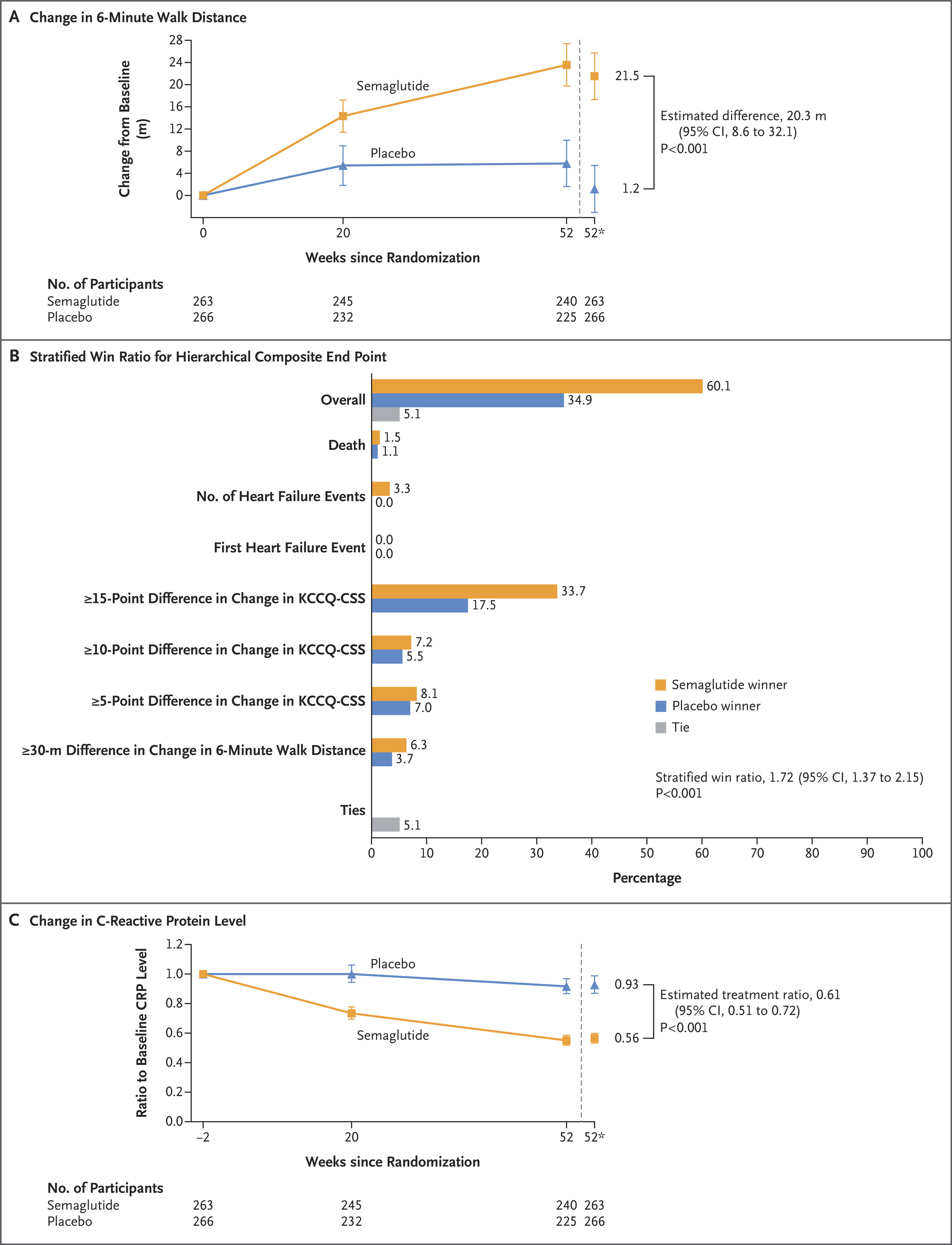
Among the confirmatory secondary endpoints, 6-minute walk distance improved by 21.5 meters with semaglutide and 1.2 meters with placebo (difference, 20.3 m; 95% CI, 8.6 to 32.1; P<0.001) [1][2]. A hierarchical composite endpoint that ranked death, heart failure events, KCCQ-CSS changes and walk-distance changes favored semaglutide, with a win ratio of 1.72 (95% CI, 1.37 to 2.15; P<0.001) [1][2]. C-reactive protein, a marker of inflammation, dropped 43.5% with semaglutide versus 7.3% with placebo (treatment ratio, 0.61; 95% CI, 0.51 to 0.72; P<0.001) [1][2].
Serious adverse events were reported in 35 participants (13.3%) taking semaglutide and 71 (26.7%) taking placebo [1][2]. The trial was funded by Novo Nordisk, which makes semaglutide; the sponsor took responsibility for trial conduct, data collection and statistical analysis, and results for the primary and confirmatory secondary endpoints were validated by a sponsor-independent statistician [1]. The trial is registered as NCT04788511 [1][2].
Why it matters for patients
For people living with obesity-related HFpEF, the day-to-day problem is usually breathlessness, fatigue and not being able to do much without stopping. STEP-HFpEF measured exactly that, using a validated symptom questionnaire and a walking test rather than only lab values [1]. The improvement of 7.8 points on the KCCQ-CSS over placebo was larger than the 4.1-point difference the trial was designed to detect [1].
There are limits worth knowing. The trial ran 52 weeks, so longer-term effects are not addressed here [1]. People with diabetes were excluded, so these results do not describe that group [1]. The trial was not sized to show whether semaglutide prevents deaths or heart failure hospitalizations on its own; those events were folded into a composite ranking rather than tested separately [1]. And publication of a trial is not regulatory approval — as of this report, no therapy had been approved for obesity-related HFpEF [1][2].
What happens next
The results were published August 25, 2023 [1][2]. Whether regulators will add an HFpEF indication, and how guideline writers will treat these findings, is not addressed in the published trial report. Any decision about heart failure treatment is one to discuss with a clinician.
Images from the sources
Sources
Semaglutides.org is for information only and is not medical advice. Always talk to a licensed healthcare provider about your own care. Some links to telehealth services are affiliate links, labeled where they appear.