Lasker Award honors the GLP-1 discovery
Three scientists behind GLP-1 medicines won the 2024 Lasker~DeBakey Clinical Medical Research Award, a reminder that today's weight-loss drugs rest on 40 years of basic research.
The Lasker Foundation awarded its 2024 Lasker~DeBakey Clinical Medical Research Award to three scientists for "the discovery and development of GLP-1-based drugs that have revolutionized the treatment of obesity" [1]. The winners are Joel Habener of Massachusetts General Hospital, Svetlana Mojsov of The Rockefeller University, and Lotte Bjerre Knudsen of Novo Nordisk [1][2].
Habener and Mojsov were honored for working out the physiologically active form of the gut hormone GLP-1, and Knudsen for turning that hormone into long-acting medicines [1].
How the science unfolded
In 1982, Habener reported that the anglerfish glucagon gene encodes a precursor protein containing glucagon plus a second, glucagon-like peptide [1]. The next year, Graeme Bell found a similar peptide in hamsters and named it glucagon-like peptide-1 [1]. Mojsov, a chemist trained by Nobel laureate Bruce Merrifield, developed a synthesis method that avoided strong acids and produced peptides of unusually high purity [1]. She proposed that the real hormone was not the predicted 37-amino-acid chain but a shorter version starting at position 7 [1][2].
In 1986, Mojsov, Habener and collaborators reported that this shorter peptide, GLP-1 (7-37), exists in nature and in the intestine [1]. In 1987, working with Gordon Weir of the Joslin Diabetes Center, they showed that tiny amounts of pure GLP-1 (7-37) triggered insulin release from isolated rat pancreases, while the longer form stayed inert even at 10,000-fold higher concentrations [1]. A 1992 human study with David Nathan showed GLP-1 prompted insulin release and lowered blood glucose, drawing in companies including Novo Nordisk, AstraZeneca, Eli Lilly and GSK [1].
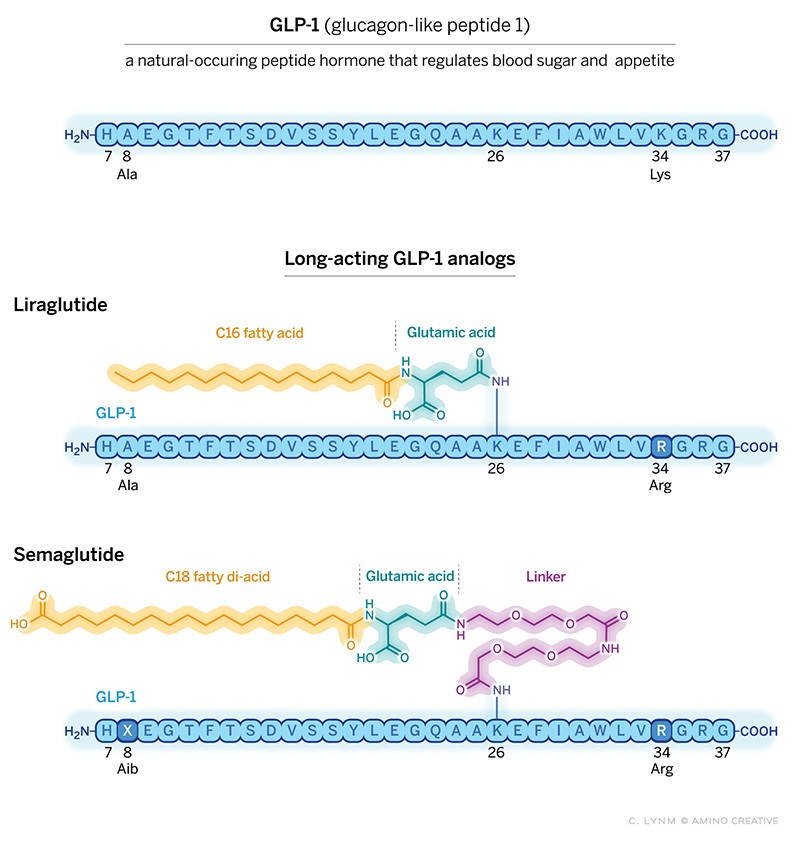
The obstacle was speed of breakdown: natural GLP-1 has a half-life of about 1.5 minutes given intravenously and about 1.5 hours under the skin, chewed up by the enzyme DPP-4 and cleared by the kidneys [1][2]. Knudsen's team attached fatty acids so the peptide would bind albumin, a blood protein that shields it from degradation [1]. That produced liraglutide, whose half-life after injection under the skin ran 13 hours instead of 1.2 [1]. Liraglutide was approved by the European Medicines Agency in 2009 for type 2 diabetes and by the FDA the next year (Victoza), after a 2010 trial in 1,300 people with type 2 diabetes [1].
For weight, a key study in people with obesity or overweight and without diabetes found an average loss of more than 12 pounds over a year, with more than a third losing at least 5% of body weight and almost a quarter losing more than 10% [1]. FDA and EMA approved it for obesity in 2014 and 2015 as Saxenda, the first GLP-1 drug cleared for that use [1].
A team led by chemists Jesper Lau and Thomas Kruse then screened about 4,000 compounds to find one with a half-life of 165 hours. They named it semaglutide [1].
Why it matters for patients
The prize does not change prices, supply, insurance coverage or labeling. What it does is make plain why these drugs work the way they do. The weekly versus daily dosing difference between semaglutide and liraglutide traces directly to chemistry: fatty-acid attachments that bind albumin, plus an amino acid swap that resists DPP-4 [1]. It also explains why injections came before pills and why early GLP-1 infusions failed as therapy [2].
The Lasker citation frames the stakes bluntly: almost 900 million adults worldwide live with obesity, as many as 40% of US adults and close to 25% in Europe, and previous attempts at safe, effective weight-loss drugs "have fallen short" [1].
What happens next
The award recognizes three people, but both accounts name many others in the GLP-1 story, including Bell, Daniel Drucker, Jens Holst and Stephen Bloom [1][2]. Exenatide, derived from lizard venom, was the first GLP-1 receptor agonist approved, in 2005 [2]. Whether this recognition leads to other honors is not addressed in these sources. The Lasker announcement was published in September 2024, with commentary in the Journal of Clinical Investigation on September 19, 2024 [2].
Sources
Semaglutides.org is for information only and is not medical advice. Always talk to a licensed healthcare provider about your own care. Some links to telehealth services are affiliate links, labeled where they appear.