Tennessee officials seize more than 300 counterfeit GLP-1 vials
Investigators in West Tennessee seized more than 300 vials of fake semaglutide and tirzepatide sold for about a tenth of brand-name prices, a reminder that cheap online and med-spa vials may not contain the drug at all.
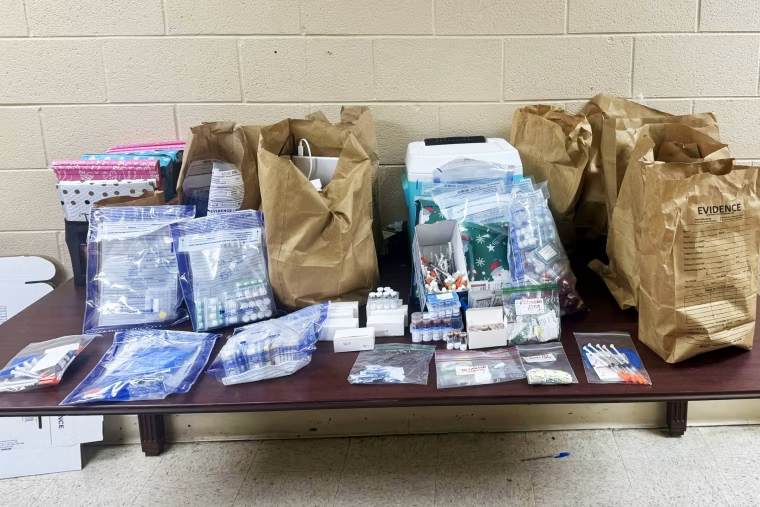
Law enforcement in West Tennessee seized more than 300 vials of counterfeit weight-loss injections from a home in Medina, Tennessee, after a months-long investigation that began with a tip about unusually cheap "Ozempic" being sold locally [1]. Testing of one seized sample by Eli Lilly found only water, according to the case details reported in December 2024 [1].
The first tip reached the West Tennessee Drug Task Force about two months before the December 17, 2024 report [1]. The tipster suspected the products couldn't be legitimate because of the prices: a 10-milligram vial of semaglutide — the active ingredient in Ozempic and Wegovy — sold for about $100, and a 15 mg vial went for $140 [1]. Novo Nordisk's brand-name versions sell for around $1,000 for a month's supply [1].
Officials said they raided the home of Emily Arnold, 41, and found more than 300 vials of counterfeit semaglutide and tirzepatide — the ingredient in Eli Lilly's Zepbound and Mounjaro — along with other drugs used for weight loss [1]. Syringes, alcohol preps, mailers and other materials were also confiscated [1]. "We stumbled into one room that was set up, sort of like a lab," said Johnie Carter, director of the West Tennessee Drug Task Force. "We even found three packages that were already packaged up and ready to go." He called the scene "very shocking" [1].
Investigators said Arnold had allegedly also been supplying the products to two med spa clinics in the state [1]. Some people who used the counterfeit drugs reported rashes and other pain from the injections, officials said [1]. Arnold has been charged with four felonies and a misdemeanor, including impersonating a licensed professional; her attorney said she will plead not guilty [1].
Counterfeit is not the same as compounded
The distinction matters, because the two words often get blurred in online marketing. Counterfeit versions of Wegovy or Zepbound are different from compounded weight-loss drugs [1]. Compounding is a legitimate practice monitored by the Food and Drug Administration, in which a licensed pharmacist makes what is essentially a copy of a medication, usually under a doctor's prescription [1].
At the time of the seizure, the FDA was allowing pharmacies to dispense compounded versions of semaglutide and tirzepatide until shortages of the brand-name drugs were fully resolved [1]. In October 2024, the agency said compounding pharmacies could continue making their own versions after a compounding trade group sued over the shortage designation [1].
Counterfeits, by contrast, sit entirely outside that system. Nothing about the vials in the Tennessee case came from a licensed pharmacy, and the product in at least one of them was reported to be plain water [1].
Why it matters for patients
The practical risk runs in two directions. A vial that contains nothing but water delivers no medicine at all — a person could inject weekly for months, see no benefit, and have no idea why [1]. A vial that contains something else entirely carries a different risk, and the rashes and injection pain reported by some users in this case suggest the contents were not sterile, properly formulated, or both [1].
Price is the clearest warning sign in the reported facts. Roughly $100 for a 10 mg vial against about $1,000 a month for the brand-name product is a gap of about tenfold [1]. That gap is what prompted the original tip to law enforcement [1].
The med spa angle is also worth noting. Two clinics in the state were allegedly supplied by this seller, meaning at least some buyers may have believed they were getting the injections in a clinical setting from a legitimate supply chain [1].
What is not yet known from the available reporting: how many of the 300-plus vials were tested, what the other vials contained, how many people received doses, or how many reported side effects. The case had not been resolved as of the December 2024 report [1].
What happens next
- October 2024: FDA said compounding pharmacies could continue producing their own tirzepatide after a trade group lawsuit [1].
- December 2024: Arnold's home raided; more than 300 counterfeit vials seized; four felony charges and one misdemeanor filed [1].
- Pending: Her attorney said she will plead not guilty; no trial date was reported [1].
As demand for these medicines grows, experts and public health officials warn that low-cost counterfeit versions are becoming increasingly common in the U.S. [1].
Sources
Semaglutides.org is for information only and is not medical advice. Always talk to a licensed healthcare provider about your own care. Some links to telehealth services are affiliate links, labeled where they appear.