GIP receptor blockade shown to work through a different pathway than activation
A mouse study in Nature Metabolism reports that blocking the GIP receptor cuts weight only when GLP-1 receptors are intact, while activating it does not — a clue to how two opposite drug strategies both work [1].
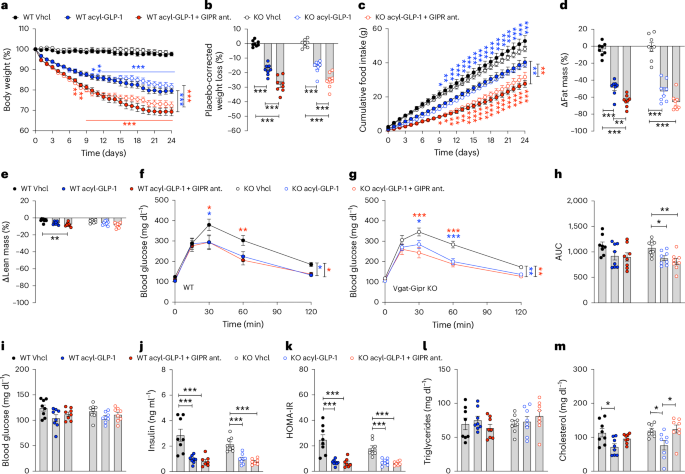
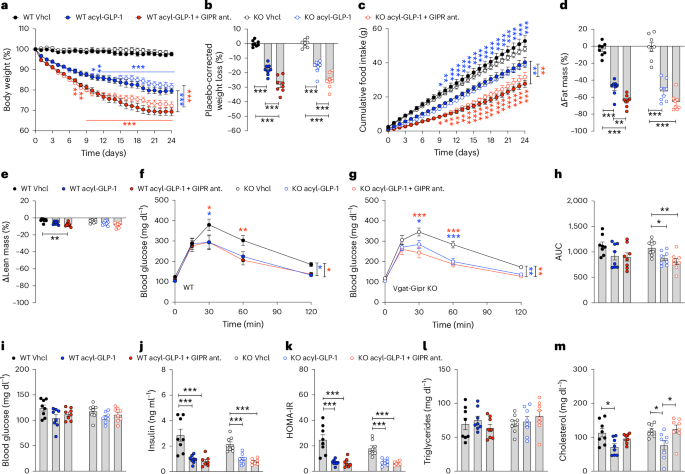
Researchers reported in Nature Metabolism on April 29, 2025 that two opposite ways of targeting the GIP receptor — turning it on and blocking it — both reduce body weight in male mice, but through different biological routes [1]. Blocking the receptor stopped working in mice that lacked the GLP-1 receptor, while activating it did not depend on GLP-1 receptor signaling [1].
The question matters because the GIP receptor sits at the center of a confusing area of obesity drug development. Tirzepatide (Mounjaro, Zepbound) is a dual agonist that activates both the GIP receptor and the GLP-1 receptor, and co-agonism at these two receptors is described in the paper as a highly effective strategy for obesity and type 2 diabetes [1]. Yet GIP receptor antagonists — drugs that block the same receptor — also lower body weight and food intake in diet-induced obese mice and in non-human primates, especially when combined with a GLP-1 receptor agonist [1]. Both directions appear to work, and until now it was unclear whether they used the same machinery.
What the experiments showed
The team tested a GIP receptor antagonist in several strains of genetically modified male mice. The weight and food intake effects disappeared in mice with global loss of either the GIP receptor gene (Gipr) or the GLP-1 receptor gene (Glp-1r) [1]. But the effects were preserved in mice that lost Gipr only in GABAergic neurons of the central nervous system, and in mice that lost Gipr in peripherin-expressing neurons of the peripheral nervous system [1].
That is close to the mirror image of what earlier work found for GIP receptor activation. The authors note that long-acting GIP receptor agonists keep working in Glp-1r-deficient mice, and that their weight-lowering effect is lost when Gipr is deleted in GABAergic neurons [1]. In other words, agonism appears to run through GABAergic GIP receptor neurons and does not need GLP-1 receptor signaling, while antagonism appears to need GLP-1 receptor signaling and does not run through those GABAergic neurons [1].
The researchers also used single-nucleus RNA sequencing to look at gene activity in the dorsal vagal complex, a hindbrain region involved in appetite and nausea. Agonism and antagonism produced opposing effects there, and it was antagonism — not agonism — that closely resembled the pattern produced by GLP-1 receptor signaling [1]. Both GIP receptor blockade and GLP-1 receptor activation also changed genes tied to synaptic plasticity, the process by which connections between neurons are remodeled [1].
The paper's conclusion is narrow but specific: GIP receptor agonism and antagonism reduce body weight by different mechanisms, with antagonism, unlike agonism, depending on functional GLP-1 receptor signaling [1].
Why it matters for patients
This is basic science in genetically engineered mice, not a clinical trial, and the experiments were done in male mice [1]. Nothing here changes how any approved medicine is prescribed or how it performs.
Still, the findings speak to a practical puzzle people taking or considering GLP-1 medicines may encounter in news coverage: how can drug companies pursue both GIP activation and GIP blockade for the same condition? This study offers a mechanistic answer — the two approaches are not simply different doses of the same idea, and they appear to engage different cells and pathways in the brain [1].
The dependence of antagonism on the GLP-1 receptor also suggests that a GIP blocker's weight effect may be tightly linked to GLP-1 biology, which is relevant because GIP antagonists in development are generally paired with GLP-1 receptor agonism [1]. Whether that translates into differences in side effects, durability of weight loss, or who responds best is not addressed by this paper and is not yet known.
The work on synaptic plasticity genes is early-stage. The study does not report what those gene changes mean for behavior, appetite over time, or weight regain, and it does not test human tissue [1].
What happens next
The article was published on April 29, 2025, and a publisher correction to it was issued on May 13, 2025 [1]. The sources provided here do not describe any planned human studies, specific drug candidates in trials, or regulatory timelines tied to these findings. Confirming whether the same split between agonism and antagonism holds in female mice, in other species, and ultimately in people would be the logical next steps, but the paper does not lay out that agenda.
Images from the sources
Sources
Semaglutides.org is for information only and is not medical advice. Always talk to a licensed healthcare provider about your own care. Some links to telehealth services are affiliate links, labeled where they appear.