Nature Metabolism paper maps how semaglutide signals in hindbrain neurons
A new Nature Metabolism study traces semaglutide's brain signaling to a specific chemical messenger in hindbrain neurons, work that could eventually guide drugs with fewer side effects.
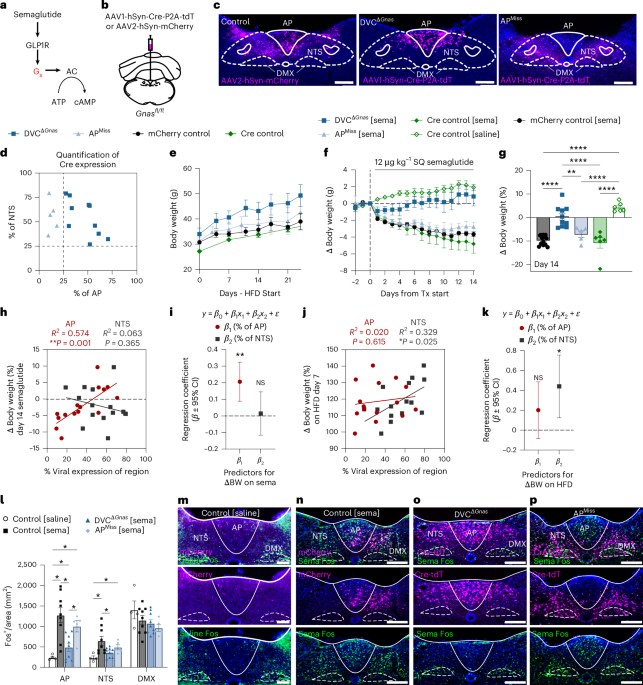
Researchers reporting in Nature Metabolism say they have mapped the intracellular signaling steps semaglutide uses inside brain cells that carry the GLP-1 receptor, finding that the drug raises levels of cyclic adenosine monophosphate (cAMP) in neurons of the area postrema and that blocking this step wipes out semaglutide's weight-loss effect [1].
Semaglutide is the active molecule in Ozempic, Wegovy and Rybelsus. It works by binding the glucagon-like peptide 1 receptor (GLP1R), which scientists have long described as a Gs-coupled G-protein-coupled receptor. But as the authors put it, "the intracellular signalling mechanisms underlying these effects remain poorly defined" [1].
What the study reports
The team focused on Glp1r-expressing neurons in the area postrema, which they call "the primary site of semaglutide action in the brain" [1]. They report that semaglutide engages both Gs- and Gq-dependent signaling in those cells, and that it activates different neuronal clusters to different degrees rather than acting on one uniform population [1].
The cAMP findings are the core of the paper. Semaglutide produced "graded increases" in cAMP in area postrema Glp1r neurons through the Gs pathway, with both transient and sustained components [1]. Blocking phosphodiesterase 4 (PDE4), the enzyme that breaks cAMP down, "enhances and sustains these cAMP responses" [1]. Going the other direction, disrupting Gs or cAMP signaling in these neurons "abolishes semaglutide-induced weight loss and downstream brain-wide activation" [1]. Figure titles indicate that local disruption of Gs signaling in the dorsal vagal complex (DVC) impaired energy balance and semaglutide-induced weight loss, and that cAMP elevation was needed for sustained neuronal activity [1].
The paper also looks downstream. Neurons in the external lateral parabrachial nucleus, labeled after semaglutide exposure, were "rapidly recruited by peripheral semaglutide administration" and were required for both semaglutide-induced weight loss and conditioned taste aversion (CTA), according to the figure descriptions [1]. A separate figure states that Gs and Gq pathways in DVC Glp1r neurons "differentially shape feeding and body weight regulation" [1]. How CTA in this experimental setting maps onto nausea in people is not explained in the material available.
Some details are not public. The article is subscription content, with online access priced at $39.95 for a single purchase [1]. The abstract does not state which species was studied; the genetic and viral tools described, and the paper's citations to rodent work on semaglutide's neural pathways, point to laboratory animals rather than humans [1]. Source data accompany the paper, additional data are available from the corresponding authors on request, and no custom code was used [1].
Why it matters for patients
This is basic science, not a clinical trial. Nothing here changes how semaglutide is prescribed, how it is dosed, or what it does in the body of a person taking it today.
What it may change over time is drug design. The authors frame their work as "providing avenues for improving obesity therapeutics" [1]. If appetite suppression and aversive effects run through partly separable signaling routes — Gs versus Gq, or different neuron clusters in the same brain region — then in principle a future molecule could be tuned to favor one over the other. The paper reports that Gs and Gq pathways shape feeding and body weight differently [1], but it does not claim to have separated weight loss from side effects in any treatment.
The PDE4 result is also a signal for future research rather than practice. Blocking that enzyme amplified and prolonged cAMP responses in the lab [1]. The paper does not report any human testing of that combination, and no safety or efficacy data in people are presented.
What is not yet known
The abstract does not say whether these signaling patterns hold in human tissue, whether they apply to tirzepatide (Mounjaro, Zepbound) or orforglipron (Foundayo), or whether targeting cAMP or PDE4 alongside a GLP-1 drug would be safe. Those questions would require separate studies that have not been reported here.
Sources
Semaglutides.org is for information only and is not medical advice. Always talk to a licensed healthcare provider about your own care. Some links to telehealth services are affiliate links, labeled where they appear.