Lilly raises Lebanon, Indiana, plant investment to $9 billion for tirzepatide
The expanded Indiana plant is meant to make the active ingredient in Zepbound and Mounjaro, but it is not expected to produce medicine until late 2026.
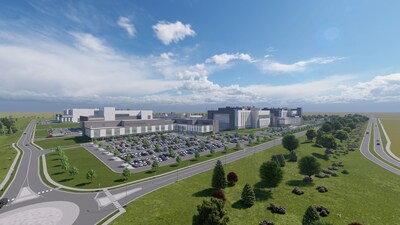
Eli Lilly announced on May 24, 2024 that it will invest an additional $5.3 billion at its Lebanon, Indiana, manufacturing site, raising its total commitment there from $3.7 billion to $9 billion [1]. The site is being built to make active pharmaceutical ingredients (API) for Zepbound (tirzepatide) injection and Mounjaro (tirzepatide) injection [1].
Lilly broke ground at the Lebanon site in 2023 and says it has turned much of the nearly 600-acre complex into an active construction site [1]. The company expects to begin making medicines in Lebanon toward the end of 2026, with operations scaling up through 2028 [1].
The added investment comes with 200 full-time jobs for engineers, scientists, operating personnel and lab technicians, which Lilly says will bring the site to an estimated 900 full-time employees when it is fully operational. The company also projects more than 5,000 construction jobs during the site's development [1].
Lilly's chair and chief executive, David A. Ricks, called the Lebanon project "the largest manufacturing investment in our company's history" and said it will make "our latest medicines, including Zepbound and Mounjaro" while supporting pipeline growth [1]. Edgardo Hernandez, president of Lilly Manufacturing Operations, said the company's commitment extends to education and training partnerships [1].
The Lebanon site sits within Indiana's LEAP Research and Innovation District. Indiana will partner on road improvements, water, electric and other utilities, along with workforce development commitments and economic incentives tied to Lilly hitting its investment and employment targets, according to the announcement. The state's support includes contributing land, pending approval, for a learning and training center within the larger development [1].
Lilly said total manufacturing commitments since 2020 now exceed $18 billion. That figure includes more than $16 billion for new sites in the United States and Europe — among them Research Triangle Park and Concord, North Carolina; Limerick, Ireland; and Alzey, Germany — plus $1.2 billion to update existing Indianapolis facilities and the recent purchase of an injectable manufacturing facility in Pleasant Prairie, Wisconsin, from Nexus Pharmaceuticals [1].
Lilly said it began the manufacturing buildout in 2020, before either product was approved, so that it could supply the medicines once Mounjaro was cleared in 2022 and Zepbound in 2023 [1]. Lilly describes Mounjaro and Zepbound as the only approved treatments that activate two incretin hormone receptors, GIP and GLP-1, and says demand for them has been strong [1].
Why it matters for patients
Zepbound and Mounjaro are both tirzepatide, and the substance made at Lebanon is the API — the active ingredient that goes into the finished medicine. Building that capacity in Indiana is a step toward having more of the drug's raw material produced domestically, rather than relying only on plants outside the United States [1].
The timing is the practical catch. Lilly does not expect the Lebanon site to start making medicines until toward the end of 2026, with output building through 2028 [1]. That means any effect on how much tirzepatide is available would come years after this announcement, not immediately.
The announcement does not say how much tirzepatide the expanded site will produce, how the added capacity might affect the supply, availability or list price of Zepbound and Mounjaro, or whether it would change insurance coverage for either drug. Those details have not been disclosed [1]. It also does not address whether people currently taking these medicines will see any change in access or cost.
What happens next
Lilly says the Lebanon campus is expected to begin making medicines toward the end of 2026, with operations scaling up through 2028 [1]. Construction continues on the roughly 600-acre site, and the company expects the facility to employ about 900 full-time workers once it is fully running [1]. Indiana's contribution of land for a learning and training center at the LEAP district is pending approval [1]. No date has been given for the start of API production beyond the end-of-2026 target.
Sources
Semaglutides.org provides information only, not medical advice. Talk to a licensed provider about your own care before making changes. Some telehealth links are affiliate links and are labeled where they appear.