FDA alerts patients and prescribers to overdoses from compounded semaglutide unit-conversion errors
FDA says patients using compounded semaglutide from vials have taken 5 to 20 times their intended dose, with some hospitalized for pancreatitis, gallstones and dehydration.
The U.S. Food and Drug Administration issued an alert on July 26, 2024, warning health care providers, compounders and patients about dosing errors with compounded injectable semaglutide products [3]. The agency said it had received reports of adverse events, some requiring hospitalization, tied to overdoses from products dispensed in multiple-dose vials [1]. FDA sent the alert to its MedWatch subscriber list on July 29 [2].
The errors came from two directions: patients measuring and self-administering the wrong amount, and health care providers miscalculating the dose in the first place [1].
What went wrong
Most of the reports described patients drawing up more than the prescribed dose from a multiple-dose vial. In those cases, patients gave themselves five to 20 times the intended dose of semaglutide [1]. Most reports indicated the patients did not know how to measure the intended dose with a syringe [1].
Many patients who received vials had no experience with self-injection, according to the adverse event reports. FDA said unfamiliarity with pulling medication from a vial into a syringe, combined with confusion between milliliters, milligrams and "units," may have contributed [1].
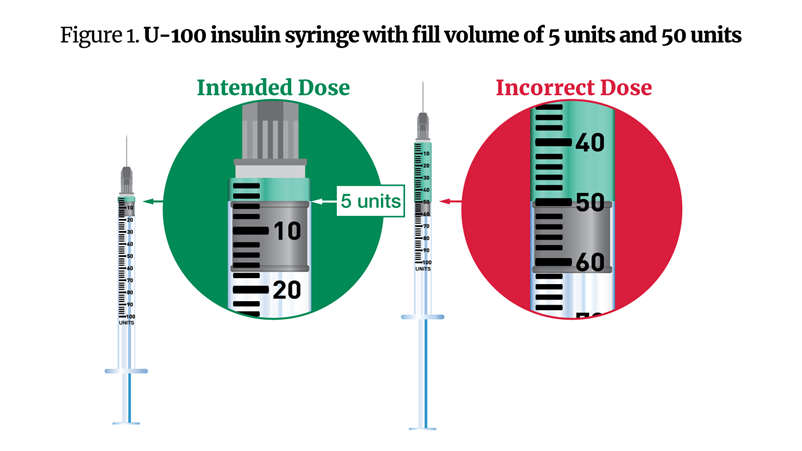
One pattern appeared repeatedly: patients were told to use a U-100 (1 milliliter) insulin syringe to draw a small dose, such as 5 units (0.05 milliliter). Some of those patients drew 50 units instead [1]. In another reported case, a patient could not get clear dosing instructions from the telemedicine provider who wrote the prescription, searched online for advice, and ended up taking five times the intended dose [1].
Providers made conversion errors too, producing doses five to 10 times too high [1]. FDA described three specific examples: one provider meant to prescribe 0.25 milligrams (5 units) but wrote 25 units, and the patient had severe vomiting; another prescribed 20 units instead of 2 units, affecting three patients who got 10 times the intended dose and had nausea and vomiting; and a patient who is himself a health care provider tried to recalculate his own dose in units and gave himself 10 times too much [1][3].
Reported harms included gastrointestinal effects such as nausea, vomiting and abdominal pain, plus fainting, headache, migraine, dehydration, acute pancreatitis and gallstones [1]. FDA did not publish a total number of reports or hospitalizations in the alert.
Why the vials are different
FDA-approved semaglutide injections are dosed in milligrams, come in standard concentrations, and are sold only in pre-filled pens: Wegovy in single-dose pens, Ozempic in multiple-dose pens for one patient [1]. Rybelsus is an oral tablet [1].
Compounded semaglutide is not standardized. FDA said compounders offer it in multiple-dose vials and prefilled syringes, that concentrations vary between compounders, and that a single compounder may sell several different concentrations [1]. Instructions, when provided, may tell users to inject a number of "units" — an amount whose actual volume depends on the concentration — rather than milligrams or milliliters [1]. FDA also said some patients were given syringes much larger than the volume they were supposed to draw [1].
Compounded drugs do not go through FDA premarket review for safety, effectiveness or quality, and the agency said they should be used only when an approved drug cannot meet a patient's needs [1].
Why it matters for patients
The practical difference here is not the molecule; it is the container and the arithmetic. A pen delivers a preset dose. A vial requires the person holding the syringe to convert a prescription into a volume, and FDA's reports show that conversion failing in both directions — at the prescriber's desk and at the kitchen table [1].
Semaglutide also has a half-life of about one week, so an overdose is not something that clears in a few hours. FDA notes that a prolonged period of observation and treatment may be needed [1]. Labeling for approved semaglutide injections describes overdose effects reported with other GLP-1 drugs, including severe nausea, severe vomiting and severe low blood sugar [1].
FDA's stated expectations were that patients talk with their provider or compounder about how to measure and give the intended dose, that compounders supply a syringe sized for that dose and counsel patients on using it, and that prescribers confirm the concentration with the compounder when unsure [1][2].
Poison centers have seen the same pattern. A Washington Poison Center article reports GLP-1 exposure calls nationally rising from about 2,500 in 2022 to 4,700 in 2023 and 8,500 in 2024, with many patients accidentally taking 10-fold overdoses; about half of that center's calls involved compounded semaglutide or tirzepatide dispensed in vials, with dosing in units cited as a source of confusion [4].
Anyone who suspects an overdose can reach a regional poison center at 1-800-222-1222 [4]. FDA asks that dosing errors be reported through MedWatch [1].
Images from the sources
Sources
- https://www.fda.gov/drugs/human-drug-compounding/fda-alerts-health-care-providers-compounders-and-patients-dosing-errors-associated-compounded
- https://content.govdelivery.com/accounts/USFDA/bulletins/3ab6dfa
- https://www.medscape.com/viewarticle/compounded-semaglutide-overdoses-tied-hospitalizations-2024a1000dte
- https://www.wapc.org/insights/glp-1s/
Semaglutides.org is for information only and is not medical advice. Always talk to a licensed healthcare provider about your own care. Some links to telehealth services are affiliate links, labeled where they appear.