Endoscopy meta-analysis finds four-fold higher odds of retained stomach contents
A pooled analysis of 23 studies and 262,018 patients found GLP-1 users were about 4.5 times more likely to have food left in the stomach at endoscopy, but showed no increase in aspiration pneumonia [1].
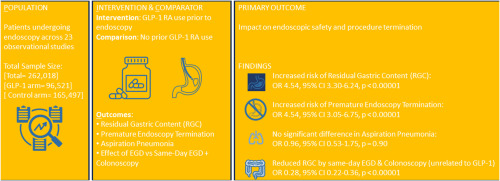
A systematic review and meta-analysis published in Gastrointestinal Endoscopy found that people taking GLP-1 receptor agonists were roughly four and a half times more likely than non-users to have food or fluid still sitting in the stomach when they arrived for a gastrointestinal endoscopy — and just as likely to have the procedure stopped early because of it [1].
The researchers, led by a team including physicians at Weill Cornell, searched PubMed, Scopus, Web of Science and Cochrane Central from database inception through July 1, 2024 (EMBASE from 1974 to June 28, 2024) [1]. The search returned 3,671 records, narrowed to 1,851 after duplicates were removed, with 38 studies reviewed in full text and 23 ultimately included [1]. All 23 were observational studies, together covering 262,018 patients [1]. The protocol was registered with PROSPERO on June 21, 2024 [1].
What the numbers showed
GLP-1 users had significantly higher odds of residual gastric contents (RGC), with an odds ratio of 4.54 (95% confidence interval, 3.30-6.24; P < .00001) [1]. The odds of an endoscopy being terminated prematurely were also elevated, with the same point estimate of 4.54 (95% CI, 3.05-6.75; P < .00001) [1].
The more serious outcome — aspiration pneumonia, which happens when stomach contents enter the lungs — showed no significant difference between users and non-users (OR, 0.96; 95% CI, 0.53-1.75; P = .90) [1]. That is the headline reassurance in an otherwise cautionary paper.
Statistical heterogeneity, a measure of how much the individual studies disagreed with each other, was moderate to high for residual gastric contents (I² = 68%) and for aspiration pneumonia (I² = 70%), but zero for premature termination (I² = 0%) [1]. High heterogeneity means the pooled estimate should be read with some caution.
One practical finding stood out: when an upper endoscopy (EGD) and a colonoscopy were done on the same day, the odds of residual stomach contents dropped sharply compared with EGD alone (OR, 0.28; 95% CI, 0.22-0.36; P < .00001; I² = 0%) [1]. The authors note that patients scheduled for same-day colonoscopy follow a bowel-prep regimen that includes clear liquids, which appears to clear the stomach more completely [1].
The authors point out that the higher RGC rates occurred despite standard fasting protocols, defined in the studies as at least 8 hours without solid food, per the 2017 practice guidelines of the American Society of Anesthesiologists [1]. They tie the finding to the known mechanism of these drugs, which slow gastric motility as part of how they control blood sugar and appetite [1].
Why it matters for patients
Endoscopy with sedation depends on an empty stomach. If food remains, the endoscopist may not be able to see the stomach lining well enough to complete the exam, which can mean the procedure is cut short and rescheduled — a second round of prep, a second day off work, and a second set of costs. The pooled data suggest that outcome is several times more likely for GLP-1 users [1].
At the same time, the analysis did not find a higher rate of aspiration pneumonia, the complication that drove much of the early alarm about these drugs and anesthesia [1]. The study's reference list includes both the American Society of Anesthesiologists' consensus-based guidance and a multisociety statement from liver and GI organizations stating there are no data to support stopping GLP-1 agonists before elective endoscopy — a disagreement between specialty groups that this meta-analysis does not fully resolve [1].
Several things are not answered here. Because every included study was observational, the analysis cannot prove the drugs caused the retained contents rather than some other difference between users and non-users [1]. The abstract does not break results down by individual medication — semaglutide versus tirzepatide, for example — or by dose, duration of use, or diabetes status, so drug-specific risk is not established by this paper [1].
What happens next
The article appeared in the April 2025 issue of Gastrointestinal Endoscopy, Volume 101, Issue 4, pages 762-771.e13, with the DOI issued in December 2024 [1]. One author, Carolyn Newberry, disclosed a consulting relationship with Eli Lilly & Company; the remaining authors reported no financial relationships [1]. Whether professional societies revise their pre-procedure guidance in response is not addressed in the source.
Sources
Semaglutides.org is for information only and is not medical advice. Always talk to a licensed healthcare provider about your own care. Some links to telehealth services are affiliate links, labeled where they appear.