Pfizer wins the $10 billion fight for Metsera
Pfizer will buy obesity drug developer Metsera for up to $86.25 a share after Novo Nordisk dropped out, a deal about experimental drugs that are still years from pharmacy shelves.
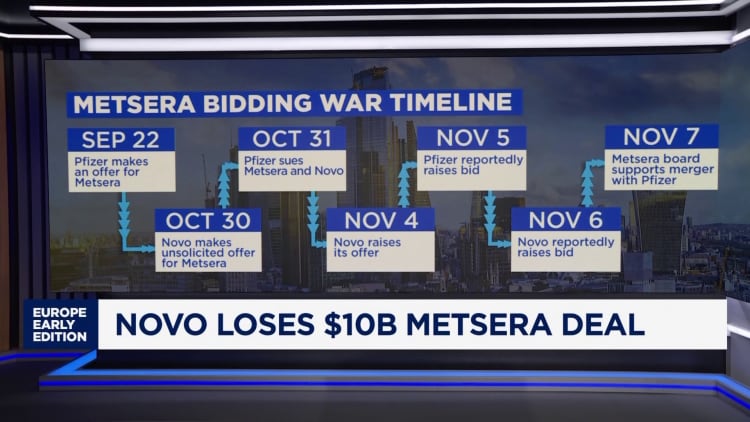
Pfizer has won a two-week bidding war for Metsera, an early-stage obesity drug developer, agreeing late on Friday, Nov. 7, to pay up to $86.25 per share in cash — a deal worth roughly $10 billion [1][4]. Novo Nordisk, maker of Ozempic and Wegovy, said the next day it would not raise its offer and was stepping away [1][4].
The structure matters for how much Pfizer actually pays. Metsera shareholders get $65.60 per share in cash up front, plus a "contingent value right" worth up to $20.65 more per share if specific clinical and regulatory milestones are hit [1][3][4]. Contingent value rights only pay out if the drugs succeed, so the headline $10 billion figure is a ceiling, not a guarantee.
How the fight unfolded
Pfizer first agreed to buy Metsera on Sept. 22 at $47.50 per share up front plus a contingent right of up to $22.50, for total consideration of up to $70.00 per share [6]. Sources describe the size of that first bid differently: BioPharma Dive puts it at $4.9 billion, while Reuters describes a $7.3 billion September offer [1][4]. Either way, the final price is far higher.
Novo Nordisk jumped in on Oct. 30 with an unsolicited counterbid of up to $77.75 per share, about $9.1 billion, using an unusual two-step structure [6]. Novo would have paid roughly $6.5 billion up front for non-voting preferred stock — money that would flow to shareholders as a special dividend before any antitrust review — with the rest paid later, after clearance [6]. Metsera's board called that offer superior three separate times [6].
Then regulators weighed in. The Federal Trade Commission sent a letter to Novo and Metsera saying the proposed deal risked violating U.S. antitrust laws, and later called Metsera to discuss the risks, including that the up-front dividend to shareholders might "never be paid" or could later be "challenged or rescinded" [1][4]. Metsera's board reversed course, saying Novo's proposal carried "unacceptably high legal and regulatory risks" compared with Pfizer's [1][4]. Novo maintains its offer structure was "compliant with antitrust laws" [1][4]. Pfizer had also sued Metsera and Novo, arguing the Danish company was trying to suppress competition by "taking over an American challenger" [4].
Metsera's stock rose nearly 60% from just before Novo's bid through Friday's close, giving it a market value of $8.75 billion [1]. The company went public in January 2025 at $18 a share [4][6].
What Metsera actually has
Metsera's two lead candidates are MET-097i, an injectable GLP-1, and MET-233i, which mimics the pancreatic hormone amylin [1][3]. Both are early-stage and unproven. One analyst, Leerink's David Risinger, projects combined peak sales of $5 billion [1][3]. What sets them apart in early testing is dosing: they might require only monthly injections rather than the weekly shots used with Wegovy and Zepbound [4].
Not everyone thinks the price makes sense. Bernstein analyst Courtney Breen said the $10 billion figure assumes Pfizer can generate $11 billion in revenue from Metsera by 2040, nearly double Metsera's own projections, and pointed to growing skepticism about long-term GLP-1 pricing [1][3].
Why it matters for patients
Nothing about this deal changes what is available at the pharmacy now. Metsera's drugs "remain years from hitting the market," and the company currently loses money with more losses expected while its drugs are in development [1]. No approval dates have been announced in these sources.
The longer-term question is competition. Analysts estimate the obesity drug market could reach $150 billion by early next decade [1][3]. The FTC's objection turned on whether the biggest seller of obesity drugs should be allowed to buy a smaller rival developing competing ones — a concern that is fundamentally about keeping more players in the market. Pfizer, which has stumbled with its own in-house weight-loss research, now gets a route in [1][4].
What happens next
Metsera shareholders vote on the amended Pfizer deal at a meeting on Nov. 13, and the board unanimously recommends approval [1][4]. Pfizer expects to close the merger promptly afterward; the transaction has already received FTC clearance, with early termination of the waiting period effective Oct. 31 [4][6]. When Metsera's drugs might reach late-stage trials or regulatory review is not stated in these sources.
Images from the sources
Sources
- https://www.reuters.com/business/healthcare-pharmaceuticals/pfizer-sweetens-offer-metsera-bidding-war-against-novo-bloomberg-news-reports-2025-11-08/
- https://www.nytimes.com/2025/11/08/business/metsera-pfizer-merger-weight-loss.html
- https://www.cnbc.com/2025/11/08/metsera-accepts-pfizers-10-billion-bid-in-ongoing-ma-battle.html
- https://www.biopharmadive.com/news/metsera-pfizer-accept-offer-novo-ftc-obesity-drugs/805080
- https://www.biopharmadive.com/news/metsera-pfizer-accept-offer-novo-ftc-obesity-drugs/805080/
- https://www.jdsupra.com/legalnews/superior-until-it-was-not-regulatory-9486480
Semaglutides.org is for information only and is not medical advice. Always talk to a licensed healthcare provider about your own care. Some links to telehealth services are affiliate links, labeled where they appear.