OCULUS trial randomizes patients to hold or continue their GLP-1 before endoscopy
A randomized Cleveland Clinic trial found 25% of patients who kept taking their GLP-1 had food left in the stomach at endoscopy, versus 3.1% who skipped a dose — and symptoms didn't predict it.
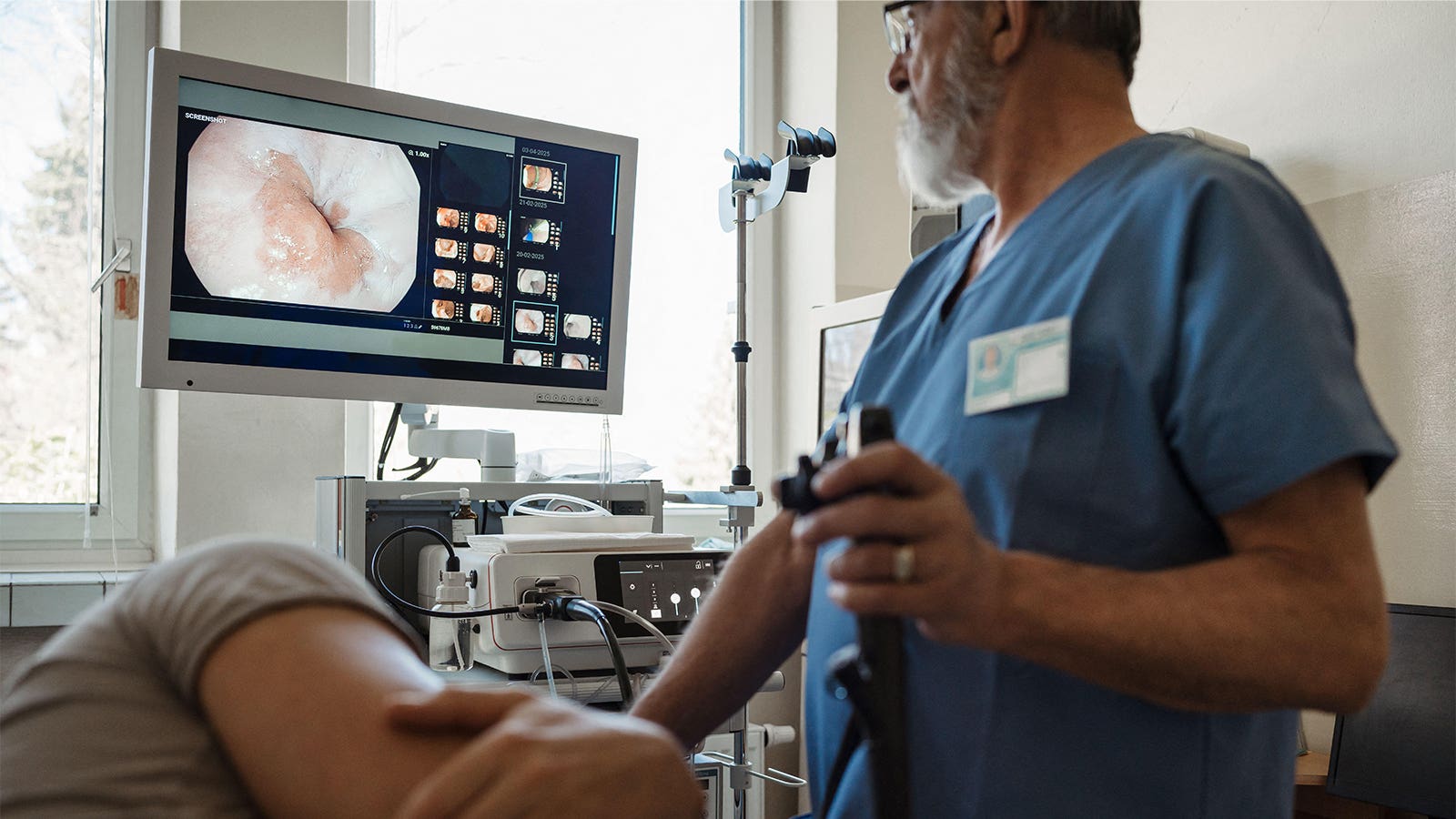
A randomized trial run in the Cleveland Clinic system found that patients who kept taking their GLP-1 or GLP-1/GIP medication right up to an upper endoscopy were far more likely to have leftover stomach contents than patients who skipped their last dose — even after following standard fasting instructions [1].
In the OCULUS trial, 25% of patients who continued their medication had what researchers called clinically significant residual gastric volume (RGV), compared with 3.1% of those who held a dose (absolute difference 21.9%, 90% CI 7%-36.7%, P=0.003) [1]. The results were published in JAMA Internal Medicine by Tilak Shah, MD, MHS, of Cleveland Clinic Florida in Weston, and colleagues [1].
What the trial measured
The single-masked, noninferiority trial enrolled 68 patients at two tertiary care centers between July 2024 and May 2025 [1]. Participants were scheduled for esophagogastroduodenoscopy, endoscopic ultrasonography, or endoscopic retrograde cholangiopancreatography [1]. Average age was 63, about half were female, and most were taking injectable semaglutide (Ozempic, Wegovy) or tirzepatide (Mounjaro, Zepbound) [1]. Patients in the hold group went without medication for 7 to 13 days for weekly drugs, or at least one day for daily drugs; continuers took their usual dose on their usual schedule [1].
"Clinically significant" RGV was defined as a composite: stomach contents that blocked the endoscopic exam, forced the procedure to end early or required a breathing tube, or caused an aspiration event leading to extended monitoring, unplanned treatment, or hospital admission [1]. Every case in this study fell into the first category — contents that precluded the exam [1]. No patient had aspiration or an unplanned intubation [1].
The gap widened in the 35 patients who had upper endoscopy only: 46.7% of continuers had significant RGV versus 5% of holders (P=0.001) [1]. Shah said the near-50% figure "was far higher than we anticipated" [1].
Clear liquids appeared to erase the difference
In a subgroup of 25 patients who had both endoscopy and colonoscopy — and therefore followed a clear liquid diet and bowel prep beforehand — there were no RGV events at all, whether or not they held the drug [1]. "None of the patients who consumed clear liquids on the day prior had retained gastric contents," Shah said [1].
Timing of the hold also mattered. Among patients on weekly medications, those who held for more than three days were more likely to have a clear stomach than those who held three days or less (92.7% vs 62.5%, P=0.047) [1]. The single patient in the hold group with significant RGV was taking daily oral semaglutide (Rybelsus) [1].
The researchers also challenged a common screening shortcut. American Society of Anesthesiologists guidance says gastrointestinal symptoms such as nausea and constipation point to delayed gastric emptying, but the trial found no link between symptoms and retained contents [1]. "In fact, all of the patients with retained solid food were without any upper GI symptoms," Shah said [1]. Only one patient reported nausea and vomiting, and that person did not have increased RGV [1]. "Our study questions the validity of considering symptoms in decision-making," he added [1].
Why it matters for patients
GLP-1 medications slow stomach emptying, which is part of how they work — but it also means food may still be in the stomach when sedation begins, raising the theoretical risk of regurgitation and aspiration [1]. Guidance has shifted: in 2023 the ASA advised holding injectables for a week and oral agents for a day, then reversed course in 2024 to say most patients shouldn't stop before elective surgery, and can instead continue while following a liquid diet for 24 hours beforehand, depending on circumstances [1].
This trial adds data to both sides of that debate. Shah told MedPage Today the results "would suggest that patients who did not hold at least one dose of the medication prior to surgery or endoscopy should be rescheduled" [1]. He also floated alternatives: point-of-care ultrasound to check the stomach and avoid cancellations, or rescheduling for the next day with clear liquids if a procedure is urgent [1]. Practically, patients on these drugs may find that pre-procedure instructions differ between centers, and that an aborted exam means repeating the prep.
Limits are real. The trial enrolled only 68 people, excluded patients with gastroparesis risk factors other than diabetes, and was not powered to compare individual GLP-1 drugs or doses [1]. Whether these drugs worsen bowel prep quality remains controversial and is the focus of the team's ongoing OCULUS-2 trial [1]. The study was funded by a Cleveland Clinic Catalyst Grant and an American Society for Gastrointestinal Endoscopy Clinical Research Award; Shah reported no disclosures, while co-authors reported industry relationships including with Novo Nordisk [1].
Images from the sources
Sources
Semaglutides.org is for information only and is not medical advice. Always talk to a licensed healthcare provider about your own care. Some links to telehealth services are affiliate links, labeled where they appear.