Orforglipron holds weight loss after patients switch off injections in ATTAIN-MAINTAIN
Lilly says people who plateaued on Wegovy or Zepbound and switched to daily oral orforglipron held most of their weight loss for a year, and the obesity application is now at FDA.
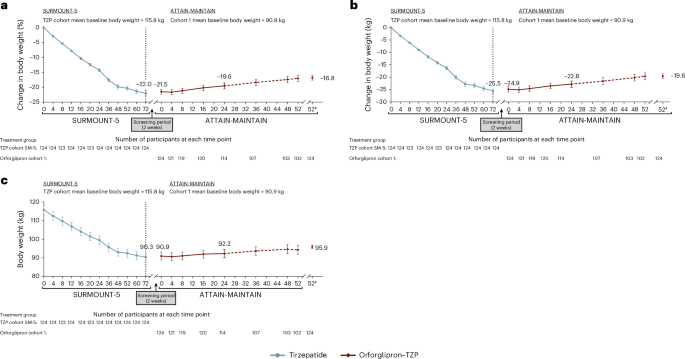
Eli Lilly reported topline results on December 18, 2025 from ATTAIN-MAINTAIN, the first Phase 3 trial to test whether people can move off an injectable incretin drug and onto a daily pill without giving back their weight loss. Over 52 weeks, participants who switched from Wegovy (semaglutide) to orforglipron kept all but 0.9 kg of the weight they had lost, and those who switched from Zepbound (tirzepatide) kept all but 5.0 kg, using the trial's efficacy estimand [1].
How the trial worked
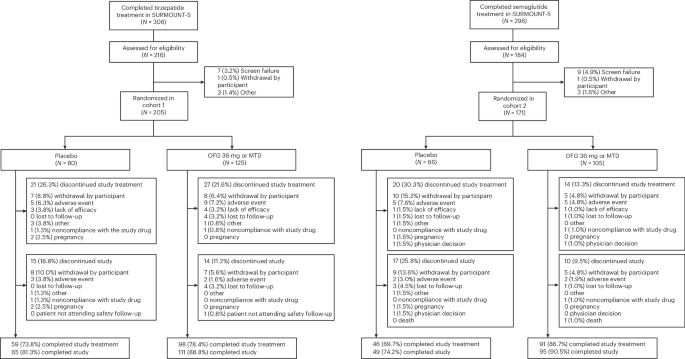
The 376 participants all came from SURMOUNT-5, the head-to-head study in which Zepbound produced average weight loss of 20.2% versus 13.7% for Wegovy at 72 weeks [1]. To enter the maintenance study, they had to have hit a plateau, defined as less than 5% body weight change between weeks 60 and 72, on the highest tolerated dose of Wegovy (1.7 mg or 2.4 mg) or Zepbound (10 mg or 15 mg) [1]. They were then randomized 3:2 to once-daily oral orforglipron or placebo, starting at 12 mg and stepping up every four weeks to 36 mg or the maximum tolerated dose of 24 mg or 36 mg [1]. The trial ran at 29 U.S. sites and enrolled between September 13, 2024 and November 21, 2025 [2].
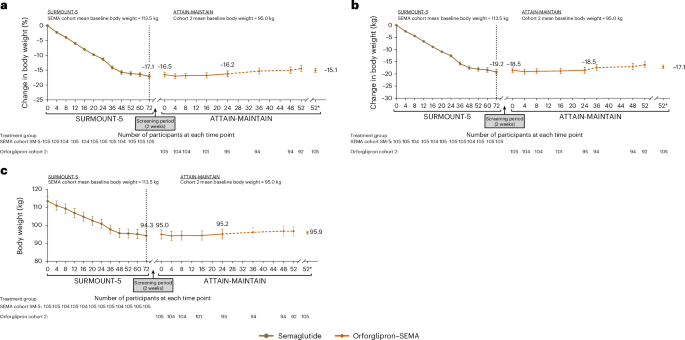
In Lilly's table of average weights, people in the Wegovy group started SURMOUNT-5 at 113.5 kg (250.2 lbs), were at 95.0 kg (209.4 lbs) when they switched to the pill, and finished the maintenance year at 95.9 kg (211.4 lbs). The Zepbound group started at 115.8 kg (255.3 lbs), switched at 90.9 kg (200.4 lbs), and ended at 95.9 kg (211.4 lbs) [1].
The peer-reviewed results, published in Nature Medicine, frame it as the share of weight loss retained. Former tirzepatide users kept 74.7% of their weight reduction on orforglipron versus 49.2% on placebo, a difference of 25.5 percentage points (95% CI 14.5 to 36.5, P<0.001). Former semaglutide users kept 79.3% versus 37.6% on placebo, a difference of 41.7 points (95% CI 24.4 to 59.0, P<0.001) [2]. In a post-hoc look at 24 weeks — the last point before placebo participants could get rescue orforglipron — weight change from the maintenance-study baseline was -0.1 kg for Wegovy switchers versus 9.4 kg for placebo, and 2.6 kg for Zepbound switchers versus 9.1 kg for placebo [1].
Safety looked consistent with earlier orforglipron trials, with mostly mild-to-moderate gastrointestinal side effects. Discontinuations due to adverse events were 4.8% (orforglipron after Wegovy), 7.6% (placebo after Wegovy), 7.2% (orforglipron after Zepbound) and 6.3% (placebo after Zepbound), and no liver safety signal was seen [1]. About 76.6% of the tirzepatide cohort and 80.1% of the semaglutide cohort completed study treatment [2].
Why it matters for patients
Many people stop injectable obesity drugs because of cost, supply, travel, needle aversion or side effects, and weight typically returns. This trial is the first direct test of a daily pill as a step-down option after an injection, and it suggests the switch is possible without a full rebound — though the amount held varied by which drug came first, with tirzepatide users giving back more, consistent with having lost more to begin with [1][2].
There are real limits. The study had no arm that simply stayed on the injectable, so it does not show whether switching matches continuing [2]. It lasted one year [2]. Everyone had already reached a plateau, so results may not apply to someone still losing weight. Anyone who regained 50% or more of their SURMOUNT-5 weight loss could receive rescue orforglipron, which shapes how the numbers are estimated [1]. Baseline weights also differ slightly between Lilly's release and the published analysis sets [1][2]. Price, insurance coverage and whether a switch would be allowed by a given plan are not addressed in these sources.
What happens next
Lilly has submitted a new drug application to the FDA for orforglipron in adults with obesity or overweight, and the drug received a Commissioner's National Priority Voucher [1]. An FDA decision date is not stated in the sources. Lilly said detailed ATTAIN-MAINTAIN results would be presented at a medical meeting and published in a peer-reviewed journal [1]; the full trial has since appeared in Nature Medicine [2]. Orforglipron is also in Phase 3 testing for type 2 diabetes, obstructive sleep apnea, hypertension, knee osteoarthritis, stress urinary incontinence, and cardiovascular and kidney outcomes [1].
Images from the sources
Sources
Semaglutides.org is for information only and is not medical advice. Always talk to a licensed healthcare provider about your own care. Some links to telehealth services are affiliate links, labeled where they appear.