Sun Pharma wins Indian approval for generic semaglutide injection
India's regulator cleared a generic semaglutide injection for weight management, showing how far GLP-1 prices can fall once patents lapse — though the US market stays protected until 2032.
Sun Pharmaceutical Industries said on January 23, 2026 that India's drug regulator approved its generic semaglutide injection for chronic weight management, clearing the company to sell it as Noveltreat once semaglutide's Indian patent expires [1]. The approval from the Drugs Controller General of India covers a once-weekly prefilled pen in five strengths — 0.25 mg/0.5 mL, 0.5 mg/0.5 mL, 1 mg/0.5 mL, 1.7 mg/0.75 mL and 2.4 mg/0.75 mL — with 2.4 mg listed as the maintenance dose [1].
Sun also received DCGI approval in December 2025 for a semaglutide injection for adults whose type 2 diabetes is not sufficiently controlled, to be launched as Sematrinity after patent expiry [1]. On March 21, 2026, Sun said it had launched both Noveltreat and Sematrinity in India, and put monthly therapy costs at about ₹900 to ₹2,000 for Noveltreat and ₹750 to ₹1,300 for Sematrinity [1].
The launches came as Novo Nordisk's semaglutide patent expired in India. CNBC reported that at least five domestic drugmakers brought generic versions to market over the weekend after the patent lapsed, undercutting Novo's original price by up to 80% [2].
Pricing accounts differ. CNBC reported that Sun's generic semaglutide launched for as little as 750 rupees (about $8) per weekly injection, or roughly 3,400 rupees a month, compared with Novo's retail price in India of 8,800 to 10,000 rupees depending on dosage [2]. Sun's own disclosure put Noveltreat at ₹900 to ₹2,000 per month [1]. The company's figure and CNBC's figure have not been reconciled.
Dr. Reddy's Laboratories launched its semaglutide brand Obeda at about 4,200 rupees per month and has described it as the first semaglutide injection in India to receive DCGI approval [1][2]. Natco Pharma priced a vial formulation at 1,250 rupees per month, and Alkem Laboratories introduced prefilled injections starting at 1,800 rupees per month, which CNBC called the lowest-priced prefilled semaglutide injections on the market [2]. Sun and Dr. Reddy's launched at about 50% below Novo's original prices, while smaller domestic-focused manufacturers offered discounts of nearly 80%, according to the report [2].
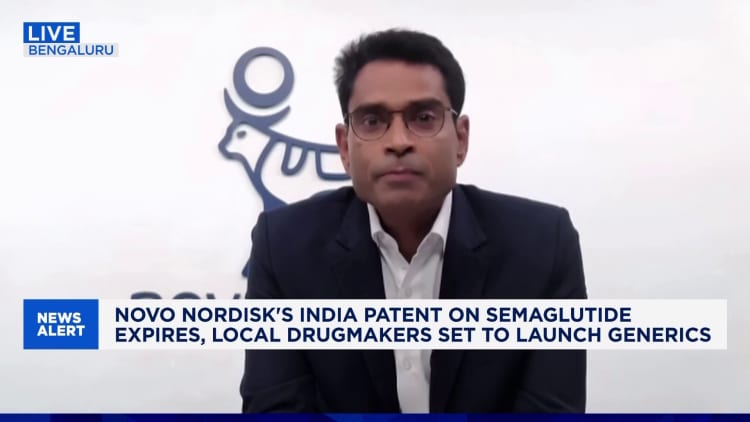
Novo cut the price of Wegovy in India by 37% from its launch price before the patent expired, and is selling Wegovy as Poviztra through a partnership with Emcure Pharma and Ozempic as Extensior with Abbott India [2]. Vikrant Shrotriya, managing director of Novo Nordisk India, told CNBC: "Our size, technology, and complete care ecosystem justify the price we are getting after a 37% reduction" [2].
India's GLP-1 market is growing quickly: sales had a moving annual turnover of 14.46 billion rupees in February, up 178% from a year earlier, according to the market intelligence firm Pharmarack [2]. Rajiv Kovil, a diabetes specialist, told CNBC that nearly 50% of his patients could benefit from GLP-1 drugs but only 5% currently use them [2]. More than 50 brands are expected to launch generic semaglutide in India in the coming months [2].
Why it matters for patients
Most of this does not change what is available in the United States. Semaglutide remains protected from generic competition in the U.S. until 2032, so the Indian products are not an option for U.S. patients, and no U.S. launch dates for generic semaglutide have been disclosed [2].
The Indian rollout does provide a public look at how far prices can fall once several manufacturers sell the same molecule. It also shows that quality and supply, not just price, shape how fast that happens. Semaglutide is a peptide-based medicine that requires specialized manufacturing and cold-chain storage, and experts told CNBC that quality control for such large molecules is harder than for small-molecule drugs like aspirin [2]. "The molecule that is given to patients has to be perfect, and it cannot have any side products or contaminants," said Knud Jensen, a chemistry professor at the University of Copenhagen and president of the European Peptide Society [2].
Some industry watchers also raised the possibility that Indian-made semaglutide could reach markets where patents are still in force. "If India is starting to manufacture GLP-1s at a large scale, that will not all stay in India, whatever companies try, countries try to prevent it from coming in," Ben van der Schaaf, a partner at Arthur D. Little, told CNBC [2].
What happens next
Dr. Reddy's plans to expand to Canada, Turkey and Brazil this year, targeting annual sales of 12 million semaglutide pens in the first year of launch across all markets including India [2]. Semaglutide patents expire in India, Canada, Brazil and China this year, while the U.S. market stays protected until 2032 [2]. Novo warned in February that its sales could decline by 5% to 13% in 2026 [2]. On further price cuts in India, CNBC reported there is no official indication yet from Novo or Eli Lilly [2].
Sources
Semaglutides.org provides information only, not medical advice. Talk to a licensed provider about your own care before making changes. Some telehealth links are affiliate links and are labeled where they appear.