US semaglutide market estimated at about $24 billion
Researchers estimate the US semaglutide market will hit about $24.1 billion in 2026, more than six in ten dollars spent on the drug worldwide, while patent protection here holds until 2032 even as cheaper copies launch abroad.[1][2]
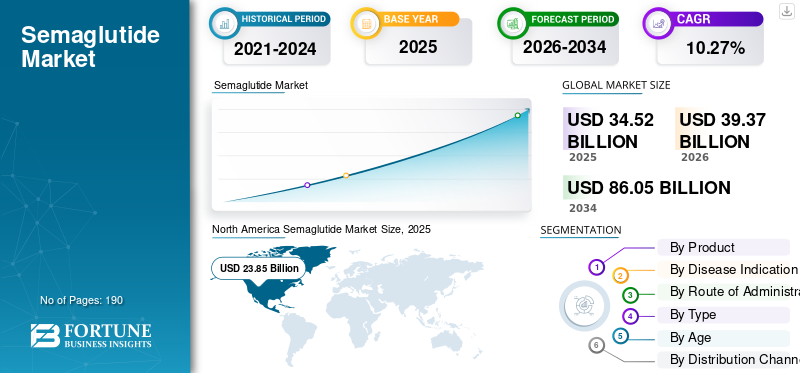
The United States is projected to account for roughly $24.1 billion of the global semaglutide market in 2026, or about 61.2% of an estimated $39.37 billion worldwide total, according to market researcher Fortune Business Insights [1]. That gap reflects a simple fact: semaglutide's US patent protection runs until 2032, while the drug has already lost patent protection this year in India, Canada, Brazil, and China [2]. For American patients, that means the branded products Ozempic, Wegovy, and Rybelsus are expected to keep their exclusive hold on the US market for several more years, even as price competition reshapes the drug's economics elsewhere.
The global market was valued at $34.52 billion in 2025 and is forecast to grow to $86.05 billion by 2034, a compound annual growth rate of about 10.27% [1]. North America held 69.09% of the global market in 2025, with the region's total reaching $23.85 billion that year [1]. Novo Nordisk, the maker of Ozempic, Wegovy, and Rybelsus, has warned that its overall 2026 sales could fall by 5% to 13% because of generic competition emerging in markets outside the US [2].
That overseas competition is already fierce. In India, at least five domestic drugmakers launched generic semaglutide over one recent weekend, undercutting Novo's original price by up to 80% [2]. Sun Pharmaceutical priced a generic version as low as 750 rupees, about $8, for a weekly injection, compared with Novo's retail price of 8,800 to 10,000 rupees depending on dose [2]. Novo has responded by cutting its Indian price by 37% and by launching second brands through local partners, betting that its reputation and care ecosystem will let it keep charging a premium over generics [2].
In the US, Novo Nordisk announced a reduction in the list price for Wegovy, Ozempic, and Rybelsus in February 2026, part of continued efforts to expand access [1]. That followed a November deal between the Trump administration and drugmakers, including Novo and Eli Lilly, that lowered GLP-1 prices in the country, though it is not yet clear whether higher sales volumes will offset the lower prices [2]. Separately, Novo said in January 2026 that its oral Wegovy pill became available through more than 70,000 US pharmacies and multiple care channels, part of a broader push toward long-term, prescription-based weight management [1]. In March 2026, Novo also announced a collaboration with the telehealth company Hims, Inc., under which it plans to offer patients access to FDA-approved GLP-1 medications along with compounded semaglutide through the platform on a limited scale [1].
Why it matters for patients
The scale of the US market, and the years remaining on Novo's exclusivity, help explain why branded semaglutide prices in the US have stayed far above prices in countries where generics now compete [2]. Patients weighing cost against other options may see continued list-price adjustments and new access programs, such as the Hims partnership, as companies compete for market share domestically without the threat of direct generic substitutes until 2032 [1][2]. Gastrointestinal side effects remain a documented factor in the market: the FDA-approved Wegovy label reports that 73% of Wegovy-treated patients in adult weight-reduction trials had gastrointestinal adverse reactions, compared with 47% on placebo, and severe reactions occurred in 4.1% of Wegovy patients versus 0.9% on placebo [1]. These figures are cited by market analysts as a factor that can affect whether patients continue treatment long-term [1].
What happens next
Analysts say it is not yet clear whether Novo Nordisk will keep its dominant US market position once patent protection ends there in 2032, though the company has historically retained large market shares after past patent expirations in other product lines [2]. In the near term, industry watchers are also weighing whether generic manufacturing capacity built up in markets like India could eventually affect supply and pricing dynamics in markets, including the US, where the patent has not yet expired [2].
Sources
Semaglutides.org is for information only and is not medical advice. Always talk to a licensed healthcare provider about your own care. Some links to telehealth services are affiliate links, labeled where they appear.