Generic semaglutide launches in India after patent expiry, at prices far below Novo's brands
Generic semaglutide went on sale in India at a fraction of Novo Nordisk's prices, but US patents block similar competition until 2032.

The patent on semaglutide in India expired on Friday, March 20, 2026, and at least six Indian drugmakers began selling generic versions the next day, undercutting Novo Nordisk's Ozempic and Wegovy by as much as 80 percent [2][3]. The launches include products priced from about 1,290 to 4,200 rupees a month, compared with 8,800 to 10,850 rupees a month for Novo's starting doses [1][2].
ThePrint reported that at least six companies launched on "Day 1": Dr Reddy's Laboratories, Sun Pharma, Glenmark Pharmaceuticals, Alkem Laboratories, Zydus Lifesciences and Natco Pharma, with Eris Lifesciences announcing pricing for a Natco-partnered brand called Sundae [2]. CNBC counted at least five domestic drugmakers [3]. Semaglutide is the molecule in Ozempic, Wegovy and Rybelsus [1].
What launched, and at what price
Dr Reddy's said it was the first Indian company to receive Drugs Controller General of India approval for generic semaglutide and launched Obeda in a pre-filled disposable pen for type 2 diabetes at about 4,200 rupees per month [1][2]. The company said a head-to-head Phase 3 trial in 312 participants found Obeda non-inferior to the original drug with a comparable safety profile, and it is separately seeking approval for weight management [2]. Dr Reddy's plans to expand to Canada, Turkey and Brazil this year and is targeting annual sales of 12 million semaglutide pens in its first year across markets [3].
Zydus launched Semaglyn, Mashema and Alterme at an average monthly cost of roughly 2,200 rupees in a reusable multi-dose pen, with approval for both type 2 diabetes and obesity [1][2]. Alkem's Semasize, Obesema and Hepaglide start at 1,800 rupees a month, or about 450 rupees a week, and are approved for type 2 diabetes and chronic weight management [1][2]. Sun Pharma's Noveltreat, for weight management, costs about 900 to 2,000 rupees a week, and its Sematrinity, for type 2 diabetes, 750 to 1,300 rupees a week [1][2].
Glenmark's GLIPIQ is the cheapest option reported, at 325 to 440 rupees a week for the vial formulation, which requires a syringe; a pen version is also launching, but Glenmark has not disclosed its price [1][2]. Natco's vial products Semanat and Semafull start at 1,290 rupees a month, with a pen device expected in April at 4,000 to 4,500 rupees [2]. Sources describe prices in different units, weekly and monthly, and at different doses, so comparisons between brands are approximate.
Why it matters for patients
Semaglutide is still protected by patents in the United States, where generic competition is not expected until 2032, so these Indian launches do not change what is available or what it costs at a US pharmacy [3]. Reuters reported that Novo cut the price of Wegovy in India by 37 percent from its launch price before the patent expired, and the company is defending its position there through partnerships: Wegovy is sold as Poviztra with Emcure Pharma and Ozempic as Extensior with Abbott India [3]. Separately, a November 2025 agreement with the Trump administration lowered GLP-1 prices in the US, CNBC reported, without giving figures [3].
Some industry watchers raised the possibility that low-cost Indian semaglutide could reach markets where the drug is still patent-protected. "If India is starting to manufacture GLP-1s at a large scale, that will not all stay in India," Ben van der Schaaf, a partner at the consulting firm Arthur D. Little, told CNBC [3]. Jyske Bank analyst Henrik Hallengreen Laustsen said Novo could keep its market dominance if the laws are followed and the drug is sold only where patents have expired [3]. No evidence of such diversion into the US was reported.
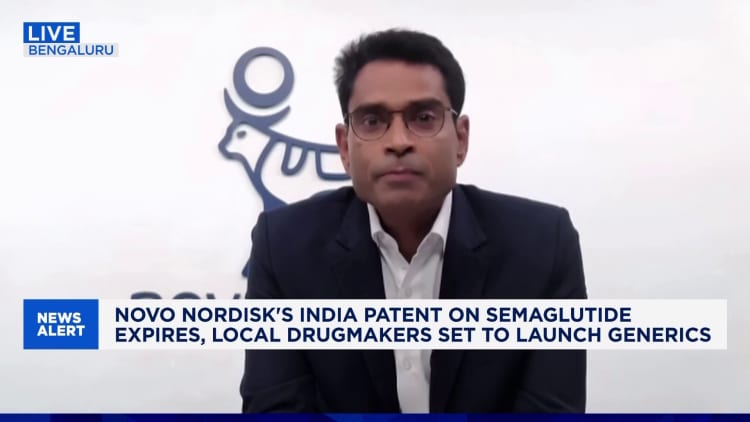
Access in India remains limited. Vikrant Shrotriya, managing director of Novo Nordisk India, said that of an estimated 250 million Indians living with obesity, only about 200,000 are on GLP-1 medications [2]. Diabetes specialist Rajiv Kovil said nearly 50 percent of his patients could benefit from GLP-1 drugs but only 5 percent use them [3].
Analysts disagree on how much ground Novo will lose. Vishal Manchanda of Systematix Group said Novo could keep a large share of the Indian market if it holds a 15 to 20 percent premium over generics, while Sydbank's Soren Lontoft Hansen said it is not yet clear whether Novo will lose its leading position [3].
What happens next
Natco expects to launch its semaglutide pen in April at 4,000 to 4,500 rupees [2]. More than 50 brands are expected to launch generic semaglutide in the coming months, according to consultant Salil Kallianpur, who said that is a small number by Indian standards because these peptide-based drugs are harder to make than typical generics and need cold-chain storage [3]. Novo has warned that its overall sales could fall 5 to 13 percent in 2026 [3]. Whether prices in India fall further, or whether Novo announces new cuts, has not been disclosed.
Images from the sources
Sources
- https://www.pearceip.law/2026/03/21/generic-semaglutide-launches-in-india-including-by-dr-reddys-zydus-alkem-sun-pharma-glenmark
- https://theprint.in/india/rs-325-4200-month-dr-reddys-sun-pharma-glenmark-kick-off-generic-semaglutide-price-war/2885525/
- https://www.cnbc.com/2026/03/23/novo-nordisk-cheap-weight-loss-drugs-india-generic-ozempic-wegovy-semaglutide.html
- https://www.pearceip.law/2026/03/21/generic-semaglutide-launches-in-india-including-by-dr-reddys-zydus-alkem-sun-pharma-glenmark/
Semaglutides.org provides information only, not medical advice. Talk to a licensed provider about your own care before making changes. Some telehealth links are affiliate links and are labeled where they appear.