Novo faces an Indian price war it cannot match
Indian drugmakers launched generic semaglutide at up to 80% below Novo Nordisk's price, but the patent that blocks copies in the US runs to 2032, so American prices are not directly affected.
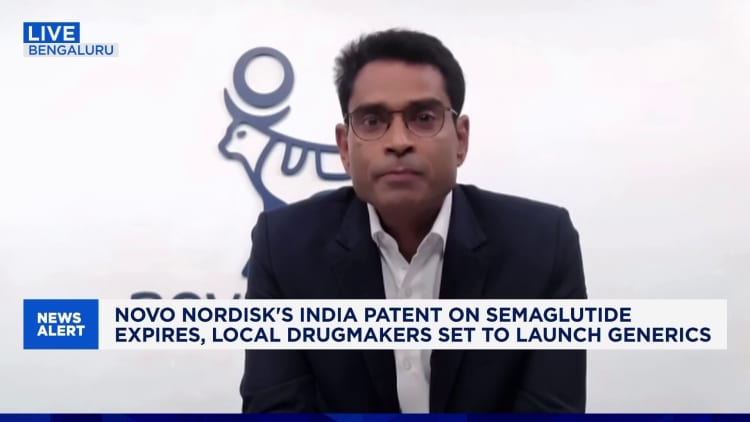
Generic versions of semaglutide — the molecule in Ozempic, Wegovy and Rybelsus — went on sale in India over the weekend of March 21-22, days after Novo Nordisk's Indian patent expired on Friday, March 20 [1][2]. At least five domestic drugmakers launched at prices up to 80% below Novo's, and more than 50 brands are expected in the coming months [1].
Dr. Reddy's Laboratories launched semaglutide for type 2 diabetes at about 4,200 rupees a month and said it plans to expand to Canada, Turkey and Brazil this year [1]. Deepak Sapra, the company's CEO of Pharmaceutical Services and API, said the goal is "to democratize access to GLP-1 drugs worldwide" at a virtual launch event, with a target of 12 million semaglutide pens in the first year across all markets, including India [1].
Other launches went lower. Sun Pharmaceutical priced a weekly injection as low as 750 rupees (about $8), or roughly 3,400 rupees a month [1]. Natco Pharma's vial formulation is 1,250 rupees a month, and Alkem Laboratories' prefilled injections start at 1,800 rupees [1]. Novo's own retail price in India runs between 8,800 and 10,000 rupees depending on dose [1] — and that is after the company cut Wegovy's price by 37% from its launch price before the patent lapsed. CNBC describes that cut as happening "in December last year," while the Reuters report it cites is dated November 11, 2025, and a separate analysis puts the cut in November 2025 [1][2].
The market at stake
India has around 100 million people living with diabetes and nearly a quarter of adults classified as obese, and it supplies about 20% of the world's off-patent medicines [1]. GLP-1 sales there are growing fast: moving annual turnover in February rose 178% from a year earlier to 14.46 billion rupees, according to market intelligence firm Pharmarack [1]. Even so, Mumbai diabetologist Rajiv Kovil said nearly 50% of his patients could benefit from GLP-1 drugs but only about 5% are on them, with price the main barrier [1]. He said he plans to wait for more evidence on how well the generics work, and how reliably they are supplied, before switching patients [1].
Analysts are split on how much Novo loses. Vishal Manchanda of Systematix Group said Novo could keep a large share if it holds a premium of 15% to 20% over generics [1]. Sydbank's Søren Løntoft Hansen said it is not yet clear whether Novo will lose its lead, noting the company has stayed dominant in insulin for a century while selling above generic rivals [1]. Novo is also co-marketing through partners: Wegovy is sold as Poviztra with Emcure Pharma and Ozempic as Extensior with Abbott India [1][2]. Vikrant Shrotriya, managing director of Novo Nordisk India, told CNBC the company's "size, technology, and complete care ecosystem justify the price we are getting after a 37% reduction" [1].
Why it matters for patients
For US patients, the short answer is that none of these prices are available here. Semaglutide stays protected from generic competition in the United States — its largest market by far — until 2032 [1]; one Indian analysis puts US and European protection at 2031-2032 [2]. Patents are expiring this year in India, Canada, Brazil and China [1].
The indirect effects are real but uncertain. Novo warned in February that its sales could fall 5% to 13% in 2026, and it is already losing share to Eli Lilly's tirzepatide (Mounjaro and Zepbound) and other competitors, plus a November deal with the Trump administration that cut GLP-1 prices in the US [1].
There is also a supply-leakage question. Ben van der Schaaf of Arthur D. Little told CNBC that large-scale Indian manufacturing "will not all stay in India," whatever companies or countries try [1]. Jyske Bank's Henrik Hallengreen Laustsen said that if the law is followed and semaglutide is sold only where the patent has expired, Novo should keep its dominance [1]. Product sold outside approved channels is not FDA-reviewed, and experts quoted by CNBC note that peptide manufacturing demands tight quality control and cold-chain handling [1].
What happens next
Dr. Reddy's has said it will move into Canada, Turkey and Brazil during 2026 [1]. Whether Novo cuts Indian prices again is not known; there was no official indication of a fresh round from Novo or Lilly as of the launch weekend [1].
Sources
Semaglutides.org is for information only and is not medical advice. Always talk to a licensed healthcare provider about your own care. Some links to telehealth services are affiliate links, labeled where they appear.