OCULUS trial stops early after residual stomach contents rise in the continue group
A randomized trial found clinically significant leftover stomach contents in 25.0% of people who kept taking their GLP-1 or GIP drug before upper endoscopy versus 3.1% of those who held one dose [1].
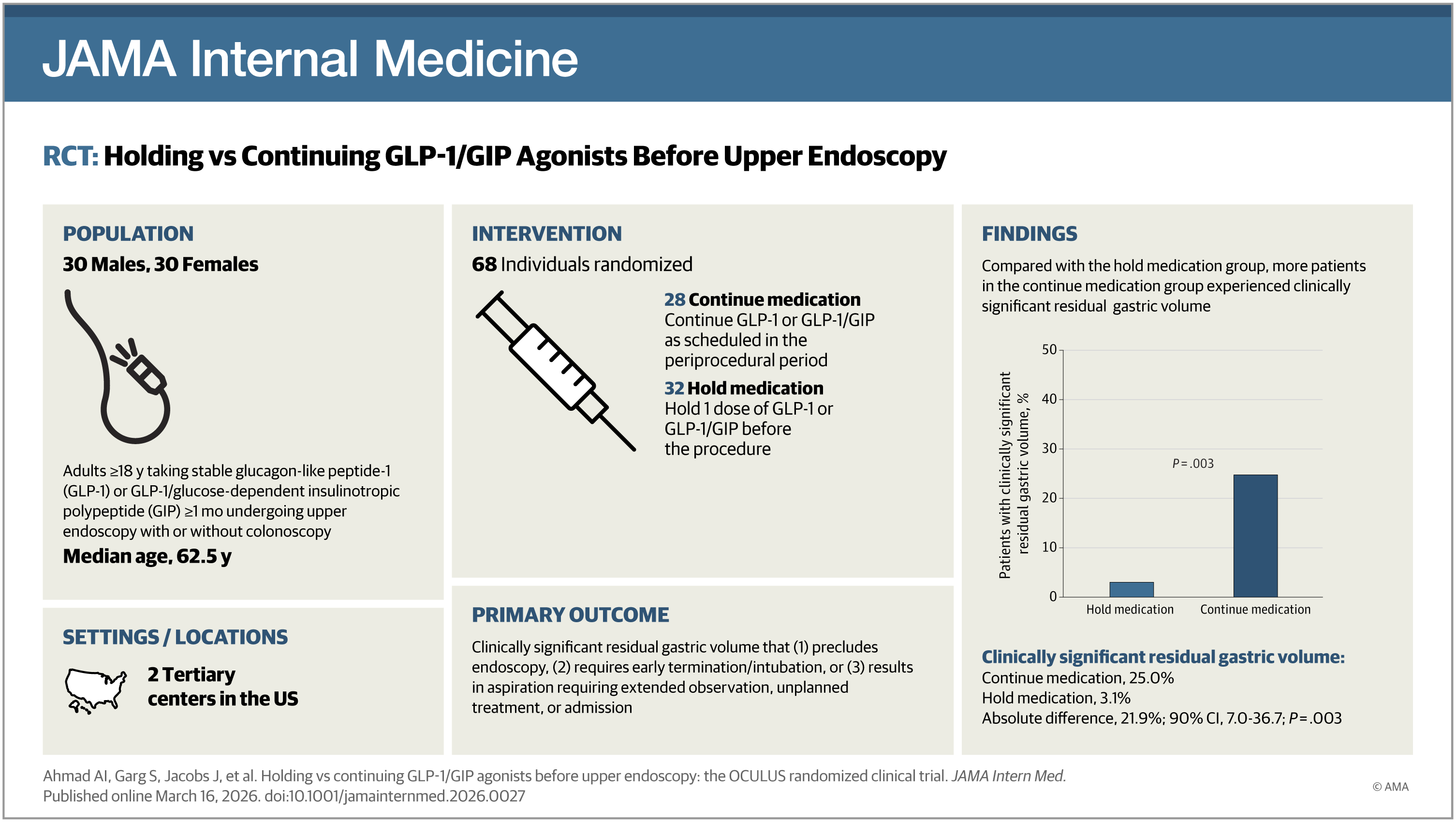
The first randomized trial to test whether patients should hold a GLP-1 or GIP receptor agonist before an upper endoscopy was stopped early after an interim look at 60 patients. In the OCULUS trial, clinically significant residual stomach contents were found in 25.0% of patients who continued their medication as usual, compared with 3.1% of those who skipped one dose before the procedure [1].
The results were published in JAMA Internal Medicine by investigators at Cleveland Clinic Florida in Weston and Cleveland Clinic in Ohio, with co-authors from the University of Missouri and MetroHealth Medical System [1].
What the trial measured
Drugs in this class — semaglutide (Ozempic, Wegovy, Rybelsus) and tirzepatide (Mounjaro, Zepbound) among them — slow how fast the stomach empties. That is part of how they curb appetite, but it has raised a practical question for sedation: if food or fluid is still sitting in the stomach when a scope goes down, there is a theoretical risk of it coming back up and entering the lungs. Until now, guidance on holding these drugs before endoscopy rested largely on observational data and expert opinion, not randomized evidence [1].
OCULUS randomized patients scheduled for upper endoscopy to either hold one dose of their GLP-1 or GIP agonist or to continue it. The primary outcome was clinically significant residual gastric volume seen at endoscopy. The trial was stopped at a planned interim analysis of 60 patients because of the difference between groups: 3.1% in the hold arm versus 25.0% in the continue arm [1].
Importantly, no patient in either group had an aspiration event, and no one required intubation [1]. That means the trial showed a difference in what endoscopists saw in the stomach, not a difference in the serious complication everyone is trying to prevent. With only 60 patients, a trial like this is far too small to detect rare events like aspiration pneumonia.
The diet finding
One subgroup result may matter as much as the randomization itself. Among the 25 patients who drank only clear liquids the day before their procedure, none had clinically significant residual gastric volume — regardless of whether they held the drug or kept taking it [1].
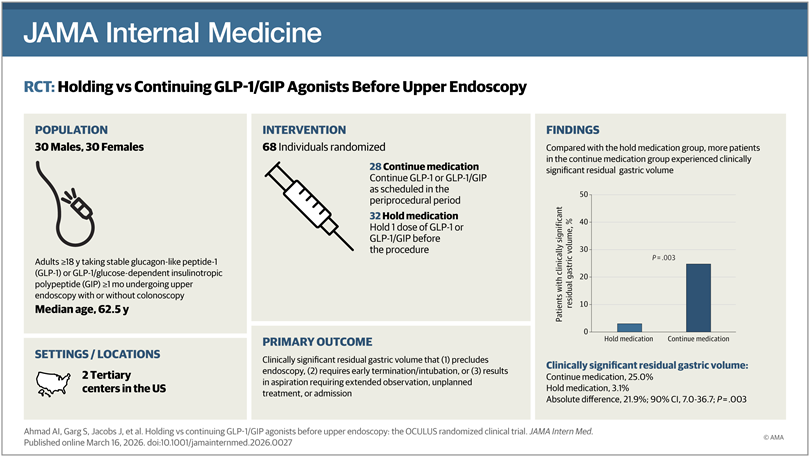
That points at the pre-procedure diet as a lever alongside the medication hold. The topic drew enough attention that JAMA Internal Medicine published a letter titled "Clear Liquids, Safer Procedures" and a reply from the trial authors [1]. The journal also issued two corrections to the published article, one for an error in the visual abstract and one for an error in Figure 2 [1].
Several things are not yet known from the available material: the exact volume threshold used to define "clinically significant," the mix of specific drugs and doses patients were taking, how many patients were on semaglutide versus tirzepatide, and whether a longer hold would perform differently than skipping a single dose. A trial stopped early at an interim analysis also tends to produce a larger apparent effect than the true one, so the 25% versus 3.1% gap should be read as a signal rather than a precise number.
Why it matters for patients
If you take a GLP-1 or GIP medication and have an upper endoscopy scheduled, this trial is likely to come up in your pre-procedure instructions. Practices differ widely right now — some centers ask patients to hold a weekly injection, some switch to clear liquids for a day, some do both, and some do neither. OCULUS gives endoscopy units their first randomized data to argue from, and it suggests two possible levers rather than one [1].
It also gives context for what a canceled or delayed procedure means. Finding leftover stomach contents often leads a team to abort the case and reschedule, which costs time and another round of prep. Reducing that is part of why this question is being studied.
What the trial does not show is that continuing the drug caused harm. No aspiration and no intubation occurred in either group [1]. Decisions about holding a dose involve your diabetes or weight management care, the procedure itself and the sedation plan — questions for the clinicians running each.
What happens next
Because OCULUS stopped early at 60 patients, larger trials would be needed to compare drug holds against clear-liquid diets head to head, and to say anything about aspiration rates. Whether professional societies update their pre-endoscopy guidance in response to this single trial is not yet known.
Images from the sources
Sources
Semaglutides.org is for information only and is not medical advice. Always talk to a licensed healthcare provider about your own care. Some links to telehealth services are affiliate links, labeled where they appear.