Eight markets lose semaglutide exclusivity in the first wave
IQVIA says semaglutide lost patent and data protection in eight countries starting in March 2026 — but not the US, which falls in a later, larger wave.

Semaglutide, the active ingredient in Ozempic, Wegovy and Rybelsus, began losing market exclusivity outside the United States this spring. In an April 7, 2026 analysis, the health data firm IQVIA said March "ushered in the first wave of off-patent competition for semaglutide," and identified eight markets in that first wave: Canada, Brazil, China, India, Mexico, Turkey, Saudi Arabia and South Africa [1].
The expiries cover both the diabetes and obesity uses, and companies are pursuing injectable and oral versions. IQVIA said most developers are working on oral and vial formulations at the same time, partly to get around the need for injector pens, which are in tight supply and carry their own patents [1].
A patchwork of rules
One reason the rollout will be uneven is that regulators disagree on what semaglutide even is. Canada and Saudi Arabia treat it as a chemical drug regardless of how it is made, requiring only bioequivalence studies [1]. Brazil, India and South Africa classify it as a biologic, with India requiring local Phase III-style clinical trials for "similar biologics" [1]. China treats recombinant versions as biologics and synthetic versions as chemical drugs but requires full clinical studies either way, while Turkey follows European practice [1]. IQVIA notes Saudi Arabia is a special case: a local patent was never filed there, so there was no typical period of protection [1].
For comparison, the FDA treats peptide chains under 40 amino acids as generics — semaglutide has 31 amino acids and tirzepatide has 39 [1].
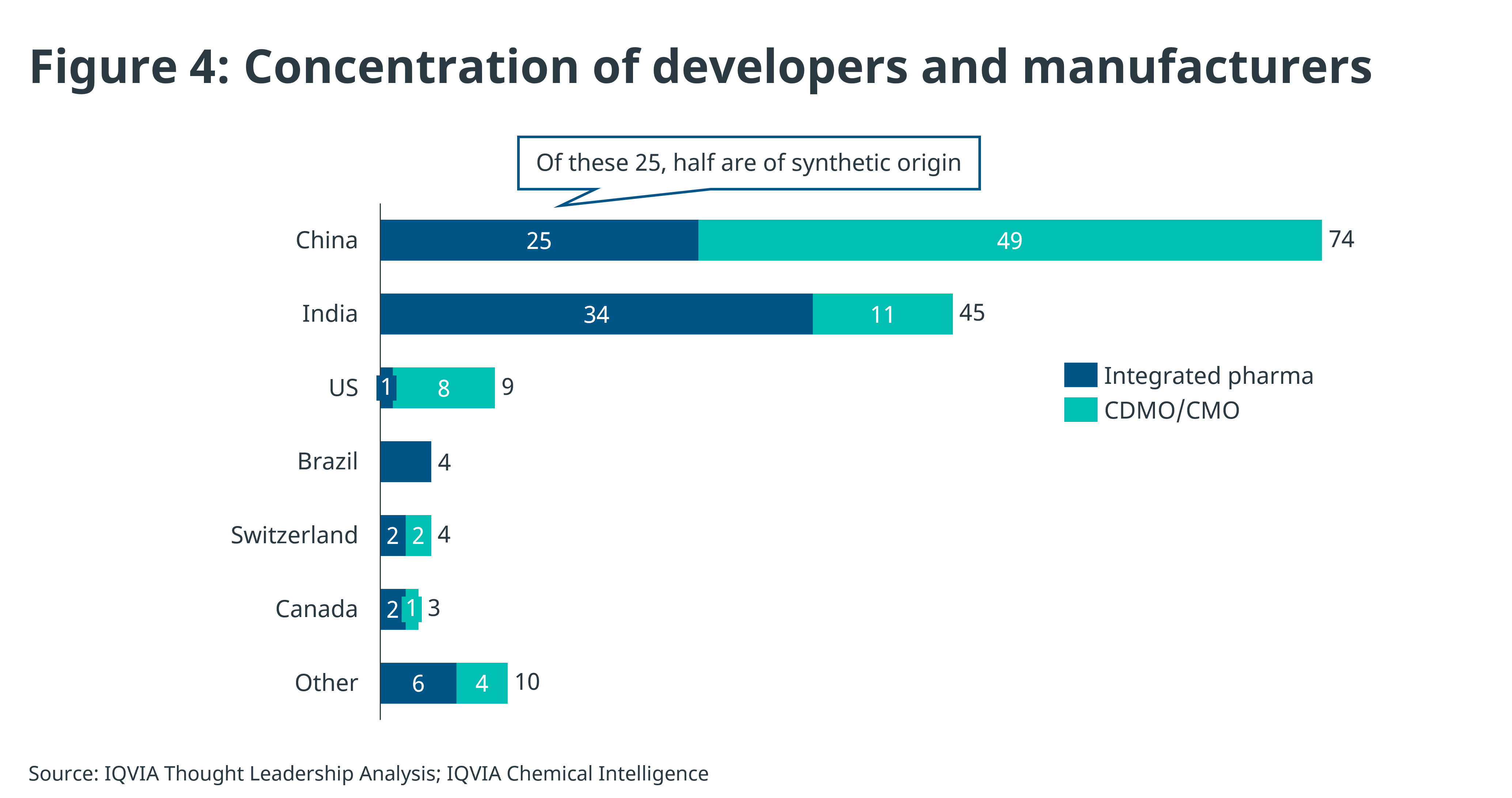
IQVIA counted more than 70 integrated pharmaceutical companies applying for marketing authorization, plus roughly 70 more companies able to manufacture semaglutide active ingredient for third parties [1]. China has the highest concentration of manufacturing; India is second but has more companies with international reach, such as Biocon, Dr. Reddy's and Lupin [1]. Of the limited public data in China, 13 of 25 integrated companies (52%) are using synthetic methods [1].
Prices are already moving
India is the clearest early example. IQVIA reports multi-dose vials priced as low as $14 per month and disposable pens at $19 per month for the lowest dose forms — discounts of up to 90% [1]. That market saw Mounjaro (tirzepatide) launch in March 2025 and Wegovy in June 2025, giving the originators a short window before competition arrived [2].
How low prices can go is contested. A study by Professor Andrew Hill and colleagues suggests finished semaglutide pens could be sold for $2.50 to $12 per month, but IQVIA argues that figure underestimates sourcing and market-access costs and assumes a cost-plus pricing model most companies do not use [1]. Hill's work also suggests oral semaglutide is more expensive to make than injections, because a daily pill needs a higher load of active ingredient [1].
These eight countries together account for 38% of the world's adults living with obesity, and most treatment there is paid out of pocket rather than by insurers [1].
Why it matters for patients
None of this changes US pricing or supply today. IQVIA places the United States and most of Europe in the third and largest wave, after a second wave that starts with the Baltics and parts of Central and Eastern Europe [1]. The sources do not give a specific US expiry date, so the timing is not yet known from this analysis.
What the first wave does offer is a preview. It will show how far prices actually fall, whether copies arrive as pens, vials or pills, and whether cheaper semaglutide pushes public health systems to start covering obesity treatment. IQVIA suggests Canada could become the first market with wide-scale reimbursement of off-patent semaglutide as a first-line obesity medicine, with pricing rules potentially requiring discounts of up to 75% versus the originator if it is classified as a generic [2].
Cost is a live issue for patients. IQVIA's review of 11,431 social media conversations found a third of all negative experiences with modern anti-obesity medications were driven by cost concerns [2]. Semaglutide had combined sales of about $26 billion in 2024, growing roughly 40% a year [2].
One caution: cheaper copies sold in other countries are approved by those countries' regulators, not the FDA, and IQVIA notes entry will be staggered by regulatory complexity and manufacturing problems [1].
What happens next
IQVIA expects staggered launches across the eight first-wave markets through 2026 [1]. After that, the Baltics and parts of Central and Eastern Europe open up, followed by the US and most of Europe in the final wave [1]. Specific dates for those later waves are not given in the sources.
Images from the sources
Sources
Semaglutides.org is for information only and is not medical advice. Always talk to a licensed healthcare provider about your own care. Some links to telehealth services are affiliate links, labeled where they appear.