Lilly agrees to acquire Kelonia Therapeutics in a deal worth up to $7 billion
Eli Lilly will pay $3.25 billion upfront, and up to $7 billion total, for cancer cell-therapy startup Kelonia — a sign of how tirzepatide profits are funding Lilly's expansion beyond obesity and diabetes.
Eli Lilly said on April 20, 2026 that it has agreed to acquire Kelonia Therapeutics, a clinical-stage biotech developing in vivo CAR-T cancer therapies, in a deal worth up to $7.00 billion in cash [1]. That includes $3.25 billion paid upfront, with the rest tied to clinical, regulatory and commercial milestones [1]. It is Lilly's largest announced deal of 2026 by headline value [2].
Kelonia's technology, called the in vivo gene placement system (iGPS), uses engineered lentiviral particles designed to enter T-cells inside the body so the patient's own immune cells produce chimeric antigen receptor (CAR) T-cells [1]. Its lead program, KLN-1010, is an investigational one-time intravenous gene therapy aimed at BCMA, a protein on the surface of multiple myeloma cells [1]. The drug is in a Phase 1 trial for relapsed or refractory multiple myeloma, and early results were presented in the plenary session of the 2025 American Society of Hematology Annual Meeting [1].
The pitch is logistical as much as scientific. Today's approved CAR-T therapies require collecting a patient's cells, engineering them in a manufacturing facility, and giving chemotherapy before the cells are infused back. Lilly says an in vivo approach could eliminate that patient-specific manufacturing and the pre-administration chemotherapy [1]. "Autologous CAR-T therapies have meaningfully improved outcomes for patients with various cancers, but significant manufacturing, safety, and access barriers mean that only a fraction of eligible patients actually receive them," said Jacob Van Naarden, president of Lilly Oncology and head of corporate business development [1]. Kelonia CEO Kevin Friedman said the company has shown "the ability to achieve deep multiple myeloma remissions with significantly reduced complexity and cost relative to ex vivo CAR T-cell approaches" [1].
Where the money is coming from
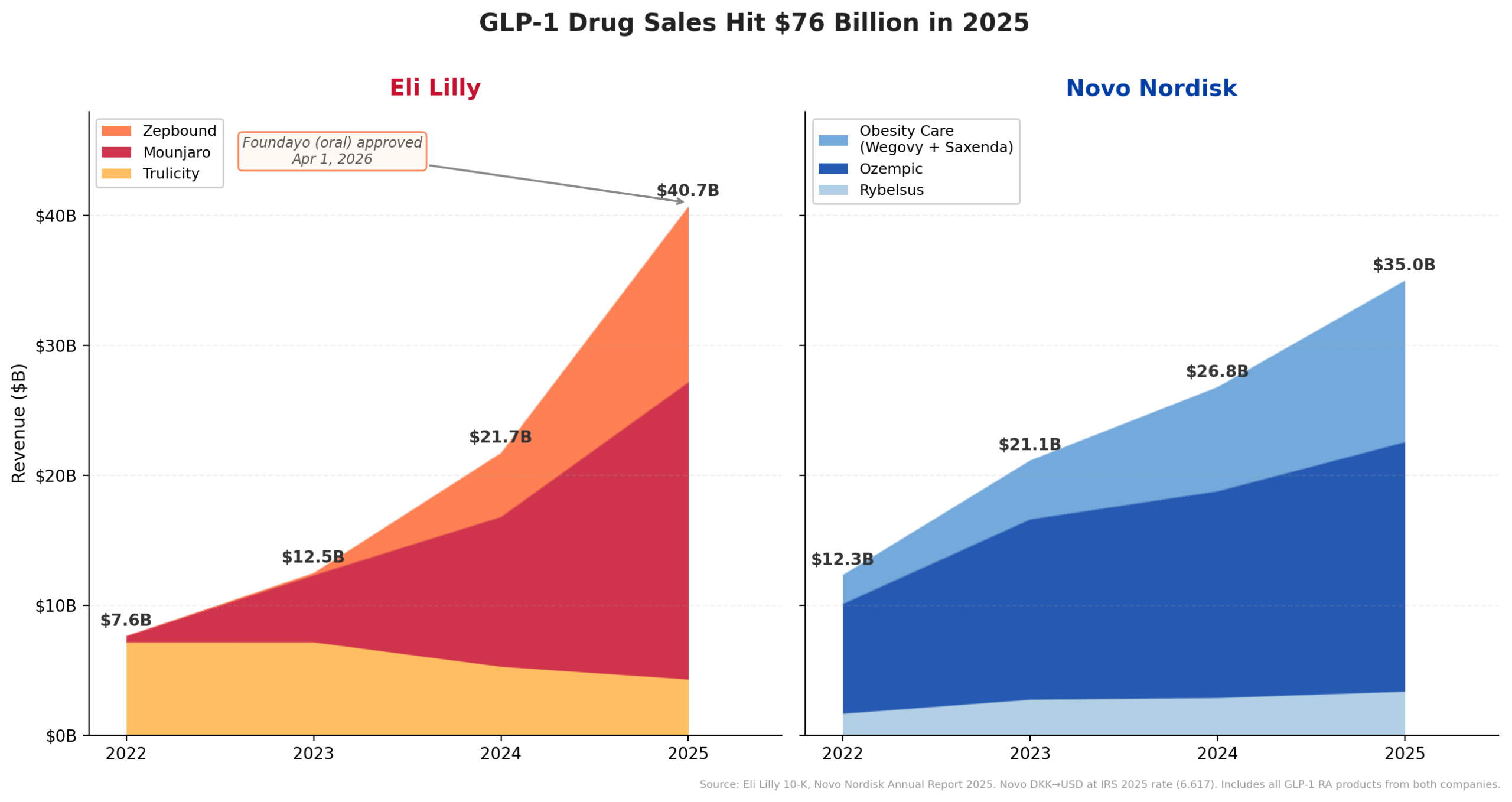
For readers of this site, the relevant part is the funding source. Lilly reported $65.2 billion in revenue for 2025, with tirzepatide — sold as Mounjaro for type 2 diabetes and Zepbound for obesity — generating roughly $36.5 billion of that, split between about $23.0 billion for Mounjaro and $13.5 billion for Zepbound [2]. Management guided to $80 billion to $83 billion in revenue for 2026 [2]. Lilly's overall GLP-1 revenue climbed from $7.6 billion in 2022 to $40.7 billion in 2025, a steeper ramp than Novo Nordisk's $12.3 billion-to-$35.0 billion climb over the same period; Novo has projected a 5% to 13% decline in adjusted sales for 2026 [2].
Lilly has been spending that cash on earlier-stage science. One tally puts its recent deal wave at roughly $18 billion in announced potential value, including Morphic (about $3.2 billion, 2024), Scorpion (up to $2.5 billion, 2025), Verve (about $1.3 billion, 2025), SiteOne (up to $1.0 billion, 2025), Kelonia (up to $7.0 billion, 2026) and a collaboration with Insilico Medicine worth up to $2.75 billion [2]. That is a different profile from Pfizer's post-COVID buying spree, which centered on commercial or late-stage assets such as the roughly $43 billion Seagen purchase, and which happened as Pfizer's revenue fell from $100.3 billion in 2022 to $58.5 billion in 2023 [2].
Why it matters for patients
Nothing about this deal changes how semaglutide or tirzepatide is prescribed, priced or supplied. Kelonia's lead candidate is an oncology therapy in Phase 1, the earliest stage of human testing, and Phase 1 data speak mainly to safety and early signals — not to whether a drug works over the long run or will ever be approved [1].
The indirect story is about what a GLP-1-funded company becomes. Lilly is using metabolic-drug profits to build in cancer, genetic medicine and other areas, which spreads its business risk but also means research dollars are flowing outward from obesity and diabetes [2]. Lilly itself cautions there is "no guarantee that the acquisition will be consumed on the intended timeline or at all" or that it will yield commercially successful products [1].
Separately, Lilly's obesity business keeps expanding: the FDA approved Foundayo (orforglipron), an oral GLP-1 for obesity, on April 1 under the National Priority Voucher program, 50 days after filing, and it is shipping through LillyDirect at $149 a month for the lowest dose, with Medicare Part D access at $50 a month expected by July [2].
What happens next
The Kelonia transaction is subject to customary closing conditions and regulatory approvals and is expected to close in the second half of 2026 [1]. Lilly will decide the accounting treatment at closing, after which the deal will show up in its financial results and guidance [1]. Lilly's first-quarter 2026 results are due April 30 [2]. Whether KLN-1010 advances past Phase 1, and on what timeline, is not yet known from the available sources.
Sources
Semaglutides.org is for information only and is not medical advice. Always talk to a licensed healthcare provider about your own care. Some links to telehealth services are affiliate links, labeled where they appear.