PLOS Medicine pooled analysis puts the NAION risk in absolute terms
A new PLOS Medicine meta-analysis estimates semaglutide roughly doubles the relative risk of a rare eye condition, NAION, but adds about one extra case per 7,000 people treated for a year [1].
A systematic review and meta-analysis published May 21, 2026 in PLOS Medicine estimates that semaglutide use in people with type 2 diabetes is linked to about a doubling of the relative risk of nonarteritic anterior ischemic optic neuropathy (NAION) — a rare, vision-threatening loss of blood flow to the optic nerve — while the absolute added risk works out to roughly 1 extra case per 7,000 people treated for a year [1].
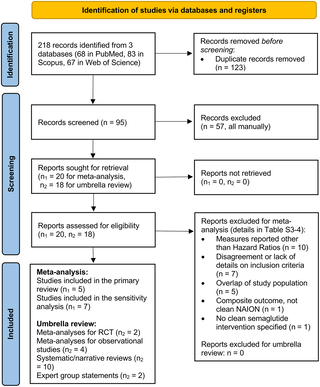
The analysis, by Chrzanowski and colleagues, pooled observational studies comparing patients with type 2 diabetes aged 12 and older who took semaglutide (sold as Ozempic and Rybelsus for diabetes and Wegovy for weight management) against patients on other glucose-lowering drugs [1]. The team searched PubMed, Scopus, and Web of Science for studies published from January 2023 through November 2025, and found five studies that met the main inclusion criteria, with seven more used in sensitivity analyses [1].
What the numbers show
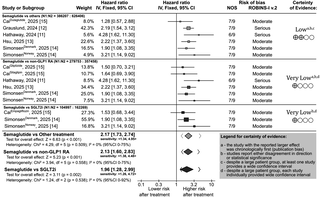
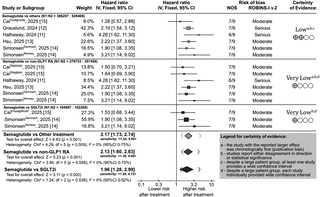
Compared with non-semaglutide glucose-lowering regimens, semaglutide was associated with a pooled hazard ratio of 2.17 (95% confidence interval 1.73 to 2.74; p < 0.001) [1]. When the comparison excluded other GLP-1 receptor agonists, the hazard ratio was 2.13 (95% CI 1.60 to 2.83; p < 0.001) [1]. Against users of SGLT2 inhibitors specifically, it was 1.96 (95% CI 1.28 to 2.99; p = 0.002) [1].
Relative risk figures like those can sound alarming without context, which is why the authors also calculated the absolute risk difference: 0.014% (95% CI 0.005% to 0.023%; p = 0.002) [1]. That translates to approximately one additional NAION case per 7,000 semaglutide-treated patients per year [1].
That estimate sits close to how regulators have already described the problem. The authors note their pooled results support conclusions from the European Medicines Agency and the World Health Organization, which classified NAION as a "very rare" side effect of semaglutide — defined as up to 1 in 10,000 users per year [1].
Important limits
The authors are explicit that the evidence is weak in quality. All the included studies were retrospective and registry-based, identifying NAION cases using International Classification of Diseases codes rather than standardized eye-exam criteria, which the authors say introduces potential misclassification and confounding by indication [1]. Studies were judged to have moderate to serious risk of bias, and the overall certainty of evidence was graded as low to very low under the GRADE framework [1]. The authors write that the findings "should be interpreted with caution" [1].
There is also a notable split in the evidence base. The paper reports that its results lined up with other meta-analyses of observational studies, but that meta-analyses of randomized controlled trials "consistently reported fewer NAION events" [1]. In other words, real-world database studies and randomized trials have not told the same story, and the reasons are not settled in this paper.
Several authors disclosed financial ties to drugmakers, including lecture honoraria and a consulting fee from Novo Nordisk, which makes semaglutide; the authors state the funders had no role in the study's design, analysis, or preparation [1].
Why it matters for patients
For people weighing semaglutide, the practical value of this paper is that it converts a scary-sounding "doubled risk" into a number that can be compared with other decisions. Doubling a very rare event still leaves a very rare event: about 0.014% added risk per year of treatment, according to the pooled estimate [1].
The authors say clinicians should be aware of the potential adverse event "particularly in individuals at increased baseline risk for optic neuropathies" [1]. The paper does not define which patients fall into that higher-risk group, and it states that more work is needed "to better identify and protect individuals at the greatest risk" [1].
The findings also back existing guidance that semaglutide be stopped in patients who are diagnosed with NAION [1]. Whether the same risk applies to other GLP-1 drugs such as tirzepatide (Mounjaro, Zepbound) is not addressed by this analysis, which focused on semaglutide in type 2 diabetes [1].
What happens next
The paper was received August 5, 2025, accepted April 8, 2026, and published May 21, 2026 [1]. Its authors call for high-quality prospective studies using standardized NAION diagnostic criteria to confirm or refute the association [1]. No timeline for such studies, and no new regulatory action tied to this publication, is described in the paper.
Images from the sources
Sources
Semaglutides.org is for information only and is not medical advice. Always talk to a licensed healthcare provider about your own care. Some links to telehealth services are affiliate links, labeled where they appear.