BMJ study finds a hair loss signal across the GLP-1 class
A BMJ study of Penn Medicine records found adults with type 2 diabetes who started a GLP-1 drug had a higher rate of diagnosed hair loss than those starting two other diabetes drug classes, though absolute risk was low.
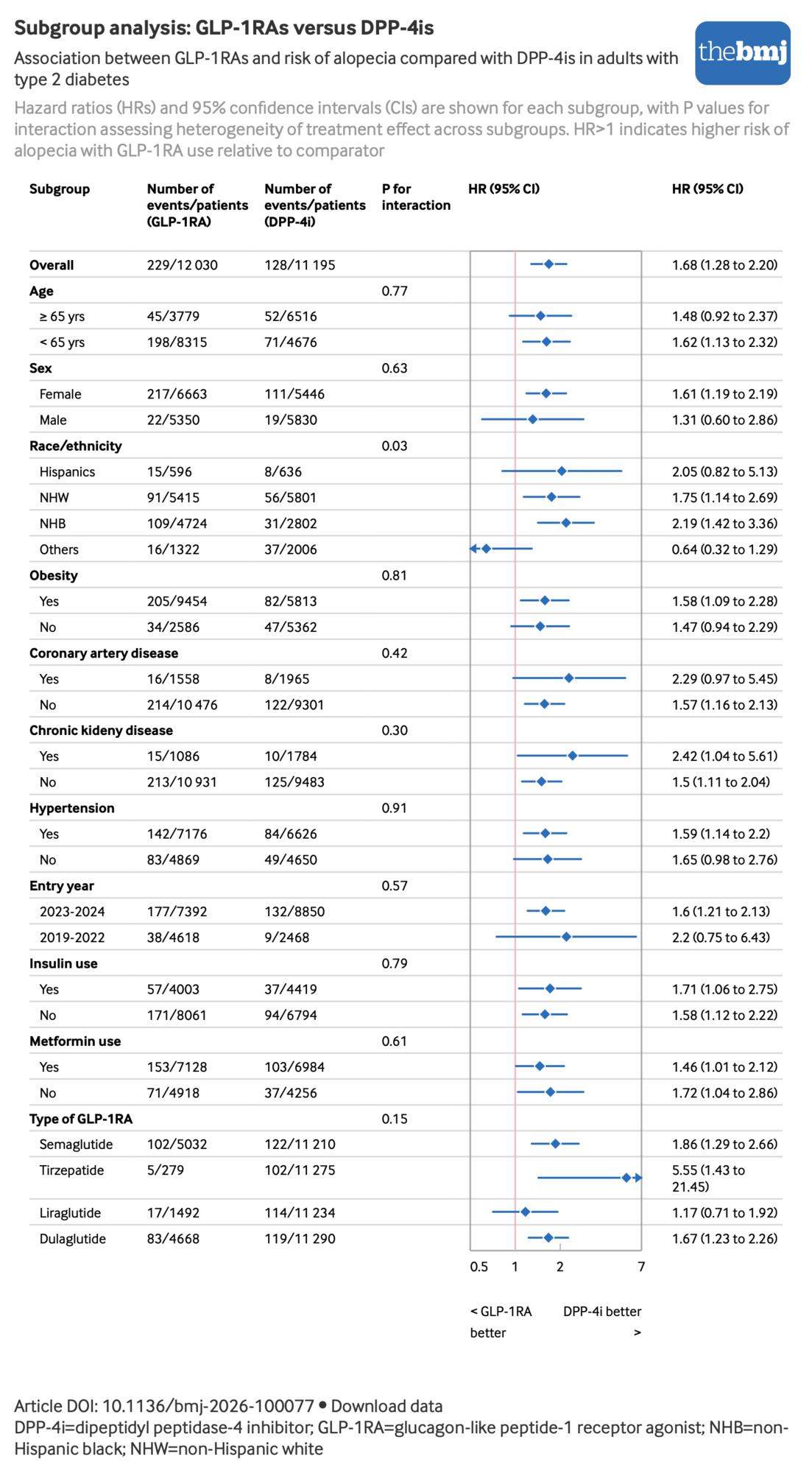
Researchers at the University of Pennsylvania reported on July 22, 2026 in The BMJ that adults with type 2 diabetes who started a GLP-1 receptor agonist were diagnosed with alopecia, or hair loss, more often than similar patients who started a different class of diabetes medicine [1]. The authors describe the absolute risk as low, but say awareness of the possible effect "may help to inform treatment decisions" [1].
The study used a method called target trial emulation, which tries to mimic the design of a randomized trial using real-world medical records [1]. It drew on electronic health records from Penn Medicine covering more than 6.5 million patients and more than 50 million clinical encounters across the Philadelphia area, central Pennsylvania, Delaware and southern New Jersey [1]. Adults over 18 with type 2 diabetes who newly started a drug between January 2019 and September 2024 were included, and people with an existing alopecia diagnosis, type 1 diabetes, end stage kidney disease or recent use of a competing diabetes drug class were excluded [1].
What the numbers show
The first comparison included 12,004 GLP-1 receptor agonist starters and 15,221 people starting an SGLT-2 inhibitor such as canagliflozin, dapagliflozin or empagliflozin [1]. The second compared 11,964 GLP-1 starters with 11,238 people starting a DPP-4 inhibitor such as sitagliptin, saxagliptin or linagliptin [1].
After statistical adjustment to balance the groups, GLP-1 use was linked to a higher risk of alopecia than SGLT-2 inhibitors (hazard ratio 1.37, 95% confidence interval 1.08 to 1.73) and than DPP-4 inhibitors (1.68, 1.28 to 2.20) [1]. When the researchers looked at subtypes, the signal was specific to non-scarring alopecia, with hazard ratios of 1.53 (1.18 to 1.97) versus SGLT-2 inhibitors and 1.72 (1.28 to 2.31) versus DPP-4 inhibitors [1].
Importantly, the authors report that the associations held up across sensitivity and subgroup analyses but were attenuated — meaning weaker — after negative control outcome calibration, a technique used to check for hidden bias [1].
The exposure group was defined broadly. It covered exenatide, liraglutide, dulaglutide, semaglutide (the molecule in Ozempic, Wegovy and Rybelsus), lixisenatide and tirzepatide (Mounjaro and Zepbound) [1]. The published abstract and introduction do not break results out by individual drug, so whether the risk differs between, say, semaglutide and tirzepatide is not yet known from this study.
Why it matters for patients
Hair loss has been a persistent complaint in online patient communities, but until now the evidence base has been thin. The authors note that randomized trials have not routinely captured alopecia as an adverse event, and earlier observational studies were limited by small sample sizes, weak comparison groups and inadequate adjustment for confounding [1].
The biology offers a plausible explanation. Weight loss and changes in nutritional status — both common with GLP-1 therapy — are established triggers for telogen effluvium, which the authors describe as a common and typically transient form of non-scarring hair loss [1]. That fits the finding that the signal was confined to non-scarring alopecia [1].
Several caveats matter. This was an observational study in people with type 2 diabetes, not in people taking these drugs only for obesity, and the authors flag that use is expanding into younger and non-diabetic populations [1]. Outcomes were identified using diagnostic codes, which capture only hair loss that a patient brought to a clinician and that got coded. The exact absolute event rates and the average duration of follow-up are not included in the portion of the paper available here.
The authors also point out that hair loss does not typically cause physical harm but can have significant psychosocial consequences, affecting self-esteem, quality of life and whether people stay on treatment [1].
What happens next
Case reports and analyses of the FDA's Adverse Event Reporting System have described hair loss after starting a GLP-1 drug, particularly with semaglutide and tirzepatide, and the FDA has indicated it is evaluating this potential safety signal [1]. The sources do not give a timeline for any FDA decision or label change, so when — or whether — US prescribing information will be updated is not yet known.
The paper was accepted on June 23, 2026 and published on July 22, 2026 as open access [1].
Sources
Semaglutides.org is for information only and is not medical advice. Always talk to a licensed healthcare provider about your own care. Some links to telehealth services are affiliate links, labeled where they appear.