Reuters documents how drugmakers work around China's ad rules for obesity drugs
A Reuters investigation found Novo Nordisk, Eli Lilly and Chinese rivals promoting obesity drugs through subway ads and gyms to skirt China's ban on direct prescription-drug marketing, a sign of how fierce global competition for GLP-1 sales has become.
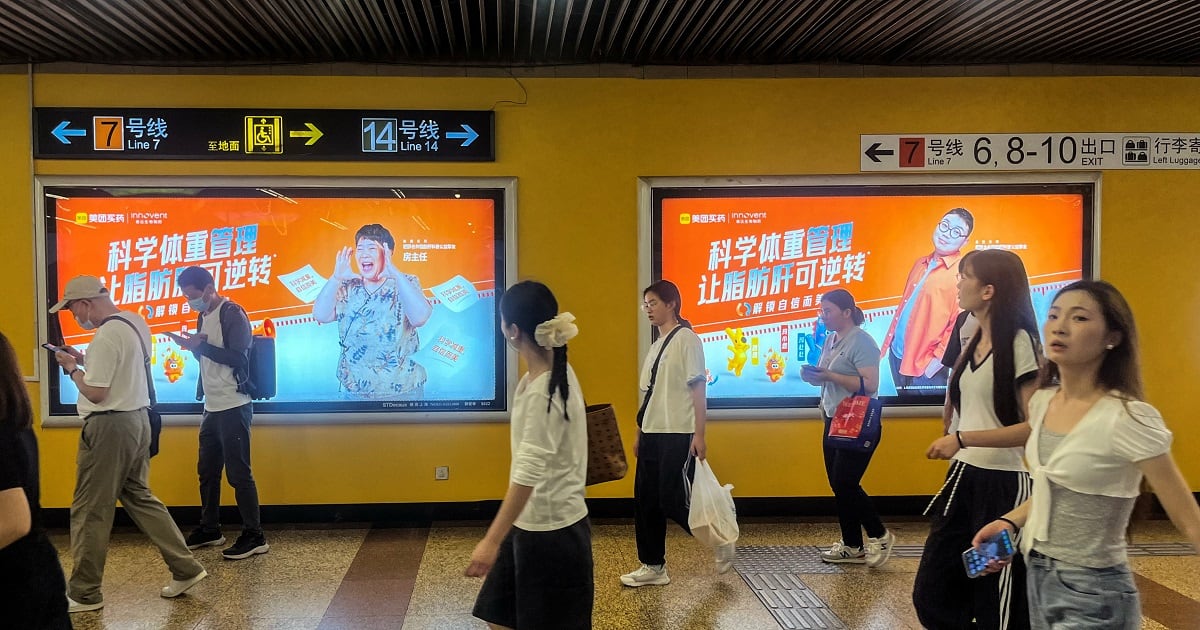
Drugmakers selling weight-loss injections in China are using subway billboards, gym partnerships and soccer-stadium ads to raise awareness of obesity, working around the country's ban on direct advertising of prescription medicines, according to a Reuters investigation [1][2]. China's National Health Commission has said the share of adults who are overweight or obese could exceed 65 percent by 2030 [1].
China bars companies from advertising prescription drugs directly to consumers, but firms can share information about disease risks and encourage people to see a doctor, as long as they do not name a product [1]. A metro banner in Shanghai carrying an Eli Lilly logo urged commuters to "pay attention to Dad's snoring and promptly visit a respiratory department or sleep centre," a reference to sleep apnea, a condition strongly linked to being overweight; Lilly's Mounjaro has been shown in clinical trials to ease the condition [1]. Ads from Innovent Biologics and e-commerce firm Meituan in the same station said "scientific weight management" can reverse fatty liver disease, and a stadium ad in Suzhou repeated "Innovent Biologics weight loss amazing!" [1]. Gym chain Supermonkey partnered with Pfizer on a "healthy weight loss party" in June and July, promoted on the social platform Xiaohongshu [1].
The campaigns appear to be working. Hospital employees in Shanghai and Guangzhou told Reuters that patients increasingly ask for weight-loss drugs by name after seeing social media promotions or hearing about them from friends and family [1]. Patients first asked for Novo Nordisk's semaglutide, sold as Wegovy, but more recently have been requesting Lilly's tirzepatide (Mounjaro) and Innovent's mazdutide, sold as Xinermei, more often, said Zhao Xiaolong, an endocrinologist at the Shanghai Public Health Clinical Centre [1].
Novo launched the first once-weekly GLP-1 for weight management in China in late 2024, followed by Lilly in January 2025, Innovent in July 2025, and Pfizer's Xianweiying, which issued its first prescriptions in April [1]. JPMorgan's head of China healthcare research, Yang Huang, estimated sales of GLP-1 weight-management therapies could reach 30 billion yuan (about R64 billion) within five to seven years, up from an estimated 3 billion to 4 billion yuan currently [1]. Lilly led once-weekly GLP-1 sales on Alibaba's Tmall and JD.com in the second quarter, according to Jefferies [1]. Novo's new Greater China president, Cai Yan, said she has heard from doctors that the company's public communication was weaker than rivals' and that Novo is now working to make its messaging more accessible to patients directly, not just doctors [1].
Some campaigns may cross legal lines. Chen Zhenggang, a partner at DeHeng Law Offices in Beijing, said Innovent and Meituan's subway billboards, which featured a mascot called "Madudu" resembling the sound of mazdutide, could lead consumers to associate the ads with a specific prescription drug even without naming it [1]. JPMorgan's Huang said companies are "definitely trying to be compliant" while also wanting to sell drugs [1]. Lilly earlier this year paused a similar obesity awareness campaign in India after regulators said it coincided with Mounjaro's launch there and could promote the drug [1]. Lilly said its educational activities do not promote specific medicines and are consistent with China's health strategies [1]. Pfizer, Innovent, Meituan and China's market regulator did not respond to requests for comment or declined to comment [1].
Why it matters for patients
This reporting concerns marketing practices in China, not US regulation, but it illustrates how aggressively drugmakers are competing for obesity-drug patients worldwide as GLP-1 demand grows. For US readers, it's a reminder that awareness campaigns, whether about snoring, fatty liver or general health, can be designed to steer people toward a specific product category even when a brand name never appears. The investigation does not report on US advertising practices or FDA rules, which differ from China's, so no comparison to US marketing compliance can be drawn from these sources.
What happens next
The sources do not describe any pending regulatory action against the companies named, or a timeline for a Chinese regulatory review of these awareness campaigns. It is not yet known whether China's market regulator will take further steps regarding the ad practices described.
Images from the sources
Sources
Semaglutides.org is for information only and is not medical advice. Always talk to a licensed healthcare provider about your own care. Some links to telehealth services are affiliate links, labeled where they appear.